›››
Bolivia
Bolivia
Population
12.4M
Rank #78Source: World Bank
Capital
La Paz
Source: REST Countries
Region
Americas
Latin America & Caribbean
Source: REST Countries
GDP (Nominal)
$54.88B
Rank #88Source: World Bank
Land Area
1.1M km²
Rank #28Source: REST Countries
Life Expectancy
68.581 yrs
Source: World Bank
Historical Trends
Population Trend (5-Year)
Source: World Bank
GDP Trend (5-Year, Nominal USD)
Source: World Bank
Geography
Area: 1,098,581 km²
Landlocked: Yes
Independent: Yes
Climate: varies with altitude; humid and tropical to cold and semiarid
Terrain: rugged Andes Mountains with a highland plateau (Altiplano), hills, lowland plains of the Amazon Basin
Elevation: mean elevation: 1,192 m lowest point: Rio Paraguay 90 m highest point: Nevado Sajama 6,542 m
Natural Hazards: flooding in the northeast (March to April)volcanism: volcanic activity in Andes Mountains on the border with Chile; historically active volcanoes in this region are Irruputuncu (5,163 m), which last...
Environmental Issues: the clearing of land for agricultural purposes and the international demand for tropical timber are contributing to deforestation; soil erosion from overgrazing and poor cultivation methods...
Land Use: agricultural land: 34.3% (2011 est.) forest: 52.5% (2011 est.) other: 13.2% (2011 est.)
Geography Note: note 1: landlocked; shares control of Lago Titicaca, world's highest navigable lake (elevation 3,805 m), with Perunote 2: the southern regions of Peru and the extreme northwestern part of Bolivia are...
Natural Resources
tinnatural gaspetroleumzinctungstenantimonysilverironleadgold
People & Society
Fertility Rate
2.55
Population
12.4M
Ethnic Groups
mestizo (mixed white and Amerindian ancestry) (68%)indigenous (20%)White (5%)cholo/chola (2%)Black (1%)other (1%)unspecified 3% ; (44%)
Religions
Roman Catholic (76.8%)Evangelical and Pentecostal (8.1%)Protestant (7.9%)other (1.7%)none (5.5%)
Economy
GDP per Capita
$4,421.166
GDP per Capita PPP
12,877.635
(2024)
(2024)
GNI per Capita
4,160
(2024)
(2024)
Gini Index
42.1
(2023)
(2023)
Unemployment
3.274%
(2024)
(2024)
Inflation
5.1%
(2024)
(2024)
Public Debt
Not Available
Energy
Electricity Access
99.8%
(2023)
(2023)
Renewable Energy
12.8%
(2021)
(2021)
CO₂ Emissions
28.436 Mt
(2024)
(2024)
Energy Intensity
3.89 MJ/$
(2021)
(2021)
Renewable Electricity
38.255%
(2021)
(2021)
Environment
Forest Coverage
46.346% of land
(2023)
(2023)
Protected Areas
15.5% of land
(2006)
(2006)
Communications
Internet Users
70.237%
(2023)
(2023)
Mobile Penetration
101.572%
(2022)
(2022)
Broadband Subscribers
10.998%
(2022)
(2022)
Transportation
Air Transport Freight
19.891 M ton-km
(2023)
(2023)
Container Port Traffic
Not Available
Airports
50,459
Rail Lines
N/A
Roads Total
179,613 km(©IRF)
Military
Military Forces
Bolivian Armed Forces: Bolivian Army (Ejercito Boliviano, EB), Bolivian Naval Force (Fuerza Naval Boliviana, FNB, includes Marines), Bolivian Air Force (Fuerza Aerea Boliviana, FAB); Ministry of...
Personnel Strength
size assessments for the Bolivian Armed Forces vary; approximately 39,000 total active troops (26,000 Army; 5,500 Navy; 7,500 Air Force)
Military Expenditure (USD)
$0.66B
Military Expenditure (% of GDP)
1.37%
Military Expenditure History
1.4% of GDP (2019) 1.5% of GDP (2018) 1.5% of GDP (2017) 1.6% of GDP (2016) 1.7% of GDP (2015)
Equipment & Inventories
the Bolivian Armed Forces are equipped with a mix of mostly Brazilian, Chinese, European, and US equipment; since 2010, China and France are the leading suppliers of military hardware to Bolivia...
Service Age & Obligation
16-49 years of age for 12-month voluntary male and female military service; Bolivian citizenship required; minimum age for combat duty is 18; when annual number of volunteers falls short of goal,...
Education
Pre-Primary Enrollment
78.471%
(2020)
(2020)
Primary Enrollment
98.573%
(2023)
(2023)
Secondary Enrollment
91.368%
(2023)
(2023)
Tertiary Enrollment
Not Available
Education Spending
8.316% of GDP
(2023)
(2023)
Adult Literacy Rate
95.55%
(2023)
(2023)
Pupil-Teacher Ratio
17.798:1
(2018)
(2018)
Health
Physicians per 1,000
1.284
(2021)
(2021)
Safe Water Access
93.388%
(2024)
(2024)
Safe Drinking Water
Not Available
Under-5 Mortality
23.1 per 1,000
(2023)
(2023)
Maternal Mortality (World Bank)
16.026 per 100,000
(2021)
(2021)
Hospital Beds per 1,000
62.874
(2021)
(2021)
UHC Coverage Index
67
(2023)
(2023)
Measles Immunization
59%
(2024)
(2024)
Social Indicators
Extreme Poverty Rate
2.8%
(2023)
(2023)
Food Insecurity
21.8%
(2023)
(2023)
Youth NEET Rate
4.271%
(2024)
(2024)
Governance
Women in Government
46.154%
(2024)
(2024)
Voice & Accountability
-0.27
(Below Average)
(2023)
(Below Average)
(2023)
Political Stability
-0.31
(Below Average)
(2023)
(Below Average)
(2023)
Government Effectiveness
-0.64
(Below Average)
(2023)
(Below Average)
(2023)
Regulatory Quality
-1.18
(Weak)
(2023)
(Weak)
(2023)
Rule of Law
-1.22
(Weak)
(2023)
(Weak)
(2023)
Control of Corruption
-0.84
(Below Average)
(2023)
(Below Average)
(2023)
Government
Government Type
presidential republic
Legal System
civil law system with influences from Roman, Spanish, canon (religious), French, and indigenous law
Executive Branch
chief of state: President Luis Alberto ARCE Catacora (since 8 November 2020); Vice President David CHOQUEHUANCA Cespedes (since 8 November 2020); note - the president is both chief of state and head...
Legislative Branch
description: bicameral Plurinational Legislative Assembly or Asamblea Legislativa Plurinacional consists of:Chamber of Senators or Camara de Senadores (36 seats; members directly elected in...
Judicial Branch
highest courts: Supreme Court or Tribunal Supremo de Justicia (consists of 12 judges or ministros organized into civil, penal, social, and administrative chambers); Plurinational Constitutional...
National Symbols
Flag Description
three equal horizontal bands of red (top), yellow, and green with the coat of arms centered on the yellow band; red stands for bravery and the blood of national heroes, yellow for the nation's...
National Symbols
llama, Andean condor, two national flowers: the cantuta and the patuju; national colors: red, yellow, green
National Anthem
name: "Cancion Patriotica" (Patriotic Song) lyrics/music: Jose Ignacio de SANJINES/Leopoldo Benedetto VINCENTI note: adopted 1852
Safety
Homicide Rate
4.418 per 100,000
(2023)
(2023)
Travel Information
Language(s): Aymara, Guaraní, Quechua, +1 more
Currency: BOB (Bs.)
Timezone(s): UTC-04:00
Landlocked: Yes
Independent: Yes
Driving Side: Right
Calling Code: +591
Car Sign: BOL
Week Starts: Monday
Photos
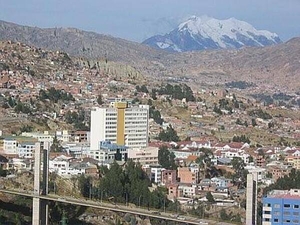
La Paz, the administrative capital of Bolivia, is the world's highest capital city (3,660 m; 12,005 ft). It was founded under the name Nuestra Senora de la Paz (Our Lady of Peace) in 1548 by Spanish conquistadores.
La Paz, the administrative capital of Bolivia, is the world's highest capital city (3,660 m; 12,005 ft). It was founded under the name Nuestra Senora de la Paz (Our Lady of Peace) in 1548 by Spanish conquistadores. • CIA World Factbook • 2020
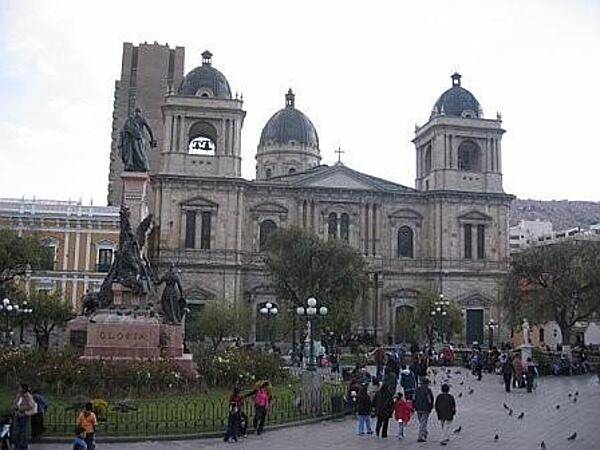
Begun in 1835, the Catedral Metropolitana Nuestra Senora de La Paz (Metropolitan Cathedral of Our Lady of Peace or Metropolitan Cathedral) in La Paz was built in the neo-classical style and was not completed until 1987.
Begun in 1835, the Catedral Metropolitana Nuestra Senora de La Paz (Metropolitan Cathedral of Our Lady of Peace or Metropolitan Cathedral) in La Paz was built in the neo-classical style and was not completed until 1987. • CIA World Factbook • 2020
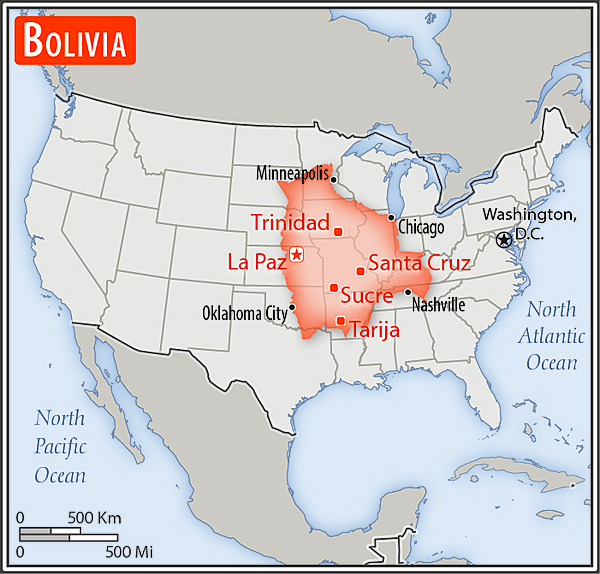
Area comparison map
Area comparison map • CIA World Factbook • 2020
3 photos available
Data sources: World Bank, UN Data • Updated daily •Learn about our data