›››
Germany
Germany
Population
83.5M
Rank #19Source: World Bank
Capital
Berlin
Source: REST Countries
Region
Europe
Europe & Central Asia
Source: REST Countries
GDP (Nominal)
$4.69T
Rank #3Source: World Bank
Land Area
357.1K km²
Rank #64Source: REST Countries
Life Expectancy
80.541 yrs
Source: World Bank
Historical Trends
Population Trend (5-Year)
Source: World Bank
GDP Trend (5-Year, Nominal USD)
Source: World Bank
Geography
Area: 357,114 km²
Landlocked: No
Independent: Yes
Climate: temperate and marine; cool, cloudy, wet winters and summers; occasional warm mountain (foehn) wind
Terrain: lowlands in north, uplands in center, Bavarian Alps in south
Elevation: mean elevation: 263 m lowest point: Neuendorf bei Wilster -3.5 m highest point: Zugspitze 2,963 m
Natural Hazards: flooding
Environmental Issues: emissions from coal-burning utilities and industries contribute to air pollution; acid rain, resulting from sulfur dioxide emissions, is damaging forests; pollution in the Baltic Sea from raw sewage...
Land Use: agricultural land: 48% (2011 est.) forest: 31.8% (2011 est.) other: 20.2% (2011 est.)
Geography Note: strategic location on North European Plain and along the entrance to the Baltic Sea; most major rivers in Germany - the Rhine, Weser, Oder, Elbe - flow northward; the Danube, which originates in the...
Natural Resources
coallignitenatural gasiron orecoppernickeluraniumpotashsaltconstruction materials
People & Society
Fertility Rate
1.39
Population
83.5M
Ethnic Groups
German (87.2%)Turkish (1.8%)Polish (1%)Syrian (1%)other (9%)
Religions
Roman Catholic (27.7%)Protestant (25.5%)Muslim (5.1%)Orthodox (1.9%)other Christian (1.1%)other (0.9%)none (37.8%)
Economy
GDP per Capita
$56,103.732
GDP per Capita PPP
73,551.935
(2024)
(2024)
GNI per Capita
55,090
(2024)
(2024)
Gini Index
32.4
(2020)
(2020)
Unemployment
3.4%
(2024)
(2024)
Inflation
2.256%
(2024)
(2024)
Public Debt
Not Available
Energy
Electricity Access
100%
(2023)
(2023)
Renewable Energy
17.6%
(2021)
(2021)
CO₂ Emissions
579.936 Mt
(2024)
(2024)
Energy Intensity
2.47 MJ/$
(2022)
(2022)
Renewable Electricity
39.831%
(2021)
(2021)
Environment
Forest Coverage
32.679% of land
(2023)
(2023)
Communications
Internet Users
93.5%
(2024)
(2024)
Mobile Penetration
124.663%
(2023)
(2023)
Broadband Subscribers
45.381%
(2023)
(2023)
Transportation
Air Transport Freight
12,766.529 M ton-km
(2023)
(2023)
Container Port Traffic
13,733,867 TEU
(2022)
(2022)
Airports
655,842
Rail Lines
33,401 km
Roads Total
829,530 km(©IRF)
Military
Military Forces
Federal Armed Forces (Bundeswehr): Army (Heer), Navy (Deutsche Marine, includes naval air arm), Air Force (Luftwaffe, includes air defense), Joint Support Service (Streitkraeftebasis, SKB), Central...
Personnel Strength
the German Federal Armed Forces have approximately 180,000 active duty personnel (62,000 Army; 16,000 Navy; 28,000 Air Force; 27,000 Joint Support Service; 20,000 Medical Service, 13,000 Cyber and...
Military Expenditure (USD)
$88.46B
Military Expenditure (% of GDP)
1.89%
Military Expenditure History
1.38% of GDP (2019 est.) 1.24% of GDP (2018) 1.23% of GDP (2017) 1.19% of GDP (2016) 1.18% of GDP (2015)
Deployments
1,300 Afghanistan (NATO); approximately 100-200 Middle East (NATO/Counter-ISIS campaign); 110 Lebanon (UNIFIL); 500 Lithuania (NATO); 400 Mali (MINUSMA); 350 Mali (EUTM); note - Germany is a...
Equipment & Inventories
the German Federal Armed Forces inventory is mostly comprised of weapons systems produced domestically or jointly with other European countries; since 2010, the US is the leading foreign supplier of...
Service Age & Obligation
17-23 years of age for male and female voluntary military service; conscription ended 1 July 2011; service obligation 8-23 months or 12 years; women have been eligible for voluntary service in all...
Education
Pre-Primary Enrollment
108.032%
(2020)
(2020)
Primary Enrollment
102.191%
(2023)
(2023)
Secondary Enrollment
100.603%
(2023)
(2023)
Tertiary Enrollment
78.595%
(2023)
(2023)
Education Spending
5.239% of GDP
(2022)
(2022)
Pupil-Teacher Ratio
12.303:1
(2017)
(2017)
Health
Physicians per 1,000
4.534
(2022)
(2022)
Safe Water Access
100%
(2024)
(2024)
Safe Drinking Water
99.917%
(2024)
(2024)
Under-5 Mortality
3.7 per 1,000
(2023)
(2023)
Maternal Mortality (World Bank)
24.873 per 100,000
(2021)
(2021)
Hospital Beds per 1,000
80.491
(2021)
(2021)
UHC Coverage Index
87
(2023)
(2023)
Measles Immunization
89%
(2024)
(2024)
Social Indicators
Extreme Poverty Rate
0.2%
(2020)
(2020)
Food Insecurity
2.5%
(2023)
(2023)
Youth NEET Rate
6.531%
(2024)
(2024)
Governance
Women in Government
35.326%
(2024)
(2024)
Voice & Accountability
1.46
(Strong)
(2023)
(Strong)
(2023)
Political Stability
0.59
(Above Average)
(2023)
(Above Average)
(2023)
Government Effectiveness
1.19
(Strong)
(2023)
(Strong)
(2023)
Regulatory Quality
1.46
(Strong)
(2023)
(Strong)
(2023)
Rule of Law
1.55
(Strong)
(2023)
(Strong)
(2023)
Control of Corruption
1.66
(Strong)
(2023)
(Strong)
(2023)
Government
Government Type
federal parliamentary republic
Legal System
civil law system
Executive Branch
chief of state: President Frank-Walter STEINMEIER (since 19 March 2017) head of government: Chancellor Angela MERKEL (since 22 November 2005) cabinet: Cabinet or Bundesminister (Federal Ministers)...
Legislative Branch
description: bicameral Parliament or Parlament consists of:Federal Council or Bundesrat (69 seats; members appointed by each of the 16 state governments) Federal Diet or Bundestag (709 seats - total...
Judicial Branch
highest courts: Federal Court of Justice (court consists of 127 judges, including the court president, vice presidents, presiding judges, other judges and organized into 25 Senates subdivided into 12...
International Organizations
ADB (nonregional member)AfDB (nonregional member)Arctic Council (observer)Australia GroupBISBSEC (observer)CBSSCD
National Symbols
Flag Description
three equal horizontal bands of black (top), red, and gold; these colors have played an important role in German history and can be traced back to the medieval banner of the Holy Roman Emperor - a...
National Symbols
eagle; national colors: black, red, yellow
National Anthem
name: "Das Lied der Deutschen" (Song of the Germans) lyrics/music: August Heinrich HOFFMANN VON FALLERSLEBEN/Franz Joseph HAYDN note: adopted 1922; the anthem, also known as "Deutschlandlied" (Song...
Safety
Homicide Rate
0.911 per 100,000
(2023)
(2023)
Travel Information
Language(s): German
Currency: EUR (€)
Timezone(s): UTC+01:00
Landlocked: No
Independent: Yes
Driving Side: Right
Calling Code: +49
Car Sign: DY
Week Starts: Monday
Photos
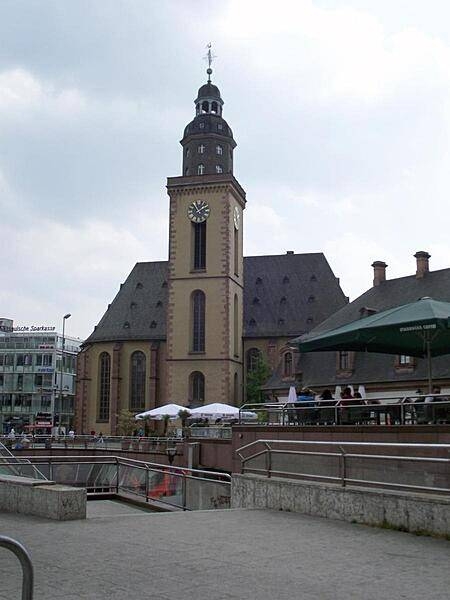
Located at the edge of the Hauptwache plaza is St. Catherine's Church, the largest Lutheran church in Frankfurt. Construction of the baroque church was completed in 1681. Destroyed by World War II bombing, it was rebuilt between 1950 and 1954.
Located at the edge of the Hauptwache plaza is St. Catherine's Church, the largest Lutheran church in Frankfurt. Construction of the baroque church was completed in 1681. Destroyed by World War II bombing, it was rebuilt between 1950 and 1954. • CIA World Factbook • 2020
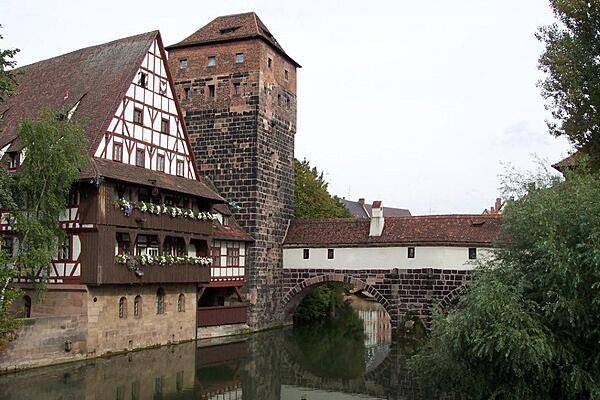
Part of the Hangman's Bridge (Henkersteg; built 1457) in Nuremberg. The city executioner used to live in the tower and the roofed walk above the River Pegnitz. Considered a "persona non grata," the hangman was avoided by the citizens of the city.
Part of the Hangman's Bridge (Henkersteg; built 1457) in Nuremberg. The city executioner used to live in the tower and the roofed walk above the River Pegnitz. Considered a "persona non grata," the hangman was avoided by the citizens of the city. • CIA World Factbook • 2020
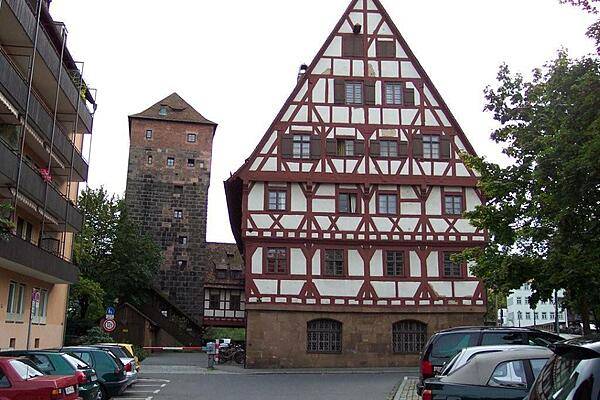
The half-timbered Weinstadel (former wine depot) is one of Nuremberg's most famous buildings. Built between 1533 and 1544, it originally served as a house for lepers, but today is a student dorm.
The half-timbered Weinstadel (former wine depot) is one of Nuremberg's most famous buildings. Built between 1533 and 1544, it originally served as a house for lepers, but today is a student dorm. • CIA World Factbook • 2020
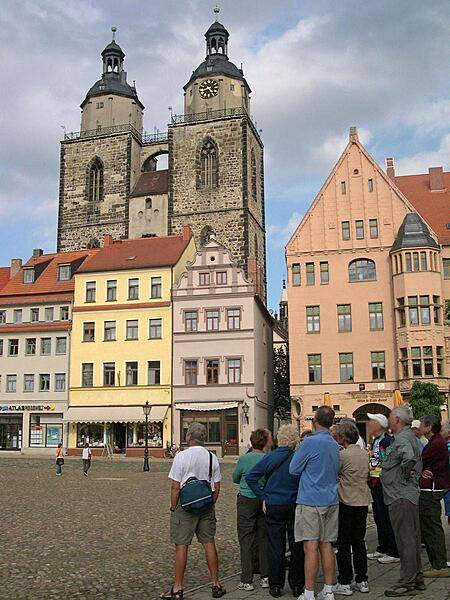
The Market Place of Wittenberg with the Stadt Kirche (City Church) - also known as Marienskirche (St. Mary's Church) or Mother Church of the Reformation - in the background. Luther did most of his preaching in the church, some parts of which date to the 13th century.
The Market Place of Wittenberg with the Stadt Kirche (City Church) - also known as Marienskirche (St. Mary's Church) or Mother Church of the Reformation - in the background. Luther did most of his preaching in the church, some parts of which date to the 13th century. • CIA World Factbook • 2020
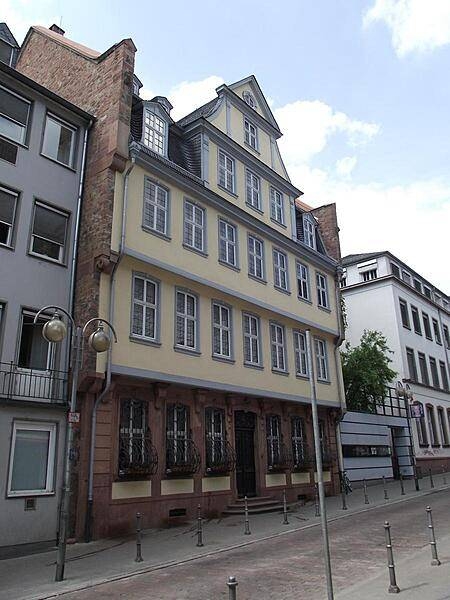
The Goethe House at 23 Grosser Hirschgraben in the old town of Frankfurt was the residence of the Goethe family until 1795. The family's most notable personality, Johann Wolfgang von Goethe, was born there in 1749, lived there till the age of 16, and returned sporadically throughout his life. The house stands next to the Goethe Museum (on the right).
The Goethe House at 23 Grosser Hirschgraben in the old town of Frankfurt was the residence of the Goethe family until 1795. The family's most notable personality, Johann Wolfgang von Goethe, was born there in 1749, lived there till the age of 16, and returned sporadically throughout his life. The house stands next to the Goethe Museum (on the right). • CIA World Factbook • 2020
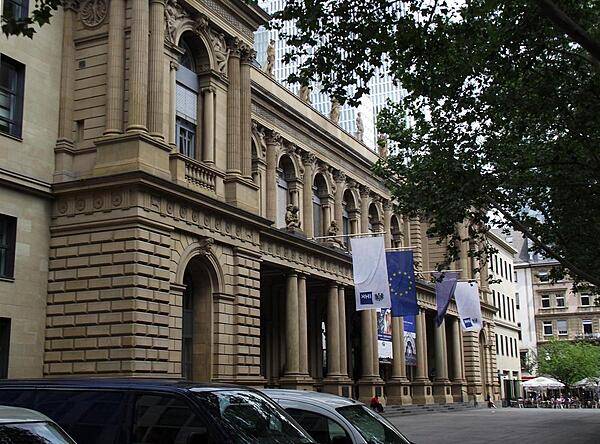
The Chamber of Commerce Building in Frankfurt. The city has been Germany's financial center for centuries, and it is the home of a number of major banks and brokerage houses. The Frankfurt Stock Exchange is Germany's largest and one of the most important in the world.
The Chamber of Commerce Building in Frankfurt. The city has been Germany's financial center for centuries, and it is the home of a number of major banks and brokerage houses. The Frankfurt Stock Exchange is Germany's largest and one of the most important in the world. • CIA World Factbook • 2020
103 photos available
View All Photos→Data sources: World Bank, UN Data • Updated daily •Learn about our data