›››
Sri Lanka
Sri Lanka
Population
21.9M
Rank #60Source: World Bank
Capital
Colombo
Source: REST Countries
Region
Asia
South Asia
Source: REST Countries
GDP (Nominal)
$98.96B
Rank #72Source: World Bank
Land Area
65.6K km²
Rank #121Source: REST Countries
Life Expectancy
77.483 yrs
Source: World Bank
Historical Trends
Population Trend (5-Year)
Source: World Bank
GDP Trend (5-Year, Nominal USD)
Source: World Bank
Geography
Area: 65,610 km²
Landlocked: No
Independent: Yes
Climate: tropical monsoon; northeast monsoon (December to March); southwest monsoon (June to October)
Terrain: mostly low, flat to rolling plain; mountains in south-central interior
Elevation: mean elevation: 228 m lowest point: Indian Ocean 0 m highest point: Pidurutalagala 2,524 m
Natural Hazards: occasional cyclones and tornadoes
Environmental Issues: deforestation; soil erosion; wildlife populations threatened by poaching and urbanization; coastal degradation from mining activities and increased pollution; coral reef destruction; freshwater...
Land Use: agricultural land: 43.5% (2011 est.) forest: 29.4% (2011 est.) other: 27.1% (2011 est.)
Geography Note: strategic location near major Indian Ocean sea lanes; Adam's Bridge is a chain of limestone shoals between the southeastern coast of India and the northwestern coast of Sri Lanka; geological evidence...
Natural Resources
limestonegraphitemineral sandsgemsphosphatesclayhydropowerarable land
People & Society
Fertility Rate
1.97
Population
21.9M
Ethnic Groups
Sinhalese (74.9%)Sri Lankan Tamil (11.2%)Sri Lankan Moors (9.2%)Indian Tamil (4.2%)other (0.5%)
Religions
Buddhist (official) (70.2%)Hindu (12.6%)Muslim (9.7%)Roman Catholic (6.1%)other Christian (1.3%)other (0.05%)
Economy
GDP per Capita
$4,515.568
GDP per Capita PPP
15,632.592
(2024)
(2024)
GNI per Capita
3,860
(2024)
(2024)
Gini Index
37.7
(2019)
(2019)
Unemployment
4.239%
(2024)
(2024)
Inflation
16.541%
(2023)
(2023)
Public Debt
73.513%
(2015)
(2015)
Energy
Electricity Access
100%
(2023)
(2023)
Renewable Energy
48.8%
(2021)
(2021)
CO₂ Emissions
23.335 Mt
(2024)
(2024)
Energy Intensity
1.67 MJ/$
(2021)
(2021)
Renewable Electricity
49.238%
(2021)
(2021)
Environment
Forest Coverage
34.005% of land
(2023)
(2023)
Protected Areas
14.3% of land
(2007)
(2007)
Communications
Internet Users
51.2%
(2023)
(2023)
Mobile Penetration
142.277%
(2023)
(2023)
Broadband Subscribers
8.765%
(2023)
(2023)
Transportation
Air Transport Freight
278.498 M ton-km
(2023)
(2023)
Container Port Traffic
6,860,000 TEU
(2022)
(2022)
Airports
24,228
Rail Lines
1,562 km
Roads Total
31,158 km(©IRF)
Military
Military Forces
Sri Lanka Army (includes National Guard and the Volunteer Force), Sri Lanka Navy (includes Marine Corps), Sri Lanka Air Force, Sri Lanka Coast Guard; Civil Security Department (Home Guard); Sri Lanka...
Personnel Strength
the Sri Lankan military has approximately 250,000 total personnel (180,000 Army; 40,000 Navy; 30,000 Air Force)
Military Expenditure (USD)
$1.33B
Military Expenditure (% of GDP)
1.43%
Military Expenditure History
1.9% of GDP (2019) 1.9% of GDP (2018) 2.1% of GDP (2017) 2.1% of GDP (2016) 2.6% of GDP (2015)
Deployments
110 Central African Republic (MINUSCA); 140 Lebanon (UNIFIL); 240 Mali (MINUSMA); 170 South Sudan (UNMISS) (2020)
Equipment & Inventories
the Sri Lankan military inventory consists mostly of Chinese and Russian-origin equipment, as well as smaller amounts from Israel, the UK, and the US; since 2000, China, India, Israel, and the US...
Service Age & Obligation
18-22 years of age for voluntary military service; no conscription
Education
Pre-Primary Enrollment
71.841%
(2020)
(2020)
Primary Enrollment
91.451%
(2023)
(2023)
Secondary Enrollment
87.953%
(2023)
(2023)
Tertiary Enrollment
20.741%
(2023)
(2023)
Education Spending
1.828% of GDP
(2023)
(2023)
Adult Literacy Rate
92.66%
(2023)
(2023)
Pupil-Teacher Ratio
21.737:1
(2018)
(2018)
Health
Physicians per 1,000
1.136
(2023)
(2023)
Safe Water Access
90.214%
(2024)
(2024)
Safe Drinking Water
46.933%
(2024)
(2024)
Under-5 Mortality
6.1 per 1,000
(2023)
(2023)
Maternal Mortality (World Bank)
22.93 per 100,000
(2021)
(2021)
Hospital Beds per 1,000
74.158
(2021)
(2021)
UHC Coverage Index
72
(2023)
(2023)
Measles Immunization
97%
(2024)
(2024)
Social Indicators
Extreme Poverty Rate
2.7%
(2019)
(2019)
Food Insecurity
7.4%
(2023)
(2023)
Youth NEET Rate
22.587%
(2023)
(2023)
Governance
Women in Government
10%
(2024)
(2024)
Voice & Accountability
-0.23
(Below Average)
(2023)
(Below Average)
(2023)
Political Stability
-0.51
(Below Average)
(2023)
(Below Average)
(2023)
Government Effectiveness
-0.25
(Below Average)
(2023)
(Below Average)
(2023)
Regulatory Quality
-0.51
(Below Average)
(2023)
(Below Average)
(2023)
Rule of Law
-0.09
(Below Average)
(2023)
(Below Average)
(2023)
Control of Corruption
-0.38
(Below Average)
(2023)
(Below Average)
(2023)
Government
Government Type
presidential republic
Legal System
mixed legal system of Roman-Dutch civil law, English common law, Jaffna Tamil customary law, and Muslim personal law
Executive Branch
chief of state: President Gotabaya RAJAPAKSA (since 18 November 2019); note - the president is both chief of state and head of government; Prime Minister Mahinda RAJAPAKSA (since 21 November...
Legislative Branch
description: unicameral Parliament (225 seats; 196 members directly elected in multi-seat constituencies by proportional representation vote using a preferential method in which voters select 3...
Judicial Branch
highest courts: Supreme Court of the Republic (consists of the chief justice and 9 justices); note - the court has exclusive jurisdiction to review legislation judge selection and term of...
National Symbols
Flag Description
yellow with two panels; the smaller hoist-side panel has two equal vertical bands of green (hoist side) and orange; the other larger panel depicts a yellow lion holding a sword on a maroon...
National Symbols
lion, water lily; national colors: maroon, yellow
National Anthem
name: "Sri Lanka Matha" (Mother Sri Lanka) lyrics/music: Ananda SAMARKONE note: adopted 1951
Safety
Homicide Rate
3.311 per 100,000
(2019)
(2019)
Travel Information
Language(s): Sinhala, Tamil
Currency: LKR (Rs රු)
Timezone(s): UTC+05:30
Landlocked: No
Independent: Yes
Driving Side: Left
Calling Code: +94
Car Sign: CL
Week Starts: Monday
Photos
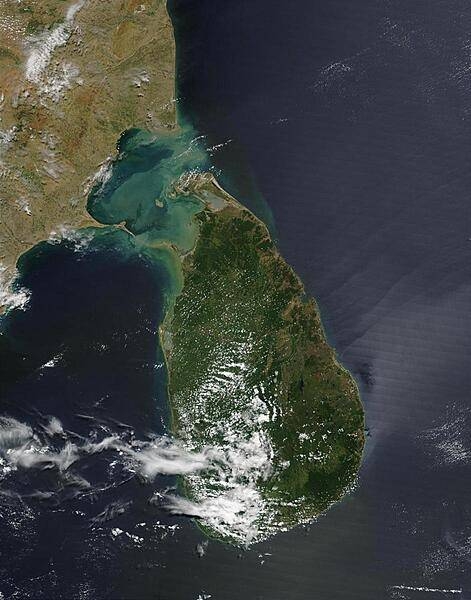
The Palk Strait separates India (upper left) from Sri Lanka (center). This image shows the Strait filled with bright sediment, while off the northeast tip of Sri Lanka, a darkening in the waters could be a phytoplankton bloom. On Sri Lanka, many of the native forests have been cleared, but small pockets remain in preserves, such as that seen in the dark green southeastern portion of the island. The imaging satellite also detected a number of fires that are indicated in red. Image courtesy of NASA.
The Palk Strait separates India (upper left) from Sri Lanka (center). This image shows the Strait filled with bright sediment, while off the northeast tip of Sri Lanka, a darkening in the waters could be a phytoplankton bloom. On Sri Lanka, many of the native forests have been cleared, but small pockets remain in preserves, such as that seen in the dark green southeastern portion of the island. The imaging satellite also detected a number of fires that are indicated in red. Image courtesy of NASA. • CIA World Factbook • 2020
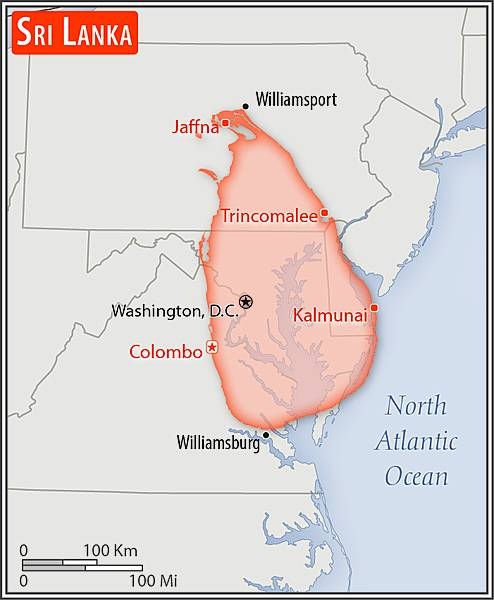
Area comparison map
Area comparison map • CIA World Factbook • 2020
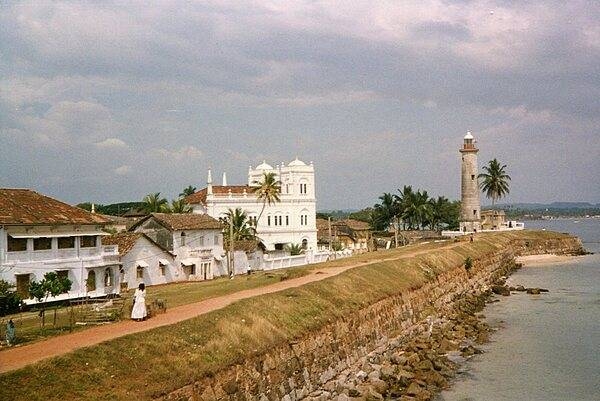
The Galle lighthouse is the oldest lighthouse in Sri Lanka, first built in 1848; it lies at the entrance to Galle harbor on southwestern coast of Sri Lanka, about 120 km south of Colombo. The lighthouse is situated within Galle Fort, first fortified by the Portuguese in 1588 and then extensively improved upon by the Dutch in the 17th and 18th centuries. The current lighthouse is 26.5 m tall and was built in 1939 after the original lighthouse was destroyed by fire in 1934. Galle was a historically important port of call in the Indian Ocean trade being visited by the Islamic explorer Ibn Batuta, the Chinese admiral Zheng He, and where the Portuguese first landed in 1502. Today, the lighthouse and surrounding fort have been designated as a World Heritage Center.
The Galle lighthouse is the oldest lighthouse in Sri Lanka, first built in 1848; it lies at the entrance to Galle harbor on southwestern coast of Sri Lanka, about 120 km south of Colombo. The lighthouse is situated within Galle Fort, first fortified by the Portuguese in 1588 and then extensively improved upon by the Dutch in the 17th and 18th centuries. The current lighthouse is 26.5 m tall and was built in 1939 after the original lighthouse was destroyed by fire in 1934. Galle was a historically important port of call in the Indian Ocean trade being visited by the Islamic explorer Ibn Batuta, the Chinese admiral Zheng He, and where the Portuguese first landed in 1502. Today, the lighthouse and surrounding fort have been designated as a World Heritage Center. • CIA World Factbook • 2020
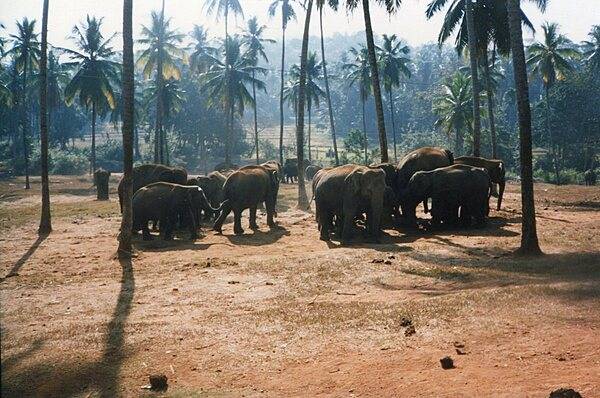
The Pinnawala Elephant Orphanage was established in 1975 to care for orphaned wild elephants found wandering the forests of Sri Lanka. The orphanage is located in the town of Pinnawala, about 90 km northeast of Colombo. Since 1995, newly found orphan elephants have been cared for at the Elephant Transit Home created by the Sri Lankan Department of Wildlife Conservation, while the Pinnawala facility has focused on the existing herd of elephants. In 1982, an elephant breeding program was begun at Pinnawala and the herd is estimated now to number about 70 elephants.
The Pinnawala Elephant Orphanage was established in 1975 to care for orphaned wild elephants found wandering the forests of Sri Lanka. The orphanage is located in the town of Pinnawala, about 90 km northeast of Colombo. Since 1995, newly found orphan elephants have been cared for at the Elephant Transit Home created by the Sri Lankan Department of Wildlife Conservation, while the Pinnawala facility has focused on the existing herd of elephants. In 1982, an elephant breeding program was begun at Pinnawala and the herd is estimated now to number about 70 elephants. • CIA World Factbook • 2020
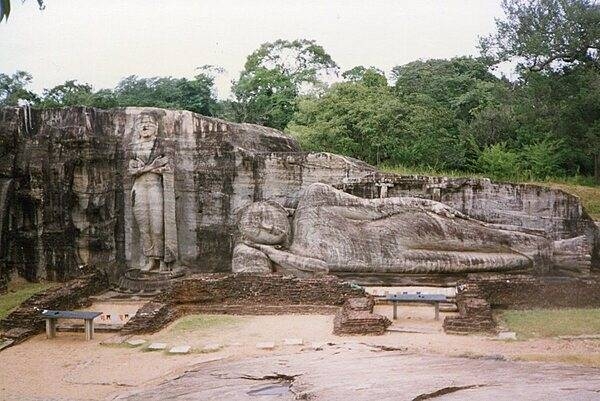
The Gal Vihara (the stone temple), known originally as the Uttararama, is a rock temple of the Buddha located in the ancient city of Polonnaruwa in North Central Province, Sri Lanka. It was carved during the reign of Parakramabahu I (1153-1186). The temple consists of four rock relief statues of the Buddha, which have been carved into the face of a single granite outcropping. The reclining Buddha is just over 14 m (46 ft) in length, making it one of the largest sculptures in South Asia. The city of Polonnaruwa has been designated a World Heritage Center.
The Gal Vihara (the stone temple), known originally as the Uttararama, is a rock temple of the Buddha located in the ancient city of Polonnaruwa in North Central Province, Sri Lanka. It was carved during the reign of Parakramabahu I (1153-1186). The temple consists of four rock relief statues of the Buddha, which have been carved into the face of a single granite outcropping. The reclining Buddha is just over 14 m (46 ft) in length, making it one of the largest sculptures in South Asia. The city of Polonnaruwa has been designated a World Heritage Center. • CIA World Factbook • 2020
5 photos available
Data sources: World Bank, UN Data • Updated daily •Learn about our data