›››
Moldova
Moldova
Population
2.4M
Rank #144Source: World Bank
Capital
Chisinau
Source: REST Countries
Region
Europe
Europe & Central Asia
Source: REST Countries
GDP (Nominal)
$18.20B
Rank #131Source: World Bank
Land Area
33.8K km²
Rank #136Source: REST Countries
Life Expectancy
71.198 yrs
Source: World Bank
Historical Trends
Population Trend (5-Year)
Source: World Bank
GDP Trend (5-Year, Nominal USD)
Source: World Bank
Geography
Area: 33,847 km²
Landlocked: Yes
Independent: Yes
Climate: moderate winters, warm summers
Terrain: rolling steppe, gradual slope south to Black Sea
Elevation: mean elevation: 139 m lowest point: Dniester (Nistru) 2 m highest point: Dealul Balanesti 430 m
Natural Hazards: landslides
Environmental Issues: heavy use of agricultural chemicals, has contaminated soil and groundwater; extensive soil erosion and declining soil fertility from poor farming methods
Land Use: agricultural land: 74.9% (2011 est.) forest: 11.9% (2011 est.) other: 13.2% (2011 est.)
Geography Note: landlocked; well endowed with various sedimentary rocks and minerals including sand, gravel, gypsum, and limestone
Natural Resources
lignitephosphoritesgypsumlimestonearable land
People & Society
Fertility Rate
1.73
Population
2.4M
Ethnic Groups
Moldovan (75.1%)Romanian (7%)Ukrainian (6.6%)Gagauz (4.6%)Russian (4.1%)Bulgarian (1.9%)other (0.8%)
Religions
Orthodox (90.1%)other Christian (2.6%)other (0.1%)
Economy
GDP per Capita
$7,576.196
GDP per Capita PPP
18,614.988
(2024)
(2024)
GNI per Capita
6,880
(2024)
(2024)
Gini Index
26.8
(2023)
(2023)
Unemployment
1.427%
(2024)
(2024)
Inflation
4.678%
(2024)
(2024)
Public Debt
34.262%
(2023)
(2023)
Energy
Electricity Access
100%
(2023)
(2023)
Renewable Energy
21.4%
(2021)
(2021)
CO₂ Emissions
8.208 Mt
(2024)
(2024)
Energy Intensity
4.69 MJ/$
(2022)
(2022)
Renewable Electricity
6.504%
(2021)
(2021)
Environment
Forest Coverage
11.737% of land
(2023)
(2023)
Communications
Internet Users
80.213%
(2023)
(2023)
Mobile Penetration
130.772%
(2023)
(2023)
Broadband Subscribers
27.421%
(2023)
(2023)
Transportation
Air Transport Freight
0.371 M ton-km
(2023)
(2023)
Container Port Traffic
818 TEU
(2019)
(2019)
Airports
6,643.666
Rail Lines
1,149 km
Roads Total
N/A
Military
Military Forces
National Army: Land Forces Command, Air Forces Command (includes air defense unit); Carabinieri Troops (a component of the Ministry of Internal Affairs that also has official status as a service of...
Personnel Strength
estimates of the size of the Moldovan National Army vary; approximately 6,000 active troops (5,000 Land Forces; 1,000 Air Force)
Military Expenditure (USD)
$0.11B
Military Expenditure (% of GDP)
0.60%
Military Expenditure History
0.4% of GDP (2019) 0.4% of GDP (2018) 0.4% of GDP (2017) 0.45% of GDP (2016) 0.4% of GDP (2015)
Equipment & Inventories
the Moldovan military's inventory is limited and almost entirely comprised of older Russian and Soviet-era equipment; since 2000, it has received small amounts of donated material from other nations,...
Service Age & Obligation
18-27 years of age for compulsory or voluntary military service; male registration required at age 16; 1-year service obligation note: Moldova intends to abolish military conscription by 2021
Education
Pre-Primary Enrollment
90.332%
(2021)
(2021)
Primary Enrollment
107.606%
(2024)
(2024)
Secondary Enrollment
99.344%
(2024)
(2024)
Tertiary Enrollment
74.711%
(2024)
(2024)
Education Spending
6.625% of GDP
(2023)
(2023)
Adult Literacy Rate
99.36%
(2014)
(2014)
Pupil-Teacher Ratio
17.923:1
(2018)
(2018)
Health
Physicians per 1,000
4.016
(2023)
(2023)
Safe Water Access
92.708%
(2024)
(2024)
Safe Drinking Water
75.816%
(2024)
(2024)
Under-5 Mortality
14.7 per 1,000
(2023)
(2023)
Maternal Mortality (World Bank)
15.948 per 100,000
(2021)
(2021)
Hospital Beds per 1,000
65.534
(2021)
(2021)
UHC Coverage Index
71
(2023)
(2023)
Measles Immunization
86%
(2024)
(2024)
Social Indicators
Extreme Poverty Rate
0.1%
(2023)
(2023)
Food Insecurity
2.5%
(2023)
(2023)
Youth NEET Rate
4.599%
(2024)
(2024)
Governance
Women in Government
40.816%
(2024)
(2024)
Voice & Accountability
0.24
(Above Average)
(2023)
(Above Average)
(2023)
Political Stability
-0.68
(Below Average)
(2023)
(Below Average)
(2023)
Government Effectiveness
-0.17
(Below Average)
(2023)
(Below Average)
(2023)
Regulatory Quality
0.10
(Above Average)
(2023)
(Above Average)
(2023)
Rule of Law
-0.15
(Below Average)
(2023)
(Below Average)
(2023)
Control of Corruption
-0.28
(Below Average)
(2023)
(Below Average)
(2023)
Government
Government Type
parliamentary republic
Legal System
civil law system with Germanic law influences; Constitutional Court review of legislative acts
Executive Branch
chief of state: President Igor DODON (since 23 December 2016); note – in 2017-19, DODON was temporarily suspended several times by the Moldovan Constitutional Court for rejecting ministerial...
Legislative Branch
description: unicameral Parliament (101 seats; 51 members directly elected in single-seat constituencies by simple majority vote and 50 members directly elected in a single, nationwide constituency...
Judicial Branch
highest courts: Supreme Court of Justice (consists of the chief judge, 3 deputy-chief judges, 45 judges, and 7 assistant judges); Constitutional Court (consists of the court president and 6 judges);...
National Symbols
Flag Description
three equal vertical bands of Prussian blue (hoist side), chrome yellow, and vermilion red; emblem in center of flag is of a Roman eagle of dark gold (brown) outlined in black with a red beak and...
National Symbols
aurochs (a type of wild cattle); national colors: blue, yellow, red
National Anthem
name: "Limba noastra" (Our Language) lyrics/music: Alexei MATEEVICI/Alexandru CRISTEA note: adopted 1994
Safety
Homicide Rate
2.543 per 100,000
(2023)
(2023)
Travel Information
Language(s): Romanian
Currency: MDL (L)
Timezone(s): UTC+02:00
Landlocked: Yes
Independent: Yes
Driving Side: Right
Calling Code: +373
Car Sign: MD
Week Starts: Monday
Photos
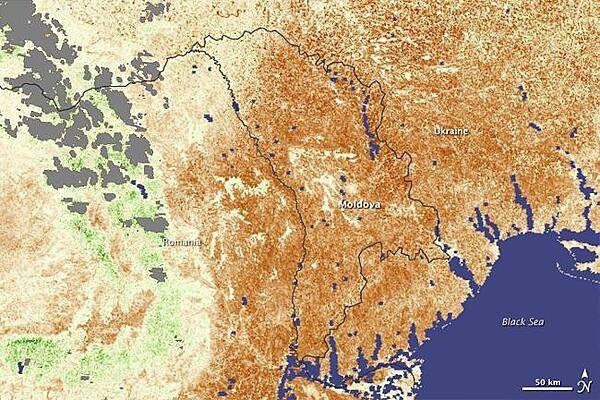
The impact of a 2007 drought on plants in Moldova and parts of Ukraine and Romania is illustrated by a pair of images (this and the next). The photos are vegetation anomaly images that indicate how quickly plants were taking in light and growing. Areas that are green are regions where plants were larger and leafier (leading to more photosynthesis) than they were on average from 2000 through 2006. Brown areas show where plants were smaller or less leafy than average, in this case as a result of drought. Gray areas indicate where clouds blocked the ground from view throughout the observation period, and blue is water. The above satellite image is a compilation of daily data collected between 28 July 28 and 12 August 2007, when the impact of the drought was at its greatest. Summer crops, such as corn and sunflowers, were in a critical stage of development, during which water was essential. The deep brown tone that covers all of Moldova reveals that the hot, dry weather devastated plants. The following image, from 29 August through 13 September, reveals just how much conditions can change in a single month. Some of what had been brown is brushed with green where plants responded to rainfall. Helpful though the precipitation evidently was to those plants that were still growing, it arrived too late to improve crop conditions in general. Photos courtesy of NASA.
The impact of a 2007 drought on plants in Moldova and parts of Ukraine and Romania is illustrated by a pair of images (this and the next). The photos are vegetation anomaly images that indicate how quickly plants were taking in light and growing. Areas that are green are regions where plants were larger and leafier (leading to more photosynthesis) than they were on average from 2000 through 2006. Brown areas show where plants were smaller or less leafy than average, in this case as a result of drought. Gray areas indicate where clouds blocked the ground from view throughout the observation period, and blue is water. The above satellite image is a compilation of daily data collected between 28 July 28 and 12 August 2007, when the impact of the drought was at its greatest. Summer crops, such as corn and sunflowers, were in a critical stage of development, during which water was essential. The deep brown tone that covers all of Moldova reveals that the hot, dry weather devastated plants. The following image, from 29 August through 13 September, reveals just how much conditions can change in a single month. Some of what had been brown is brushed with green where plants responded to rainfall. Helpful though the precipitation evidently was to those plants that were still growing, it arrived too late to improve crop conditions in general. Photos courtesy of NASA. • CIA World Factbook • 2020
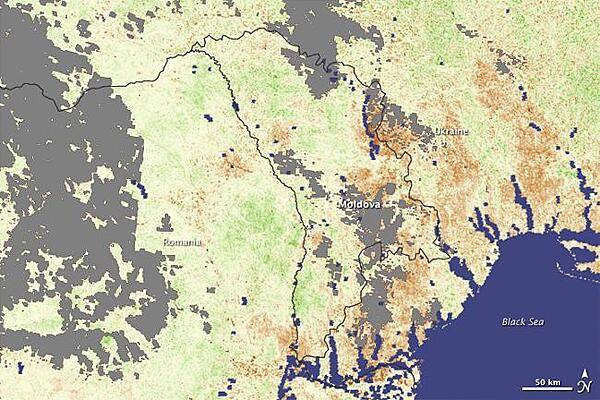
The impact of a 2007 drought on plants in Moldova and parts of Ukraine and Romania is illustrated by a pair of images (this and the previous). The photos are vegetation anomaly images that indicate how quickly plants were taking in light and growing. Areas that are green are regions where plants were larger and leafier (leading to more photosynthesis) than they were on average from 2000 through 2006. Brown areas show where plants were smaller or less leafy than average, in this case as a result of drought. Gray areas indicate where clouds blocked the ground from view throughout the observation period, and blue is water. The earlier satellite image is a compilation of daily data collected between 28 July 28 and 12 August 2007, when the impact of the drought was at its greatest. Summer crops, such as corn and sunflowers, were in a critical stage of development, during which water was essential. The deep brown tone that covered all of Moldova revealed that the hot, dry weather devastated plants. The image above, from 29 August through 13 September, reveals just how much conditions can change in a single month. Some of what had been brown is brushed with green where plants responded to rainfall. Helpful though the precipitation evidently was to those plants that were still growing, it arrived too late to improve crop conditions in general. Photos courtesy of NASA.
The impact of a 2007 drought on plants in Moldova and parts of Ukraine and Romania is illustrated by a pair of images (this and the previous). The photos are vegetation anomaly images that indicate how quickly plants were taking in light and growing. Areas that are green are regions where plants were larger and leafier (leading to more photosynthesis) than they were on average from 2000 through 2006. Brown areas show where plants were smaller or less leafy than average, in this case as a result of drought. Gray areas indicate where clouds blocked the ground from view throughout the observation period, and blue is water. The earlier satellite image is a compilation of daily data collected between 28 July 28 and 12 August 2007, when the impact of the drought was at its greatest. Summer crops, such as corn and sunflowers, were in a critical stage of development, during which water was essential. The deep brown tone that covered all of Moldova revealed that the hot, dry weather devastated plants. The image above, from 29 August through 13 September, reveals just how much conditions can change in a single month. Some of what had been brown is brushed with green where plants responded to rainfall. Helpful though the precipitation evidently was to those plants that were still growing, it arrived too late to improve crop conditions in general. Photos courtesy of NASA. • CIA World Factbook • 2020
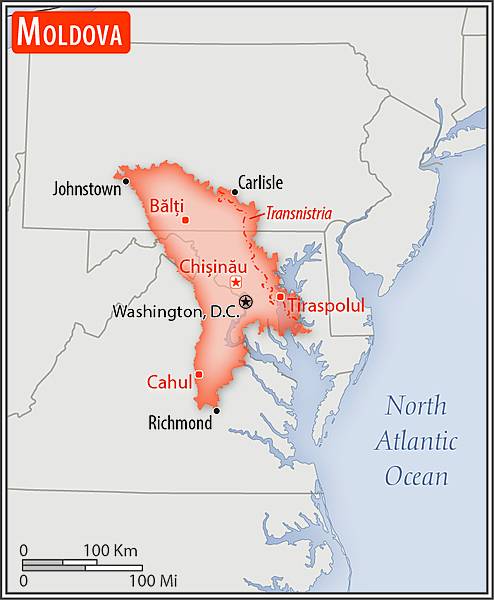
Area comparison map
Area comparison map • CIA World Factbook • 2020
3 photos available
Data sources: World Bank, UN Data • Updated daily •Learn about our data