›››
New Caledonia
New Caledonia
Population
292.6K
Rank #178Source: World Bank
Capital
Noum'ea
Source: REST Countries
Region
Asia
East Asia & Pacific
Source: REST Countries
GDP (Nominal)
$8.55B
Rank #152Source: World Bank
Land Area
18.6K km²
Rank #152Source: REST Countries
Life Expectancy
78.766 yrs
Source: World Bank
Historical Trends
Population Trend (5-Year)
Source: World Bank
GDP Trend (5-Year, Nominal USD)
Source: World Bank
Geography
Area: 18,575 km²
Landlocked: No
Independent: No
Climate: tropical; modified by southeast trade winds; hot, humid
Terrain: coastal plains with interior mountains
Elevation: lowest point: Pacific Ocean 0 m highest point: Mont Panie 1,628 m
Natural Hazards: cyclones, most frequent from November to Marchvolcanism: Matthew and Hunter Islands are historically active
Environmental Issues: preservation of coral reefs; prevention of invasive species; limiting erosion caused by nickel mining and forest fires
Land Use: agricultural land: 10.4% (2011 est.) forest: 45.9% (2011 est.) other: 43.7% (2011 est.)
Geography Note: consists of the main island of New Caledonia (one of the largest in the Pacific Ocean), the archipelago of Iles Loyaute, and numerous small, sparsely populated islands and atolls
Natural Resources
nickelchromeironcobaltmanganesesilvergoldleadcopper
People & Society
Fertility Rate
1.98
Population
292.6K
Ethnic Groups
Kanak (39.1%)European (27.1%)Futunian (8.2%)Tahitian (2.1%)Indonesian (1.4%)Ni-Vanuatu (1%)Vietnamese (0.9%)other (17.7%)unspecified (2.5%)
Religions
Roman Catholic (60%)Protestant (30%)other (10%)
Economy
GDP per Capita
$29,213.192
GDP per Capita PPP
Not Available
GNI per Capita
30,070
(2024)
(2024)
Gini Index
Not Available
Unemployment
10.991%
(2024)
(2024)
Inflation
0.578%
(2016)
(2016)
Public Debt
Not Available
Energy
Electricity Access
100%
(2023)
(2023)
Renewable Energy
9.6%
(2022)
(2022)
CO₂ Emissions
4.998 Mt
(2024)
(2024)
Energy Intensity
13.47 MJ/$
(2022)
(2022)
Renewable Electricity
22.477%
(2021)
(2021)
Environment
Forest Coverage
45.827% of land
(2023)
(2023)
Communications
Internet Users
82.006%
(2017)
(2017)
Mobile Penetration
91.676%
(2022)
(2022)
Broadband Subscribers
19.373%
(2022)
(2022)
Transportation
Air Transport Freight
Not Available
Container Port Traffic
111,875 TEU
(2019)
(2019)
Airports
N/A
Rail Lines
N/A
Roads Total
N/A
Military
Military Forces
no regular military forces; France bases land, air, and naval forces on New Caledonia (Forces Armées de la Nouvelle-Calédonie, FANC)
Health
Physicians per 1,000
Not Available
Safe Water Access
99.539%
(2024)
(2024)
Safe Drinking Water
96.865%
(2024)
(2024)
Under-5 Mortality
Not Available
Maternal Mortality (World Bank)
Not Available
Social Indicators
Extreme Poverty Rate
Not Available
Food Insecurity
4.9%
(2023)
(2023)
Youth NEET Rate
34.514%
(2023)
(2023)
Governance
Women in Government
Not Available
Voice & Accountability
Not Available
Political Stability
Not Available
Government Effectiveness
Not Available
Regulatory Quality
Not Available
Rule of Law
Not Available
Control of Corruption
Not Available
Government
Government Type
parliamentary democracy (Territorial Congress); an overseas collectivity of France
Legal System
civil law system based on French civil law
Executive Branch
chief of state: President Emmanuel MACRON (since 14 May 2017); represented by High Commissioner Laurent PREVOST (since 5 August 2019) head of government: President of the Government Thierry SANTA...
Legislative Branch
description: unicameral Territorial Congress or Congrès du Territoire (54 seats; members indirectly selected proportionally by the partisan makeup of the 3 Provincial Assemblies or Assemblés...
Judicial Branch
highest courts: Court of Appeal in Noumea or Cour d'Appel; organized into civil, commercial, social, and pre-trial investigation chambers; court bench normally includes the court president and 2...
International Organizations
National Symbols
Flag Description
New Caledonia has two official flags; alongside the flag of France, the Kanak (indigenous Melanesian) flag has equal status; the latter consists of three equal horizontal bands of blue (top), red,...
National Symbols
fleche faitiere (native rooftop adornment), kagu bird; national colors: gray, red
National Anthem
name: "Soyons unis, devenons freres" (Let Us Be United, Let Us Become Brothers) lyrics/music: Chorale Melodia (a local choir) note: adopted 2008; contains a mixture of lyrics in both French and...
Travel Information
Language(s): French
Currency: XPF (₣)
Timezone(s): UTC+11:00
Landlocked: No
Independent: No
Driving Side: Right
Calling Code: +687
Car Sign: F
Week Starts: Monday
Photos
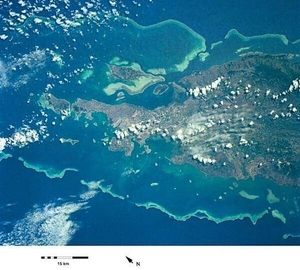
View of the northern portion of New Caledonia. The world's second largest barrier reef encircles the island. Image courtesy of NASA.
View of the northern portion of New Caledonia. The world's second largest barrier reef encircles the island. Image courtesy of NASA. • CIA World Factbook • 2020
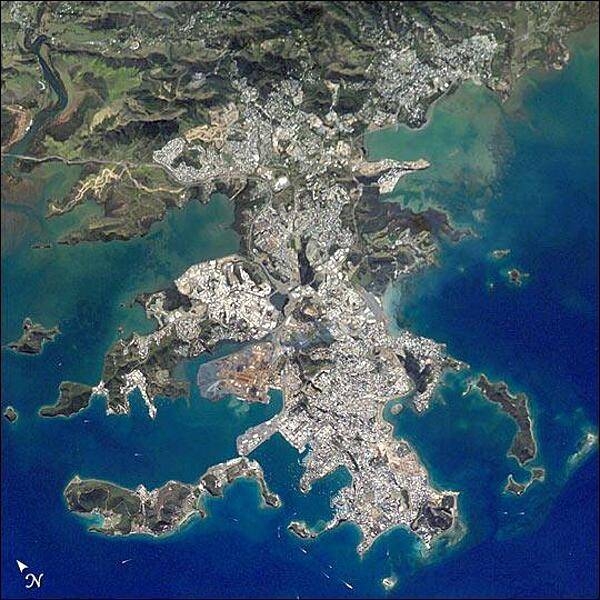
This image shows details of New Caledonia's main city, Noumea, which is built on a peninsula that juts into the lagoon on the southwest side of the island. The reefs here face problems from pollution and overfishing. The tourism industry is very important to the economy of Noumea, with extensive hotel development in the city and along the southeast coast of New Caledonia Island. The picture shows how urban development extends to the steep slopes of the coastal hills. Image courtesy of NASA.
This image shows details of New Caledonia's main city, Noumea, which is built on a peninsula that juts into the lagoon on the southwest side of the island. The reefs here face problems from pollution and overfishing. The tourism industry is very important to the economy of Noumea, with extensive hotel development in the city and along the southeast coast of New Caledonia Island. The picture shows how urban development extends to the steep slopes of the coastal hills. Image courtesy of NASA. • CIA World Factbook • 2020
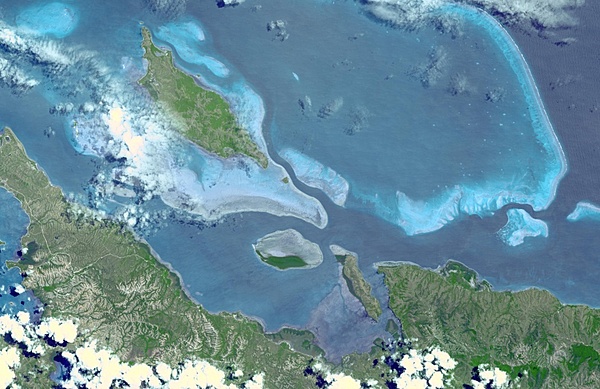
In 2008, UNESCO added the Lagoons of New Caledonia to the World Heritage Site list. The Lagoons comprise six marine clusters that represent the main diversity of coral reefs and associated ecosystems in the French Pacific Ocean archipelago of New Caledonia and one of the three most extensive reef systems in the world. These Lagoons feature a remarkable diversity of coral and fish species and a continuum of habitats from mangroves to seagrasses with the world's most diverse concentration of reef structures. The Lagoons of New Caledonia display intact ecosystems, with healthy populations of large predators, and a great number and diversity of big fish. They provide habitat to a number of emblematic or threatened marine species such as turtles, whales, and dugongs whose population here is the third largest in the world. Photo courtesy of NASA.
In 2008, UNESCO added the Lagoons of New Caledonia to the World Heritage Site list. The Lagoons comprise six marine clusters that represent the main diversity of coral reefs and associated ecosystems in the French Pacific Ocean archipelago of New Caledonia and one of the three most extensive reef systems in the world. These Lagoons feature a remarkable diversity of coral and fish species and a continuum of habitats from mangroves to seagrasses with the world's most diverse concentration of reef structures. The Lagoons of New Caledonia display intact ecosystems, with healthy populations of large predators, and a great number and diversity of big fish. They provide habitat to a number of emblematic or threatened marine species such as turtles, whales, and dugongs whose population here is the third largest in the world. Photo courtesy of NASA. • CIA World Factbook • 2020
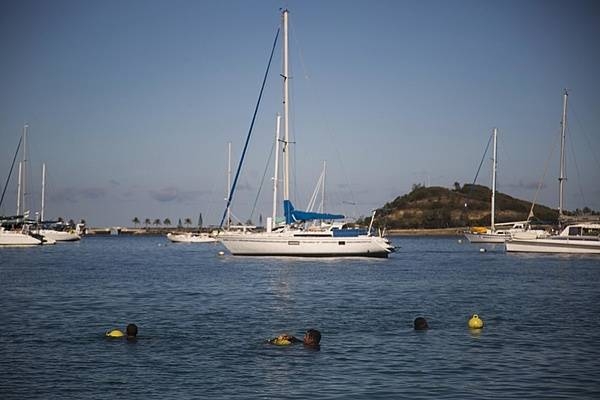
The harbor at Noumea. Photo courtesy of the US Marine Corps/ Sgt. Douglas D. Simons.
The harbor at Noumea. Photo courtesy of the US Marine Corps/ Sgt. Douglas D. Simons. • CIA World Factbook • 2020
4 photos available
Data sources: World Bank, UN Data • Updated daily •Learn about our data