›››
Nepal
Nepal
Population
29.7M
Rank #51Source: World Bank
Capital
Kathmandu
Source: REST Countries
Region
Asia
South Asia
Source: REST Countries
GDP (Nominal)
$42.91B
Rank #102Source: World Bank
Land Area
147.2K km²
Rank #94Source: REST Countries
Life Expectancy
70.354 yrs
Source: World Bank
Historical Trends
Population Trend (5-Year)
Source: World Bank
GDP Trend (5-Year, Nominal USD)
Source: World Bank
Geography
Area: 147,181 km²
Landlocked: Yes
Independent: Yes
Climate: varies from cool summers and severe winters in north to subtropical summers and mild winters in south
Terrain: Tarai or flat river plain of the Ganges in south; central hill region with rugged Himalayas in north
Elevation: mean elevation: 2,565 m lowest point: Kanchan Kalan 70 m highest point: Mount Everest (highest peak in Asia and highest point on earth above sea level) 8,849 m
Natural Hazards: severe thunderstorms; flooding; landslides; drought and famine depending on the timing, intensity, and duration of the summer monsoons
Environmental Issues: deforestation (overuse of wood for fuel and lack of alternatives); forest degradation; soil erosion; contaminated water (with human and animal wastes, agricultural runoff, and industrial effluents);...
Land Use: agricultural land: 28.8% (2011 est.) forest: 25.4% (2011 est.) other: 45.8% (2011 est.)
Geography Note: landlocked; strategic location between China and India; contains eight of world's 10 highest peaks, including Mount Everest and Kanchenjunga - the world's tallest and third tallest mountains - on the...
Natural Resources
quartzwatertimberhydropowerscenic beautysmall deposits of lignitecoppercobaltiron ore
People & Society
Fertility Rate
1.98
Population
29.7M
Ethnic Groups
Chhettri (16.6%)Brahman-Hill (12.2%)Magar (7.1%)Tharu (6.6%)Tamang (5.8%)Newar (5%)Kami (4.8%)Muslim (4.4%)Yadav (4%)Rai (2.3%)Gurung (2%)Damai/Dholii (1.8%)Thakuri (1.6%)Limbu (1.5%)Sarki (1.4%)Teli (1.4%)Chamar/Harijan/Ram (1.3%)Koiri/Kushwaha (1.2%)other (19%)
Religions
Hindu (81.3%)Buddhist (9%)Muslim (4.4%)Kirant (3.1%)Christian (1.4%)other (0.5%)unspecified (0.2%)
Economy
GDP per Capita
$1,447.31
GDP per Capita PPP
5,736.621
(2024)
(2024)
GNI per Capita
1,470
(2024)
(2024)
Gini Index
30
(2022)
(2022)
Unemployment
10.5%
(2024)
(2024)
Inflation
4.685%
(2024)
(2024)
Public Debt
39.922%
(2021)
(2021)
Energy
Electricity Access
94%
(2023)
(2023)
Renewable Energy
73.7%
(2021)
(2021)
CO₂ Emissions
15.892 Mt
(2024)
(2024)
Energy Intensity
5.63 MJ/$
(2021)
(2021)
Renewable Electricity
83.829%
(2021)
(2021)
Environment
Forest Coverage
41.591% of land
(2023)
(2023)
Protected Areas
25.4% of land
(2006)
(2006)
Communications
Internet Users
55.772%
(2023)
(2023)
Mobile Penetration
133.273%
(2022)
(2022)
Broadband Subscribers
4.832%
(2022)
(2022)
Transportation
Air Transport Freight
16.929 M ton-km
(2023)
(2023)
Container Port Traffic
Not Available
Airports
67,501
Rail Lines
N/A
Roads Total
35,809 km(©IRF)
Military
Military Forces
Nepal Army (includes Air Wing); Nepal Armed Police Force (under the Ministry of Home Affairs; paramilitary force responsible for border and internal security, including counter-insurgency, and...
Personnel Strength
the Nepal Army has approximately 95,000 active troops (including a small air wing of about 500 personnel); approximately 15,000 Nepal Armed Police
Military Expenditure (USD)
$0.43B
Military Expenditure (% of GDP)
0.98%
Military Expenditure History
1.6% of GDP (2019) 1.6% of GDP (2018) 1.7% of GDP (2017) 1.7% of GDP (2016) 1.6% of GDP (2015)
Deployments
720 Central African Republic (MINUSCA); 880 Democratic Republic of the Congo (MONUSCO); 400 Golan Heights (UNDOF); 870 Lebanon (UNIFIL); 230 Liberia (UNSMIL); 150 Mali (MINUSMA); 1,700 South Sudan...
Equipment & Inventories
the Army's inventory includes a mix of older equipment largely of British, Chinese, Indian, Russian, and South African origin; since 2010, China, Italy, and Russia are the top suppliers of military...
Service Age & Obligation
18 years of age for voluntary military service (including women); no conscription
Education
Pre-Primary Enrollment
93.698%
(2022)
(2022)
Primary Enrollment
124.622%
(2024)
(2024)
Secondary Enrollment
90.388%
(2024)
(2024)
Tertiary Enrollment
21.292%
(2024)
(2024)
Education Spending
3.688% of GDP
(2024)
(2024)
Adult Literacy Rate
68.71%
(2019)
(2019)
Pupil-Teacher Ratio
19.744:1
(2019)
(2019)
Health
Physicians per 1,000
1.011
(2023)
(2023)
Safe Water Access
93.64%
(2024)
(2024)
Safe Drinking Water
16.487%
(2024)
(2024)
Under-5 Mortality
26.5 per 1,000
(2023)
(2023)
Maternal Mortality (World Bank)
18.341 per 100,000
(2021)
(2021)
Hospital Beds per 1,000
71.794
(2021)
(2021)
UHC Coverage Index
58
(2023)
(2023)
Measles Immunization
97%
(2024)
(2024)
Social Indicators
Extreme Poverty Rate
2.4%
(2022)
(2022)
Food Insecurity
5.3%
(2023)
(2023)
Youth NEET Rate
20.529%
(2017)
(2017)
Governance
Women in Government
33.088%
(2024)
(2024)
Voice & Accountability
-0.02
(Below Average)
(2023)
(Below Average)
(2023)
Political Stability
-0.23
(Below Average)
(2023)
(Below Average)
(2023)
Government Effectiveness
-0.81
(Below Average)
(2023)
(Below Average)
(2023)
Regulatory Quality
-0.66
(Below Average)
(2023)
(Below Average)
(2023)
Rule of Law
-0.46
(Below Average)
(2023)
(Below Average)
(2023)
Control of Corruption
-0.51
(Below Average)
(2023)
(Below Average)
(2023)
Government
Government Type
federal parliamentary republic
Legal System
English common law and Hindu legal concepts; note - new criminal and civil codes came into effect on 17 August 2018
Executive Branch
chief of state: President Bidhya Devi BHANDARI (since October 2015) head of government: Prime Minister Khadga Prasad (KP) Sharma OLI (since 15 February 2018); deputy prime ministers Ishwar POKHREL,...
Legislative Branch
description: bicameral Federal Parliament consists of:National Assembly (59 seats; 56 members, including at least 3 women, 1 Dalit, 1 member with disabilities, or 1 minority indirectly elected by an...
Judicial Branch
highest courts: Supreme Court (consists of the chief justice and up to 20 judges) judge selection and term of office: Supreme Court chief justice appointed by the president upon the recommendation of...
National Symbols
Flag Description
crimson red with a blue border around the unique shape of two overlapping right triangles; the smaller, upper triangle bears a white stylized moon and the larger, lower triangle displays a white...
National Symbols
rhododendron blossom; national color: red
National Anthem
name: "Sayaun Thunga Phool Ka" (Hundreds of Flowers) lyrics/music: Pradeep Kumar RAI/Ambar GURUNG note: adopted 2007; after the abolition of the monarchy in 2006, a new anthem was required because of...
Safety
Homicide Rate
2.13 per 100,000
(2020)
(2020)
Travel Information
Language(s): Nepali
Currency: NPR (₨)
Timezone(s): UTC+05:45
Landlocked: Yes
Independent: Yes
Driving Side: Left
Calling Code: +977
Car Sign: NEP
Week Starts: Sunday
Photos
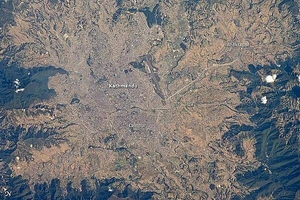
The capital and largest city of Nepal, Kathmandu, occupies much of the valley located near the center of the country. Nepal is home to much of the Himalaya mountain range between Tibet (China) to the north and India to the south. Geological and fossil evidence indicates that the Kathmandu Valley was covered by a large lake between approximately 2.8 million and 10,000 years ago. Paleo-Kathmandu Lake is thought to have drained in phases due to the drying of the regional climate; continuing mountain building-tectonic uplift and faulting-in the region; and the formation of an integrated drainage system, as river channels cut through previous rock ridge dams. The green, vegetated slopes that ring the Kathmandu metro area (light gray, image center) include both forest reserves and national parks. The metropolitan area is relatively flat compared to the surrounding mountains. Tribhuvan International Airport, near the eastern margin of the city, is the only international airport in Nepal. Archeological evidence suggests that the human development of Kathmandu, together with the nearby "sister cities" of Lalitpur and Bhaktapur, began almost 2,000 years ago. Today, the three cities form the governmental, cultural, and-as a main access point to the Himalayas for tourism-economic center of the country. Photo courtesy of NASA.
The capital and largest city of Nepal, Kathmandu, occupies much of the valley located near the center of the country. Nepal is home to much of the Himalaya mountain range between Tibet (China) to the north and India to the south. Geological and fossil evidence indicates that the Kathmandu Valley was covered by a large lake between approximately 2.8 million and 10,000 years ago. Paleo-Kathmandu Lake is thought to have drained in phases due to the drying of the regional climate; continuing mountain building-tectonic uplift and faulting-in the region; and the formation of an integrated drainage system, as river channels cut through previous rock ridge dams.
The green, vegetated slopes that ring the Kathmandu metro area (light gray, image center) include both forest reserves and national parks. The metropolitan area is relatively flat compared to the surrounding mountains. Tribhuvan International Airport, near the eastern margin of the city, is the only international airport in Nepal.
Archeological evidence suggests that the human development of Kathmandu, together with the nearby "sister cities" of Lalitpur and Bhaktapur, began almost 2,000 years ago. Today, the three cities form the governmental, cultural, and-as a main access point to the Himalayas for tourism-economic center of the country. Photo courtesy of NASA. • CIA World Factbook • 2020
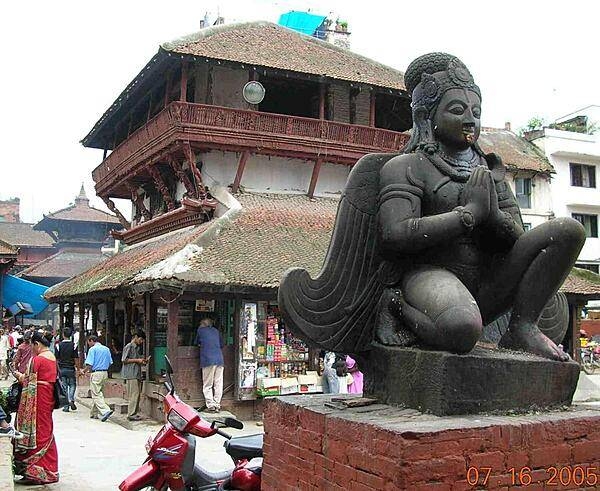
A building and statue in Durbar Square, Kathmandu.
A building and statue in Durbar Square, Kathmandu. • CIA World Factbook • 2020
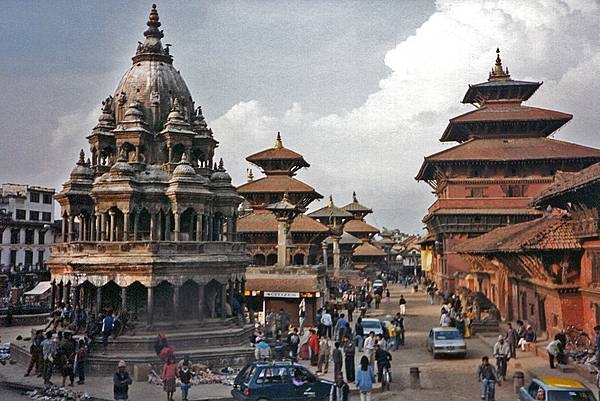
A view of temples in the area of Durbar Square in the historic center of Kathmandu, capital of Nepal. This photograph was taken before the devastating earthquake of 2015, during which many of these buildings were severely damaged or destroyed.
A view of temples in the area of Durbar Square in the historic center of Kathmandu, capital of Nepal. This photograph was taken before the devastating earthquake of 2015, during which many of these buildings were severely damaged or destroyed. • CIA World Factbook • 2020
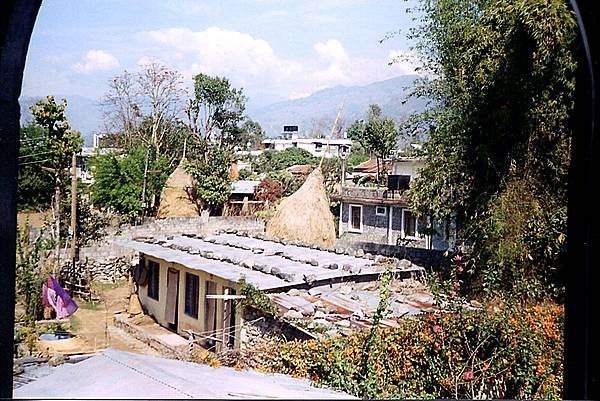
Farming community outside of the city of Pokhara in Nepal.
Farming community outside of the city of Pokhara in Nepal. • CIA World Factbook • 2020
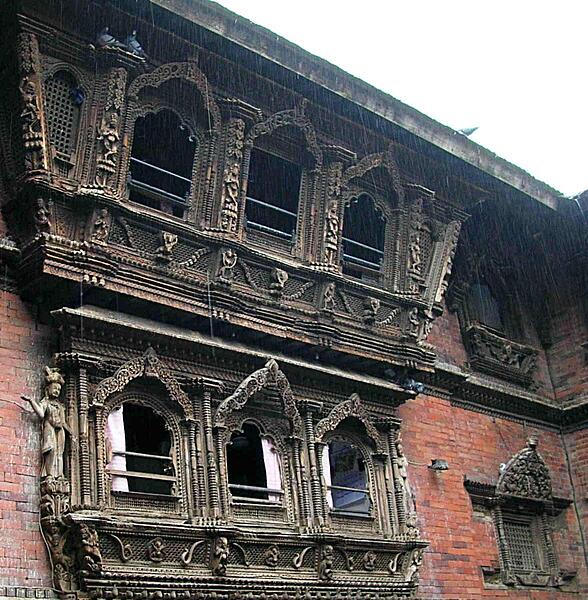
Kumari Ghar building that houses the Kumari Devi, a pre-pubescent girl considered a living goddess, next to Durbar Square, Kathmandu (2005).
Kumari Ghar building that houses the Kumari Devi, a pre-pubescent girl considered a living goddess, next to Durbar Square, Kathmandu (2005). • CIA World Factbook • 2020
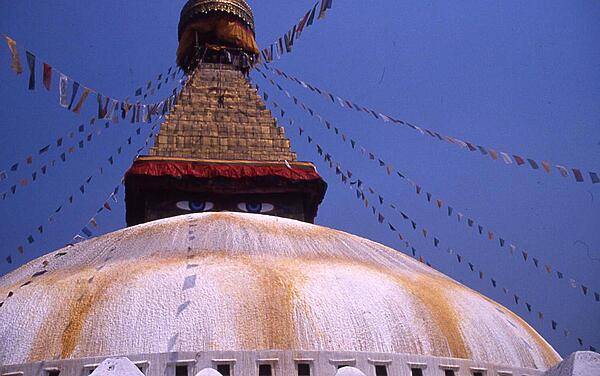
The eyes of Buddha gaze out over the dome of the Swayambhunath Stupa in Kathmandu.
The eyes of Buddha gaze out over the dome of the Swayambhunath Stupa in Kathmandu. • CIA World Factbook • 2020
8 photos available
View All Photos→Data sources: World Bank, UN Data • Updated daily •Learn about our data