›››
Oman
Oman
Population
5.3M
Rank #124Source: World Bank
Capital
Muscat
Source: REST Countries
Region
Africa
Middle East, North Africa, Afghanistan & Pakistan
Source: REST Countries
GDP (Nominal)
$107.14B
Rank #70Source: World Bank
Land Area
309.5K km²
Rank #72Source: REST Countries
Life Expectancy
80.031 yrs
Source: World Bank
Historical Trends
Population Trend (5-Year)
Source: World Bank
GDP Trend (5-Year, Nominal USD)
Source: World Bank
Geography
Area: 309,500 km²
Landlocked: No
Independent: Yes
Climate: dry desert; hot, humid along coast; hot, dry interior; strong southwest summer monsoon (May to September) in far south
Terrain: central desert plain, rugged mountains in north and south
Elevation: mean elevation: 310 m lowest point: Arabian Sea 0 m highest point: Jabal Shams 3,004 m
Natural Hazards: summer winds often raise large sandstorms and dust storms in interior; periodic droughts
Environmental Issues: limited natural freshwater resources; high levels of soil and water salinity in the coastal plains; beach pollution from oil spills; industrial effluents seeping into the water tables and aquifers;...
Land Use: agricultural land: 4.7% (2011 est.) forest: 0% (2011 est.) other: 95.3% (2011 est.)
Geography Note: consists of Oman proper and two northern exclaves, Musandam and Al Madhah; the former is a peninsula that occupies a strategic location adjacent to the Strait of Hormuz, a vital transit point for...
Natural Resources
petroleumcopperasbestossome marblelimestonechromiumgypsumnatural gas
People & Society
Fertility Rate
2.52
Population
5.3M
Religions
Muslim (85.9%)Christian (6.5%)Hindu (5.5%)Buddhist (0.8%)other (1%)unaffiliated 0.2%
note: Omani citizens represent approximately 56.4% of the population and are overwhelming Muslim (Ibadhi and Sunni sects each constitute about (45%)and Shia about (5%)and Buddhists account for roughly (5%)
Economy
GDP per Capita
$20,285.227
GDP per Capita PPP
41,740.166
(2024)
(2024)
GNI per Capita
19,520
(2024)
(2024)
Gini Index
Not Available
Unemployment
3.203%
(2024)
(2024)
Inflation
0.594%
(2024)
(2024)
Public Debt
Not Available
Energy
Electricity Access
100%
(2023)
(2023)
Renewable Energy
0.1%
(2021)
(2021)
CO₂ Emissions
98.511 Mt
(2024)
(2024)
Energy Intensity
7.21 MJ/$
(2021)
(2021)
Renewable Electricity
1.945%
(2021)
(2021)
Environment
Forest Coverage
0.008% of land
(2023)
(2023)
Protected Areas
2.5% of land
(2009)
(2009)
Communications
Internet Users
95.252%
(2024)
(2024)
Mobile Penetration
135.218%
(2023)
(2023)
Broadband Subscribers
10.879%
(2023)
(2023)
Transportation
Air Transport Freight
542.341 M ton-km
(2023)
(2023)
Container Port Traffic
5,228,456 TEU
(2022)
(2022)
Airports
63,371
Rail Lines
N/A
Roads Total
77,749 km(©IRF)
Military
Military Forces
Sultan's Armed Forces (SAF): Royal Army of Oman (RAO), Royal Navy of Oman (RNO), Royal Air Force of Oman (RAFO), Royal Guard of Oman (RGO); Royal Oman Police Coast Guard; Tribal Home Guard
Personnel Strength
the Sultan's Armed Forces (SAF) have approximately 40,000 total active troops (25,000 Army, 4,200 Navy; 4,500 Air Force; 6,400 Royal Guard); 400 Coast Guard; 4,000 Tribal Home Guard
Military Expenditure (USD)
$5.99B
Military Expenditure (% of GDP)
5.59%
Military Expenditure History
8.8% of GDP (2019) 8.2% of GDP (2018) 9.6% of GDP (2017) 12% of GDP (2016) 10.9% of GDP (2015)
Equipment & Inventories
the SAF's inventory includes mostly a mix of older and some more modern British and US weapons systems, with smaller quantities of equipment from South Africa and a variety of European countries;...
Service Age & Obligation
18-30 years of age for voluntary military service; no conscription
Education
Pre-Primary Enrollment
27.397%
(2021)
(2021)
Primary Enrollment
89.246%
(2022)
(2022)
Secondary Enrollment
91.965%
(2022)
(2022)
Tertiary Enrollment
43.843%
(2021)
(2021)
Education Spending
4.301% of GDP
(2022)
(2022)
Adult Literacy Rate
97.34%
(2022)
(2022)
Pupil-Teacher Ratio
9.674:1
(2018)
(2018)
Health
Physicians per 1,000
1.992
(2022)
(2022)
Safe Water Access
92.67%
(2024)
(2024)
Safe Drinking Water
91.101%
(2024)
(2024)
Under-5 Mortality
10.4 per 1,000
(2023)
(2023)
Maternal Mortality (World Bank)
17.252 per 100,000
(2021)
(2021)
Hospital Beds per 1,000
70.895
(2021)
(2021)
UHC Coverage Index
73
(2023)
(2023)
Measles Immunization
99%
(2024)
(2024)
Social Indicators
Extreme Poverty Rate
Not Available
Food Insecurity
5.9%
(2023)
(2023)
Youth NEET Rate
15.47%
(2020)
(2020)
Governance
Women in Government
Not Available
Voice & Accountability
-1.00
(Weak)
(2023)
(Weak)
(2023)
Political Stability
0.59
(Above Average)
(2023)
(Above Average)
(2023)
Government Effectiveness
0.28
(Above Average)
(2023)
(Above Average)
(2023)
Regulatory Quality
0.43
(Above Average)
(2023)
(Above Average)
(2023)
Rule of Law
0.61
(Above Average)
(2023)
(Above Average)
(2023)
Control of Corruption
0.21
(Above Average)
(2023)
(Above Average)
(2023)
Government
Government Type
absolute monarchy
Legal System
mixed legal system of Anglo-Saxon law and Islamic law
Executive Branch
chief of state: Sultan and Prime Minister HAYTHAM bin Tariq bin Taimur Al-Said (since 11 January 2020); note - the monarch is both chief of state and head of government head of government: Sultan and...
Legislative Branch
description: bicameral Council of Oman or Majlis Oman consists of:Council of State or Majlis al-Dawla (85 seats including the chairman; members appointed by the sultan from among former government...
Judicial Branch
highest courts: Supreme Court (consists of 5 judges) judge selection and term of office: judges nominated by the 9-member Supreme Judicial Council (chaired by the monarch) and appointed by the...
National Symbols
Flag Description
three horizontal bands of white (top), red, and green of equal width with a broad, vertical, red band on the hoist side; the national emblem (a khanjar dagger in its sheath superimposed on two...
National Symbols
khanjar dagger superimposed on two crossed swords; national colors: red, white, green
National Anthem
name: "Nashid as-Salaam as-Sultani" (The Sultan's Anthem) lyrics/music: Rashid bin Uzayyiz al KHUSAIDI/James Frederick MILLS, arranged by Bernard EBBINGHAUS note: adopted 1932; new lyrics written...
Safety
Homicide Rate
0.139 per 100,000
(2023)
(2023)
Travel Information
Language(s): Arabic
Currency: OMR (ر.ع.)
Timezone(s): UTC+04:00
Landlocked: No
Independent: Yes
Driving Side: Right
Calling Code: +968
Car Sign: OM
Week Starts: Sunday
Photos
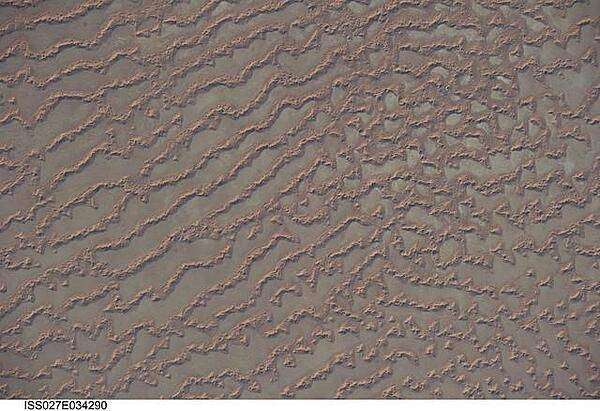
The Ar Rub al Khali (Great Sandy Desert) lies in the southern Arabian Peninsula. Also known as the "Empty Quarter," it is a large region of sand dunes and interdune flats known as a sand sea (or erg). This photo, taken from the International Space Station, highlights a part of the Ar Rub al Khali located close to its southeastern margin in the Sultanate of Oman. Reddish-brown, large, linear sand dunes alternate with blue-gray interdune salt flats known as sabkhas at left. The major trend of the linear dunes is transverse to northwesterly trade winds that originate in Iraq (known as the Shamal winds). Formation of secondary barchan (crescent-shaped) and star dunes (dune crests in several directions originating from a single point, looking somewhat like a starfish from above) on the linear dunes is supported by southwesterly winds that occur during the monsoon season (Khareef winds). The long linear dunes begin to break up into isolated large star dunes to the northeast and east (right). This is likely a result of both wind pattern interactions and changes in the sand supply to the dunes. The Empty Quarter covers much of the south-central portion of the Arabian Peninsula, and with an area of approximately 660,000 sq km (255,000 sq mi) it is the largest continuous sand desert on Earth. The Empty Quarter's hyperarid climate and the difficulty of travel through the dunes has not encouraged permanent settlement within the region. There is geological and archeological evidence, however, to support cooler and wetter past climates in the region together with human settlement. This evidence includes exposed lakebed sediments, scattered stone tools, and the fossils of hippopotamus, water buffalo, and long-horned cattle. Image courtesy of NASA.
The Ar Rub al Khali (Great Sandy Desert) lies in the southern Arabian Peninsula. Also known as the "Empty Quarter," it is a large region of sand dunes and interdune flats known as a sand sea (or erg). This photo, taken from the International Space Station, highlights a part of the Ar Rub al Khali located close to its southeastern margin in the Sultanate of Oman. Reddish-brown, large, linear sand dunes alternate with blue-gray interdune salt flats known as sabkhas at left. The major trend of the linear dunes is transverse to northwesterly trade winds that originate in Iraq (known as the Shamal winds). Formation of secondary barchan (crescent-shaped) and star dunes (dune crests in several directions originating from a single point, looking somewhat like a starfish from above) on the linear dunes is supported by southwesterly winds that occur during the monsoon season (Khareef winds). The long linear dunes begin to break up into isolated large star dunes to the northeast and east (right). This is likely a result of both wind pattern interactions and changes in the sand supply to the dunes.
The Empty Quarter covers much of the south-central portion of the Arabian Peninsula, and with an area of approximately 660,000 sq km (255,000 sq mi) it is the largest continuous sand desert on Earth. The Empty Quarter's hyperarid climate and the difficulty of travel through the dunes has not encouraged permanent settlement within the region. There is geological and archeological evidence, however, to support cooler and wetter past climates in the region together with human settlement. This evidence includes exposed lakebed sediments, scattered stone tools, and the fossils of hippopotamus, water buffalo, and long-horned cattle. Image courtesy of NASA. • CIA World Factbook • 2020
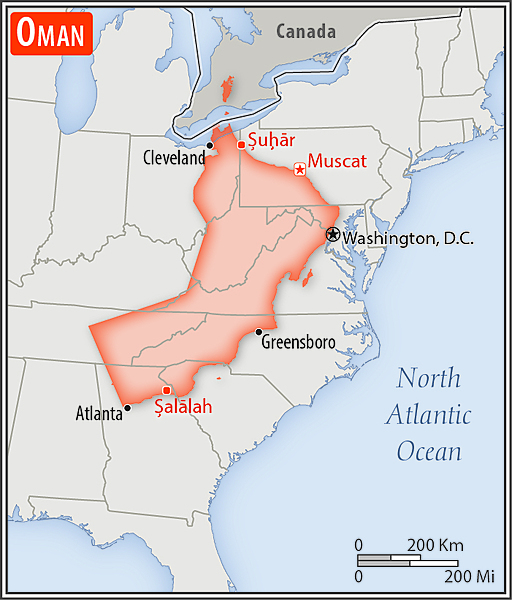
Area comparison map
Area comparison map • CIA World Factbook • 2020
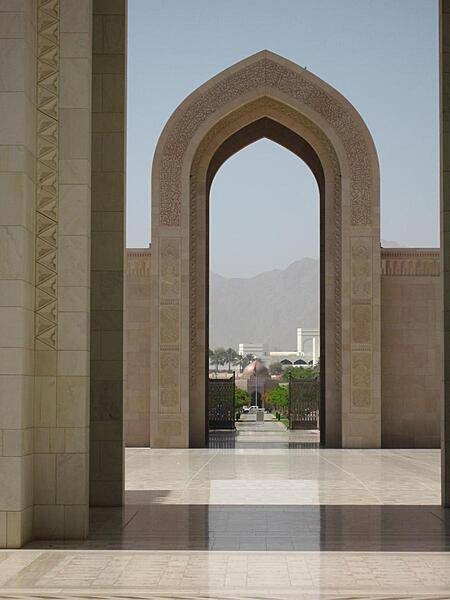
The Grand Mosque in Muscat was commissioned by Sultan Qaboos in 1992. It was inaugurated in 2001 and can accommodate up to 20,000 worshipers.
The Grand Mosque in Muscat was commissioned by Sultan Qaboos in 1992. It was inaugurated in 2001 and can accommodate up to 20,000 worshipers. • CIA World Factbook • 2020
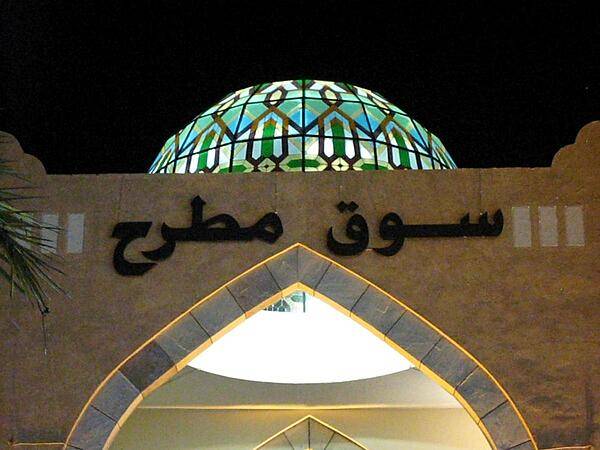
The Souq Muttrah is a traditional bazaar in the largest seaport in the region. Before the discovery of oil, Muttrah was the center of commerce in Oman.
The Souq Muttrah is a traditional bazaar in the largest seaport in the region. Before the discovery of oil, Muttrah was the center of commerce in Oman. • CIA World Factbook • 2020
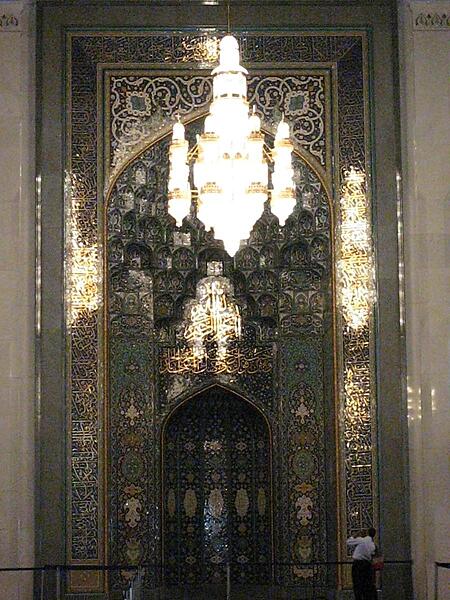
The 70 x 60 m (230 x 197 ft) prayer carpet in the main prayer hall of the Grand Mosque in Muscat is the second largest hand-woven, single-piece carpet in the world and took four years to complete. The primary chandelier, a smaller version of which is shown in this photo, is 14 m (46 ft) tall.
The 70 x 60 m (230 x 197 ft) prayer carpet in the main prayer hall of the Grand Mosque in Muscat is the second largest hand-woven, single-piece carpet in the world and took four years to complete. The primary chandelier, a smaller version of which is shown in this photo, is 14 m (46 ft) tall. • CIA World Factbook • 2020
5 photos available
Data sources: World Bank, UN Data • Updated daily •Learn about our data