›››
Tunisia
Tunisia
Population
12.3M
Rank #79Source: World Bank
Capital
Tunis
Source: REST Countries
Region
Africa
Middle East, North Africa, Afghanistan & Pakistan
Source: REST Countries
GDP (Nominal)
$51.33B
Rank #93Source: World Bank
Land Area
163.6K km²
Rank #92Source: REST Countries
Life Expectancy
76.508 yrs
Source: World Bank
Historical Trends
Population Trend (5-Year)
Source: World Bank
GDP Trend (5-Year, Nominal USD)
Source: World Bank
Geography
Area: 163,610 km²
Landlocked: No
Independent: Yes
Climate: temperate in north with mild, rainy winters and hot, dry summers; desert in south
Terrain: mountains in north; hot, dry central plain; semiarid south merges into the Sahara
Elevation: mean elevation: 246 m lowest point: Shatt al Gharsah -17 m highest point: Jebel ech Chambi 1,544 m
Natural Hazards: flooding; earthquakes; droughts
Environmental Issues: toxic and hazardous waste disposal is ineffective and poses health risks; water pollution from raw sewage; limited natural freshwater resources; deforestation; overgrazing; soil erosion;...
Land Use: agricultural land: 64.8% (2011 est.) forest: 6.6% (2011 est.) other: 28.6% (2011 est.)
Geography Note: strategic location in central Mediterranean; Malta and Tunisia are discussing the commercial exploitation of the continental shelf between their countries, particularly for oil exploration
Natural Resources
petroleumphosphatesiron oreleadzincsalt
People & Society
Fertility Rate
1.83
Population
12.3M
Ethnic Groups
Arab (98%)European (1%)Jewish and other (1%)
Religions
Muslim (official; Sunni) (99.1%)other (includes Christian, Jewish, Shia Muslim, and Baha'i) (1%)
Economy
GDP per Capita
$4,181.138
GDP per Capita PPP
14,521.008
(2024)
(2024)
GNI per Capita
3,880
(2024)
(2024)
Gini Index
33.7
(2021)
(2021)
Unemployment
15.341%
(2024)
(2024)
Inflation
7.207%
(2024)
(2024)
Public Debt
42.52%
(2012)
(2012)
Energy
Electricity Access
100%
(2023)
(2023)
Renewable Energy
11.6%
(2021)
(2021)
CO₂ Emissions
32.18 Mt
(2024)
(2024)
Energy Intensity
3.7 MJ/$
(2022)
(2022)
Renewable Electricity
2.82%
(2021)
(2021)
Environment
Forest Coverage
4.553% of land
(2023)
(2023)
Communications
Internet Users
72.354%
(2023)
(2023)
Mobile Penetration
134.136%
(2023)
(2023)
Broadband Subscribers
14.144%
(2023)
(2023)
Transportation
Air Transport Freight
10.959 M ton-km
(2023)
(2023)
Container Port Traffic
464,823 TEU
(2022)
(2022)
Airports
35,726
Rail Lines
1,777 km
Roads Total
19,963 km(©IRF)
Military
Military Forces
Tunisian Armed Forces (Forces Armees Tunisiens, FAT): Tunisian Army (includes Tunisian Air Defense Force), Tunisian Navy, Republic of Tunisia Air Force; Ministry of Interior: Tunisian National Guard
Personnel Strength
the Tunisian Armed Forces (FAT) have approximately 36,000 active personnel (27,000 Army; 5,000 Navy; 4,000 Air Force); est. 12,000 National Guard
Military Expenditure (USD)
$1.31B
Military Expenditure (% of GDP)
2.51%
Military Expenditure History
2.6% of GDP (2019) 2.1% of GDP (2018) 2.1% of GDP (2017) 2.4% of GDP (2016) 2.3% of GDP (2015)
Equipment & Inventories
the Tunisian military's inventory includes mostly older or secondhand US and European equipment; since 2010, the Netherlands and US are the leading suppliers of arms to Tunisia (2019 est.)
Service Age & Obligation
20-23 years of age for compulsory service, 1-year service obligation; 18-23 years of age for voluntary service
Education
Pre-Primary Enrollment
44.615%
(2016)
(2016)
Primary Enrollment
104.424%
(2023)
(2023)
Secondary Enrollment
90.326%
(2016)
(2016)
Tertiary Enrollment
38.122%
(2023)
(2023)
Education Spending
6.734% of GDP
(2023)
(2023)
Adult Literacy Rate
86.25%
(2023)
(2023)
Pupil-Teacher Ratio
16.872:1
(2018)
(2018)
Health
Physicians per 1,000
1.315
(2021)
(2021)
Safe Water Access
96.733%
(2024)
(2024)
Safe Drinking Water
64.978%
(2024)
(2024)
Under-5 Mortality
12.9 per 1,000
(2023)
(2023)
Maternal Mortality (World Bank)
20.485 per 100,000
(2021)
(2021)
Hospital Beds per 1,000
71.512
(2021)
(2021)
UHC Coverage Index
76
(2023)
(2023)
Measles Immunization
97%
(2024)
(2024)
Social Indicators
Extreme Poverty Rate
0.7%
(2021)
(2021)
Food Insecurity
3%
(2023)
(2023)
Youth NEET Rate
38.513%
(2023)
(2023)
Governance
Women in Government
15.686%
(2024)
(2024)
Voice & Accountability
-0.21
(Below Average)
(2023)
(Below Average)
(2023)
Political Stability
-0.63
(Below Average)
(2023)
(Below Average)
(2023)
Government Effectiveness
-0.30
(Below Average)
(2023)
(Below Average)
(2023)
Regulatory Quality
-0.62
(Below Average)
(2023)
(Below Average)
(2023)
Rule of Law
-0.14
(Below Average)
(2023)
(Below Average)
(2023)
Control of Corruption
-0.34
(Below Average)
(2023)
(Below Average)
(2023)
Government
Government Type
parliamentary republic
Legal System
mixed legal system of civil law, based on the French civil code and Islamic (sharia) law; some judicial review of legislative acts in the Supreme Court in joint session
Executive Branch
chief of state: President Kais SAIED (elected 13 October, sworn in 23 October 2019) head of government: Prime Minister Hichem MECHICHI (since 2 September 2020) cabinet: selected by the prime minister...
Legislative Branch
description: unicameral Assembly of the Representatives of the People or Majlis Nuwwab ash-Sha'b (Assemblee des representants du peuple) (217 seats; 199 members directly elected in Tunisian...
Judicial Branch
highest courts: Court of Cassation (consists of the first president, chamber presidents, and magistrates and organized into 27 civil and 11 criminal chambers) judge selection and term of...
National Symbols
Flag Description
red with a white disk in the center bearing a red crescent nearly encircling a red five-pointed star; resembles the Ottoman flag (red banner with white crescent and star) and recalls Tunisia's...
National Symbols
encircled red crescent moon and five-pointed star; national colors: red, white
National Anthem
name: "Humat Al Hima" (Defenders of the Homeland) lyrics/music: Mustafa Sadik AL-RAFII and Aboul-Qacem ECHEBBI/Mohamad Abdel WAHAB note: adopted 1957, replaced 1958, restored 1987; Mohamad Abdel...
Safety
Homicide Rate
4.693 per 100,000
(2020)
(2020)
Travel Information
Language(s): Arabic
Currency: TND (د.ت)
Timezone(s): UTC+01:00
Landlocked: No
Independent: Yes
Driving Side: Right
Calling Code: +216
Car Sign: TN
Week Starts: Monday
Photos
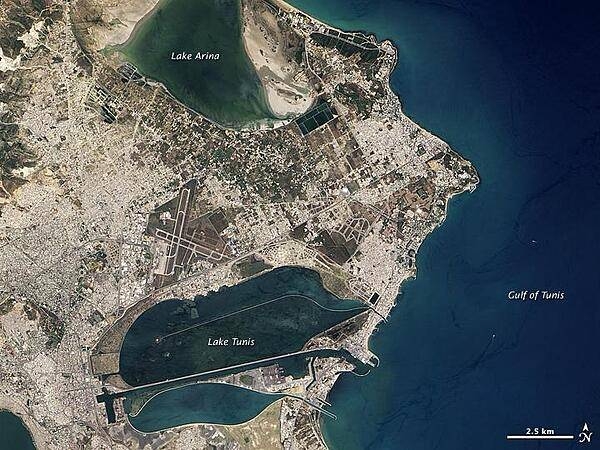
"Carthage is situated at the inmost point of a gulf into which it protrudes on a strip of land, almost entirely surrounded on one side by the sea and on the other by a lake," observed the Greek historian Polybius in the second century BC. He pointed out some of the features that made Carthage attractive for human occupation for centuries. Today, Carthage is a suburb of Tunis, the capital city of northern Africa's Tunisia. Although cityscape covers most of the ancient port city, the area's attractions to ancient mariners remain apparent. In the east, Carthage narrows to a point that stretches into the Gulf of Tunis. From that point, skinny strips of land extend toward the northwest and southwest, both strips enclosing water bodies. North of Carthage is Sebkhet Arina, a shallow evaporative lake. Rocky outcrops connected by sand separate this shallow lake from the Gulf of Tunis. South of Carthage is Lake Tunis, a water body actively modified and maintained by humans over thousands of years. Skilled merchants and mariners, the ancient Phoenicians founded Carthage probably sometime between 817 and 748 BC. Romans destroyed the city in the Punic Wars around 146 BC, but eventually rebuilt in the same area.This image courtesy of NASA.
"Carthage is situated at the inmost point of a gulf into which it protrudes on a strip of land, almost entirely surrounded on one side by the sea and on the other by a lake," observed the Greek historian Polybius in the second century BC. He pointed out some of the features that made Carthage attractive for human occupation for centuries. Today, Carthage is a suburb of Tunis, the capital city of northern Africa's Tunisia. Although cityscape covers most of the ancient port city, the area's attractions to ancient mariners remain apparent.
In the east, Carthage narrows to a point that stretches into the Gulf of Tunis. From that point, skinny strips of land extend toward the northwest and southwest, both strips enclosing water bodies. North of Carthage is Sebkhet Arina, a shallow evaporative lake. Rocky outcrops connected by sand separate this shallow lake from the Gulf of Tunis. South of Carthage is Lake Tunis, a water body actively modified and maintained by humans over thousands of years.
Skilled merchants and mariners, the ancient Phoenicians founded Carthage probably sometime between 817 and 748 BC. Romans destroyed the city in the Punic Wars around 146 BC, but eventually rebuilt in the same area.This image courtesy of NASA. • CIA World Factbook • 2020
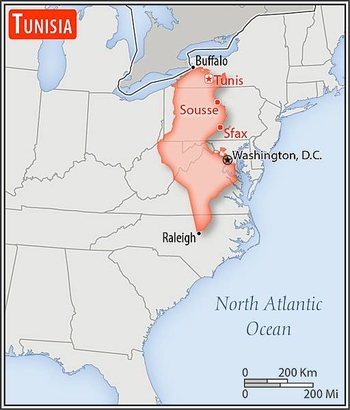
Area comparison map
Area comparison map • CIA World Factbook • 2020
2 photos available
Data sources: World Bank, UN Data • Updated daily •Learn about our data