›››
Uruguay
Uruguay
Population
3.4M
Rank #133Source: World Bank
Capital
Montevideo
Source: REST Countries
Region
Americas
Latin America & Caribbean
Source: REST Countries
GDP (Nominal)
$80.96B
Rank #81Source: World Bank
Land Area
181.0K km²
Rank #90Source: REST Countries
Life Expectancy
78.138 yrs
Source: World Bank
Historical Trends
Population Trend (5-Year)
Source: World Bank
GDP Trend (5-Year, Nominal USD)
Source: World Bank
Geography
Area: 181,034 km²
Landlocked: No
Independent: Yes
Climate: warm temperate; freezing temperatures almost unknown
Terrain: mostly rolling plains and low hills; fertile coastal lowland
Elevation: mean elevation: 109 m lowest point: Atlantic Ocean 0 m highest point: Cerro Catedral 514 m
Natural Hazards: seasonally high winds (the pampero is a chilly and occasional violent wind that blows north from the Argentine pampas), droughts, floods; because of the absence of mountains, which act as weather...
Environmental Issues: water pollution from meat packing/tannery industry; heavy metal pollution; inadequate solid/hazardous waste disposal; deforestation
Land Use: agricultural land: 87.2% (2011 est.) forest: 10.2% (2011 est.) other: 2.6% (2011 est.)
Geography Note: second-smallest South American country (after Suriname); most of the low-lying landscape (three-quarters of the country) is grassland, ideal for cattle and sheep raising
Natural Resources
arable landhydropowerminor mineralsfish
People & Society
Fertility Rate
1.41
Population
3.4M
Ethnic Groups
White (87.7%)Black (4.6%)indigenous (2.4%)other (0.3%)none or unspecified (5%)
Religions
Roman Catholic (47.1%)non-Catholic Christians (11.1%)nondenominational (23.2%)Jewish (0.3%)atheist or agnostic (17.2%)other (1.1%)
Economy
GDP per Capita
$23,906.513
GDP per Capita PPP
36,417.874
(2024)
(2024)
GNI per Capita
21,650
(2024)
(2024)
Gini Index
40
(2024)
(2024)
Unemployment
8.209%
(2024)
(2024)
Inflation
4.849%
(2024)
(2024)
Public Debt
66.405%
(2024)
(2024)
Energy
Electricity Access
100%
(2023)
(2023)
Renewable Energy
57.8%
(2021)
(2021)
CO₂ Emissions
8.695 Mt
(2024)
(2024)
Energy Intensity
2.94 MJ/$
(2021)
(2021)
Renewable Electricity
84.354%
(2021)
(2021)
Environment
Forest Coverage
11.964% of land
(2023)
(2023)
Communications
Internet Users
91.991%
(2024)
(2024)
Mobile Penetration
141.719%
(2023)
(2023)
Broadband Subscribers
32.403%
(2023)
(2023)
Transportation
Air Transport Freight
Not Available
Container Port Traffic
1,080,445 TEU
(2022)
(2022)
Airports
N/A
Rail Lines
1,498 km
Roads Total
8,833 km(©IRF)
Military
Military Forces
Armed Forces of Uruguay (Fuerzas Armadas del Uruguay): National Army (Ejercito Nacional), National Navy (Armada Nacional, includes Maritime National Prefecture (Coast Guard)), Uruguayan Air Force...
Personnel Strength
the Armed Forces of Uruguay have approximately 22,000 active personnel (14,500 Army; 5,000 Navy; 2,500 Air Force); est. 1,400 Guardia Nacional Republicana
Military Expenditure (USD)
$1.74B
Military Expenditure (% of GDP)
2.31%
Military Expenditure History
2% of GDP (2019) 2.1% of GDP (2018) 2% of GDP (2017) 1.9% of GDP (2016) 1.8% of GDP (2015)
Deployments
900 Democratic Republic of the Congo (MINUSCO); 210 Golan Heights (UNDOF) (2020)
Equipment & Inventories
the Armed Forces of Uruguay inventory includes a wide variety of older or second-hand equipment imported from a range of suppliers, including Brazil, Chile, Ecuador, France, Germany, Italy, Portugal,...
Service Age & Obligation
18-30 years of age (18-22 years of age for Navy) for male or female voluntary military service; up to 40 years of age for specialists; enlistment is voluntary in peacetime, but the government has the...
Education
Pre-Primary Enrollment
97.144%
(2020)
(2020)
Primary Enrollment
104.532%
(2023)
(2023)
Secondary Enrollment
119.105%
(2023)
(2023)
Tertiary Enrollment
79.954%
(2023)
(2023)
Education Spending
4.811% of GDP
(2023)
(2023)
Adult Literacy Rate
98.91%
(2024)
(2024)
Pupil-Teacher Ratio
11.019:1
(2017)
(2017)
Health
Physicians per 1,000
4.674
(2022)
(2022)
Safe Water Access
99.633%
(2024)
(2024)
Safe Drinking Water
Not Available
Under-5 Mortality
6.7 per 1,000
(2023)
(2023)
Maternal Mortality (World Bank)
17.44 per 100,000
(2021)
(2021)
Hospital Beds per 1,000
71.247
(2021)
(2021)
UHC Coverage Index
85
(2023)
(2023)
Measles Immunization
94%
(2024)
(2024)
Social Indicators
Extreme Poverty Rate
0.2%
(2024)
(2024)
Food Insecurity
2.5%
(2023)
(2023)
Youth NEET Rate
26.522%
(2024)
(2024)
Governance
Women in Government
28.283%
(2024)
(2024)
Voice & Accountability
1.28
(Strong)
(2023)
(Strong)
(2023)
Political Stability
0.96
(Above Average)
(2023)
(Above Average)
(2023)
Government Effectiveness
0.85
(Above Average)
(2023)
(Above Average)
(2023)
Regulatory Quality
0.68
(Above Average)
(2023)
(Above Average)
(2023)
Rule of Law
0.72
(Above Average)
(2023)
(Above Average)
(2023)
Control of Corruption
1.57
(Strong)
(2023)
(Strong)
(2023)
Government
Government Type
presidential republic
Legal System
civil law system based on the Spanish civil code
Executive Branch
chief of state: President Luis Alberto LACALLE POU (since 1 March 2020); Vice President Beatriz ARGIMON Cedeira (since 1 March 2020); the president is both chief of state and head of government head...
Legislative Branch
description: bicameral General Assembly or Asamblea General consists of:Chamber of Senators or Camara de Senadores (31 seats; members directly elected in a single nationwide constituency by...
Judicial Branch
highest courts: Supreme Court of Justice (consists of 5 judges) judge selection and term of office: judges nominated by the president and appointed in joint conference of the General Assembly; judges...
National Symbols
Flag Description
nine equal horizontal stripes of white (top and bottom) alternating with blue; a white square in the upper hoist-side corner with a yellow sun bearing a human face (delineated in black) known as the...
National Symbols
Sun of May (a sun-with-face symbol); national colors: blue, white, yellow
National Anthem
name: "Himno Nacional" (National Anthem of Uruguay) lyrics/music: Francisco Esteban ACUNA de Figueroa/Francisco Jose DEBALI note: adopted 1848; the anthem is also known as "Orientales, la Patria o la...
Safety
Homicide Rate
11.245 per 100,000
(2023)
(2023)
Travel Information
Language(s): Spanish
Currency: UYU ($)
Timezone(s): UTC-03:00
Landlocked: No
Independent: Yes
Driving Side: Right
Calling Code: +598
Car Sign: ROU
Week Starts: Monday
Photos
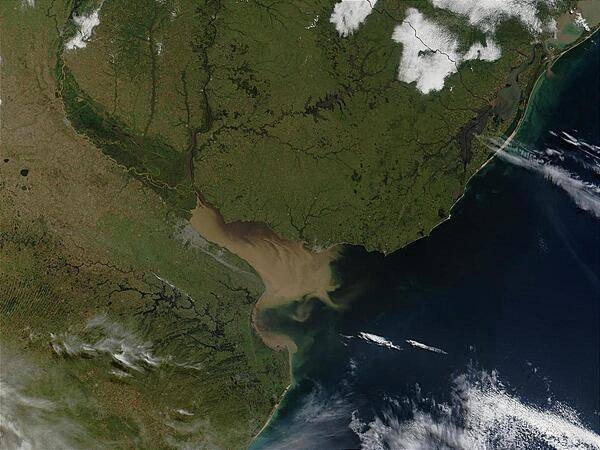
The Rio de la Plata is the brown, rather short, sediment-filled river in the center of the image. It is the widest river in the world, ranging from around 40 km (25 mi) in width near Buenos Aires, to approximately 220 km (140 mi) near its mouth. As its water mixes with clearer ocean water, it creates swirls and cloudy formations. Visible in this image (in gray) is Buenos Aires, the capital city of Argentina, located inland near the head of the river. Montevideo, Uruguay's capital, is located downstream on the opposite side of the Rio de la Plata (and also appears gray). Photo: NASA.
The Rio de la Plata is the brown, rather short, sediment-filled river in the center of the image. It is the widest river in the world, ranging from around 40 km (25 mi) in width near Buenos Aires, to approximately 220 km (140 mi) near its mouth. As its water mixes with clearer ocean water, it creates swirls and cloudy formations. Visible in this image (in gray) is Buenos Aires, the capital city of Argentina, located inland near the head of the river. Montevideo, Uruguay's capital, is located downstream on the opposite side of the Rio de la Plata (and also appears gray). Photo: NASA. • CIA World Factbook • 2020
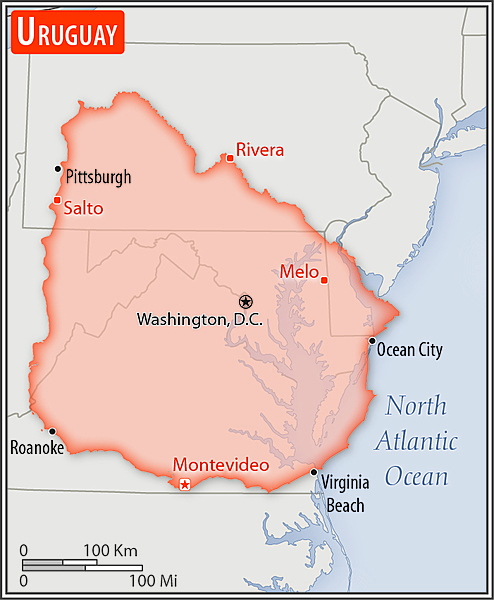
Area comparison map
Area comparison map • CIA World Factbook • 2020
2 photos available
Data sources: World Bank, UN Data • Updated daily •Learn about our data