›››
Venezuela, RB
Venezuela, RB
Population
28.4M
Rank #53Source: World Bank
Capital
Caracas
Source: REST Countries
Region
Americas
Latin America & Caribbean
Source: REST Countries
GDP (Nominal)
$119.80B
Rank #66Source: World Bank
Land Area
916.4K km²
Rank #33Source: REST Countries
Life Expectancy
72.514 yrs
Source: World Bank
Historical Trends
Population Trend (5-Year)
Source: World Bank
GDP Trend (5-Year, Nominal USD)
Source: World Bank
Geography
Area: 916,445 km²
Landlocked: No
Independent: Yes
Climate: tropical; hot, humid; more moderate in highlands
Terrain: Andes Mountains and Maracaibo Lowlands in northwest; central plains (llanos); Guiana Highlands in southeast
Elevation: mean elevation: 450 m lowest point: Caribbean Sea 0 m highest point: Pico Bolivar 4,978 m
Natural Hazards: subject to floods, rockslides, mudslides; periodic droughts
Environmental Issues: sewage pollution of Lago de Valencia; oil and urban pollution of Lago de Maracaibo; deforestation; soil degradation; urban and industrial pollution, especially along the Caribbean coast; threat to...
Land Use: agricultural land: 24.5% (2011 est.) forest: 52.1% (2011 est.) other: 23.4% (2011 est.)
Geography Note: note 1: the country lies on major sea and air routes linking North and South America note 2: Venezuela has some of the most unique geology in the world; tepuis are massive table-top mountains of the...
Natural Resources
petroleumnatural gasiron oregoldbauxiteother mineralshydropowerdiamonds
People & Society
Fertility Rate
2.08
Population
28.4M
Religions
nominally Roman Catholic (96%)Protestant (2%)other (2%)
Economy
GDP per Capita
$4,217.591
GDP per Capita PPP
21,241.435
(2011)
(2011)
GNI per Capita
3,820
(2024)
(2024)
Gini Index
Not Available
Unemployment
5.321%
(2024)
(2024)
Inflation
62.169%
(2014)
(2014)
Public Debt
Not Available
Energy
Electricity Access
100%
(2023)
(2023)
Renewable Energy
33.7%
(2021)
(2021)
CO₂ Emissions
96.411 Mt
(2024)
(2024)
Energy Intensity
8.32 MJ/$
(2021)
(2021)
Renewable Electricity
75.447%
(2021)
(2021)
Environment
Forest Coverage
52.234% of land
(2023)
(2023)
Communications
Internet Users
61.6%
(2017)
(2017)
Mobile Penetration
70.22%
(2023)
(2023)
Broadband Subscribers
10.638%
(2023)
(2023)
Transportation
Air Transport Freight
0.123 M ton-km
(2023)
(2023)
Container Port Traffic
179,529 TEU
(2019)
(2019)
Airports
23,302
Rail Lines
N/A
Roads Total
N/A
Military
Military Forces
Bolivarian National Armed Forces (Fuerza Armada Nacional Bolivariana, FANB): Bolivarian Army (Ejercito Bolivariano, EB), Bolivarian Navy (Armada Bolivariana, AB; includes Marines, Coast Guard),...
Personnel Strength
the Bolivarian National Armed Forces (FANB) have approximately 125,000 active personnel (62,000 Army; 25,000 Navy; 11,000 Air Force; 27,000 National Guard)
Military Expenditure (USD)
$0.00B
Military Expenditure (% of GDP)
0.50%
Military Expenditure History
0.5% of GDP (2017) 0.5% of GDP (2016) 1% of GDP (2015) 1.2% of GDP (2014) 1.7% of GDP (2013)
Equipment & Inventories
the FANB inventory is mainly of Chinese and Russian origin with a smaller mix of equipment from Western countries such as France, Germany, Italy, the Netherlands, Spain, the UK, and the US; since...
Service Age & Obligation
all citizens of military service age (18-60 years old) are obligated to register for military service and subject to military training, though mandatory recruitment is forbidden; the minimum service...
Education
Pre-Primary Enrollment
69.515%
(2017)
(2017)
Primary Enrollment
113.694%
(2024)
(2024)
Secondary Enrollment
97.791%
(2024)
(2024)
Tertiary Enrollment
Not Available
Education Spending
0.003% of GDP
(2023)
(2023)
Adult Literacy Rate
97.187%
(2017)
(2017)
Pupil-Teacher Ratio
Not Available
Health
Physicians per 1,000
1.664
(2017)
(2017)
Safe Water Access
93.332%
(2024)
(2024)
Safe Drinking Water
Not Available
Under-5 Mortality
24.3 per 1,000
(2023)
(2023)
Maternal Mortality (World Bank)
17.436 per 100,000
(2021)
(2021)
Hospital Beds per 1,000
75.95
(2021)
(2021)
UHC Coverage Index
75
(2023)
(2023)
Measles Immunization
62%
(2024)
(2024)
Social Indicators
Extreme Poverty Rate
Not Available
Food Insecurity
5.9%
(2023)
(2023)
Youth NEET Rate
13.65%
(2020)
(2020)
Governance
Women in Government
Not Available
Voice & Accountability
-1.53
(Weak)
(2023)
(Weak)
(2023)
Political Stability
-1.19
(Weak)
(2023)
(Weak)
(2023)
Government Effectiveness
-1.60
(Weak)
(2023)
(Weak)
(2023)
Regulatory Quality
-2.03
(Weak)
(2023)
(Weak)
(2023)
Rule of Law
-2.15
(Weak)
(2023)
(Weak)
(2023)
Control of Corruption
-1.69
(Weak)
(2023)
(Weak)
(2023)
Government
Government Type
federal presidential republic
Legal System
civil law system based on the Spanish civil code
Executive Branch
chief of state: Notification Statement: the United States recognizes Juan GUAIDO as the Interim President of VenezuelaPresident Nicolas MADURO Moros (since 19 April 2013); Executive Vice President...
Legislative Branch
description: unicameral National Assembly or Asamblea Nacional (167 seats; 113 members directly elected in single- and multi-seat constituencies by simple majority vote, 51 directly elected in...
Judicial Branch
highest courts: Supreme Tribunal of Justice (consists of 32 judges organized into constitutional, political-administrative, electoral, civil appeals, criminal appeals, and social divisions) judge...
National Symbols
Flag Description
three equal horizontal bands of yellow (top), blue, and red with the coat of arms on the hoist side of the yellow band and an arc of eight white five-pointed stars centered in the blue band; the flag...
National Symbols
troupial (bird); national colors: yellow, blue, red
National Anthem
name: "Gloria al bravo pueblo" (Glory to the Brave People) lyrics/music: Vicente SALIAS/Juan Jose LANDAETA note: adopted 1881; lyrics written in 1810, the music some years later; both SALIAS and...
Safety
Homicide Rate
12.647 per 100,000
(2022)
(2022)
Travel Information
Language(s): Spanish
Currency: VES (Bs.S.)
Timezone(s): UTC-04:00
Landlocked: No
Independent: Yes
Driving Side: Right
Calling Code: +58
Car Sign: YV
Week Starts: Monday
Photos
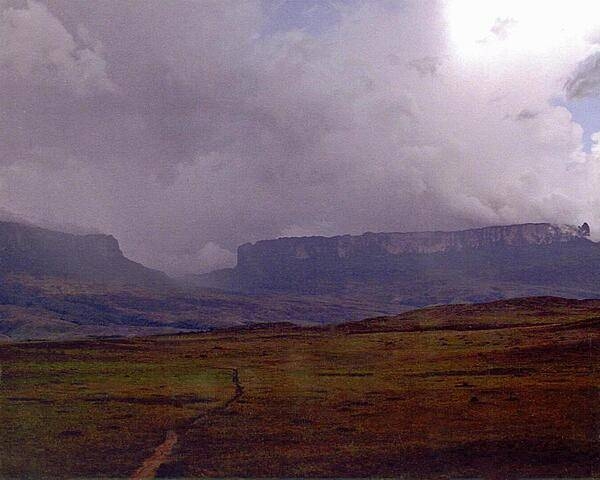
Mount Roraima on the right is the world's highest tepui (tabletop mountain), its peak is 2,835 meters; on the left is Kukeras Tepui.
Mount Roraima on the right is the world's highest tepui (tabletop mountain), its peak is 2,835 meters; on the left is Kukeras Tepui. • CIA World Factbook • 2020
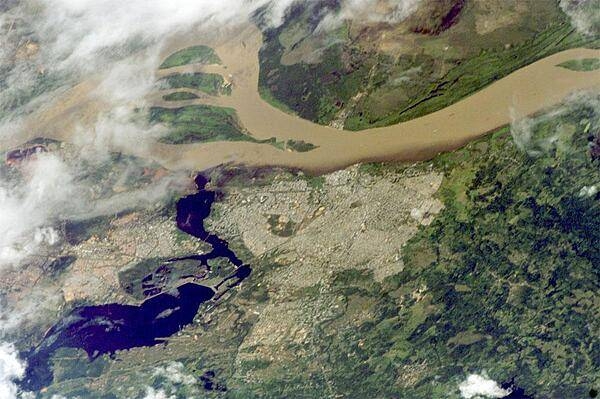
Ciudad Guayana lies on the south bank of the Orinoco River, the second largest in South America, at its confluence with the Caroní River (lower left). Islands have developed in the Orinoco in a wide spot opposite the city (upper left). Guayana is one of the newest cities in Venezuela, constructed in 1961 as a new economic center for the interior of Venezuela, especially for major industries such as iron, steel, and aluminum. The city stretches 40 km (24 mi) along the south bank of the Orinoco and is one of Venezuela's largest. A low barrage (lower left) dams the Caroní as a water supply for the city. The Orinoco River is muddy brown, carrying sediment produced by erosion of the Andes Mountains far to the southwest. By contrast, the Caroní is clear blue, as it drains the ancient landscapes of the Guyana Highlands, where erosion is much slower. A mixing zone can be seen in the middle of this image. The clear Caroní water produces a less muddy zone for tens of kilometers downstream of the confluence (this part of the Orinoco flows almost due east, left to right). Image courtesy of NASA.
Ciudad Guayana lies on the south bank of the Orinoco River, the second largest in South America, at its confluence with the Caroní River (lower left). Islands have developed in the Orinoco in a wide spot opposite the city (upper left). Guayana is one of the newest cities in Venezuela, constructed in 1961 as a new economic center for the interior of Venezuela, especially for major industries such as iron, steel, and aluminum. The city stretches 40 km (24 mi) along the south bank of the Orinoco and is one of Venezuela's largest. A low barrage (lower left) dams the Caroní as a water supply for the city. The Orinoco River is muddy brown, carrying sediment produced by erosion of the Andes Mountains far to the southwest. By contrast, the Caroní is clear blue, as it drains the ancient landscapes of the Guyana Highlands, where erosion is much slower. A mixing zone can be seen in the middle of this image. The clear Caroní water produces a less muddy zone for tens of kilometers downstream of the confluence (this part of the Orinoco flows almost due east, left to right). Image courtesy of NASA. • CIA World Factbook • 2020
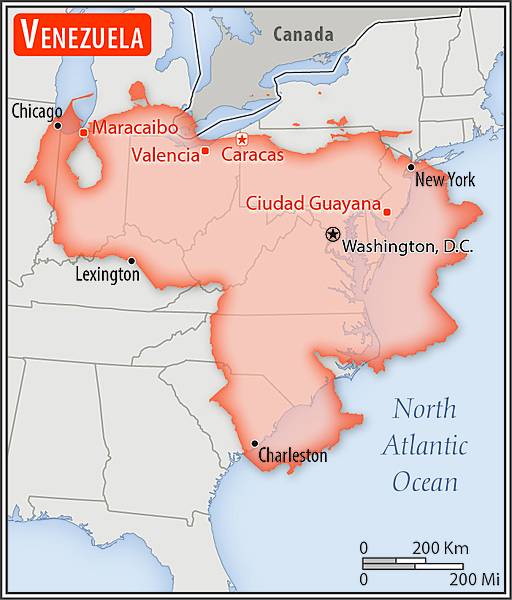
Area comparison map
Area comparison map • CIA World Factbook • 2020
3 photos available
Data sources: World Bank, UN Data • Updated daily •Learn about our data