›››
Albania
Albania
Population
2.4M
Rank #145Source: World Bank
Capital
Tirane
Source: REST Countries
Region
Europe
Europe & Central Asia
Source: REST Countries
GDP (Nominal)
$27.05B
Rank #112Source: World Bank
Land Area
28.7K km²
Rank #141Source: REST Countries
Life Expectancy
79.602 yrs
Source: World Bank
Historical Trends
Population Trend (5-Year)
Source: World Bank
GDP Trend (5-Year, Nominal USD)
Source: World Bank
Geography
Area: 28,748 km²
Landlocked: No
Independent: Yes
Climate: mild temperate; cool, cloudy, wet winters; hot, clear, dry summers; interior is cooler and wetter
Terrain: mostly mountains and hills; small plains along coast
Elevation: mean elevation: 708 m lowest point: Adriatic Sea 0 m highest point: Maja e Korabit (Golem Korab) 2,764 m
Natural Hazards: destructive earthquakes; tsunamis occur along southwestern coast; floods; drought
Environmental Issues: deforestation; soil erosion; water pollution from industrial and domestic effluents; air pollution from industrial and power plants; loss of biodiversity due to lack of resources for sound...
Land Use: agricultural land: 43.1% (2016 est.) forest: 28.12% (2016 est.) other: 28.75% (2016 est.)
Geography Note: strategic location along Strait of Otranto (links Adriatic Sea to Ionian Sea and Mediterranean Sea)
Natural Resources
petroleumnatural gascoalbauxitechromitecopperiron orenickelsalttimber
People & Society
Fertility Rate
1.35
Population
2.4M
Ethnic Groups
Albanian (82.6%)Greek (0.9%)other (1%)unspecified (15.5%)
Religions
Muslim (56.7%)Roman Catholic (10%)Orthodox (6.8%)atheist (2.5%)Bektashi (a Sufi order) (2.1%)other (5.7%)unspecified (16.2%)
Economy
GDP per Capita
$11,377.776
GDP per Capita PPP
27,146.381
(2024)
(2024)
GNI per Capita
9,910
(2024)
(2024)
Gini Index
29.4
(2020)
(2020)
Unemployment
10.689%
(2024)
(2024)
Inflation
2.216%
(2024)
(2024)
Public Debt
81.92%
(2021)
(2021)
Energy
Electricity Access
100%
(2023)
(2023)
Renewable Energy
41.9%
(2021)
(2021)
CO₂ Emissions
4.244 Mt
(2024)
(2024)
Energy Intensity
2.06 MJ/$
(2022)
(2022)
Renewable Electricity
98.611%
(2011)
(2011)
Environment
Forest Coverage
28.792% of land
(2023)
(2023)
Communications
Internet Users
83.136%
(2023)
(2023)
Mobile Penetration
92.997%
(2023)
(2023)
Broadband Subscribers
22.505%
(2023)
(2023)
Transportation
Air Transport Freight
Not Available
Container Port Traffic
145,762 TEU
(2019)
(2019)
Airports
3,074
Rail Lines
N/A
Roads Total
3,606.05 km(©IRF)
Military
Military Forces
Land Forces Command, Navy Force Command (includes Coast Guard), Air Forces Command, Support Command, Training and Doctrination Command
Personnel Strength
the Albanian military has approximately 10,000 total active duty personnel (8,000 Army; 1,500 Navy; 500 Air Force; note - as many as 4,000 personnel are assigned to support forces)
Military Expenditure (USD)
$0.54B
Military Expenditure (% of GDP)
2.04%
Military Expenditure History
1.3% of GDP (2019 est.) 1.2% of GDP (2018) 1.1% of GDP (2017) 1.1% of GDP (2016) 1.2% of GDP (2015)
Deployments
100 Afghanistan (NATO) (June 2020)
Equipment & Inventories
the Albanian military was previously equipped with mostly Soviet-era weapons that were sold or destroyed; its inventory now includes a mix of mostly donated and second-hand European and US equipment;...
Service Age & Obligation
19 is the legal minimum age for voluntary military service; 18 is the legal minimum age in case of general/partial compulsory mobilization
Education
Pre-Primary Enrollment
69.234%
(2021)
(2021)
Primary Enrollment
111.512%
(2024)
(2024)
Secondary Enrollment
108.355%
(2024)
(2024)
Tertiary Enrollment
81.999%
(2024)
(2024)
Education Spending
3.092% of GDP
(2023)
(2023)
Adult Literacy Rate
97.68%
(2023)
(2023)
Pupil-Teacher Ratio
17.573:1
(2018)
(2018)
Health
Physicians per 1,000
1.879
(2020)
(2020)
Safe Water Access
95.119%
(2024)
(2024)
Safe Drinking Water
70.794%
(2024)
(2024)
Under-5 Mortality
9.4 per 1,000
(2023)
(2023)
Maternal Mortality (World Bank)
21.353 per 100,000
(2021)
(2021)
Hospital Beds per 1,000
76.391
(2021)
(2021)
UHC Coverage Index
71
(2023)
(2023)
Measles Immunization
97%
(2024)
(2024)
Social Indicators
Extreme Poverty Rate
0.3%
(2020)
(2020)
Food Insecurity
5.4%
(2023)
(2023)
Youth NEET Rate
25.419%
(2023)
(2023)
Governance
Women in Government
35.714%
(2024)
(2024)
Voice & Accountability
0.17
(Above Average)
(2023)
(Above Average)
(2023)
Political Stability
0.18
(Above Average)
(2023)
(Above Average)
(2023)
Government Effectiveness
0.25
(Above Average)
(2023)
(Above Average)
(2023)
Regulatory Quality
0.17
(Above Average)
(2023)
(Above Average)
(2023)
Rule of Law
-0.16
(Below Average)
(2023)
(Below Average)
(2023)
Control of Corruption
-0.33
(Below Average)
(2023)
(Below Average)
(2023)
Government
Government Type
parliamentary republic
Legal System
civil law system except in the northern rural areas where customary law known as the "Code of Leke" is still present
Executive Branch
chief of state: President of the Republic Ilir META (since 24 July 2017) head of government: Prime Minister Edi RAMA (since 10 September 2013); Deputy Prime Minister Senida MESI (since 13 September...
Legislative Branch
description: unicameral Assembly or Kuvendi (140 seats; members directly elected in multi-seat constituencies by proportional representation vote to serve 4-year terms) elections: last held on 25...
Judicial Branch
highest courts: Supreme Court (consists of 19 judges, including the chief justice); Constitutional Court (consists of 9 judges, including the chairman) judge selection and term of office: Supreme...
National Symbols
Flag Description
red with a black two-headed eagle in the center; the design is claimed to be that of 15th-century hero Georgi Kastrioti SKANDERBEG, who led a successful uprising against the Ottoman Turks that...
National Symbols
black double-headed eagle; national colors: red, black
National Anthem
name: "Hymni i Flamurit" (Hymn to the Flag) lyrics/music: Aleksander Stavre DRENOVA/Ciprian PORUMBESCU note: adopted 1912
Safety
Homicide Rate
1.387 per 100,000
(2023)
(2023)
Travel Information
Language(s): Albanian
Currency: ALL (L)
Timezone(s): UTC+01:00
Landlocked: No
Independent: Yes
Driving Side: Right
Calling Code: +355
Car Sign: AL
Week Starts: Monday
Photos
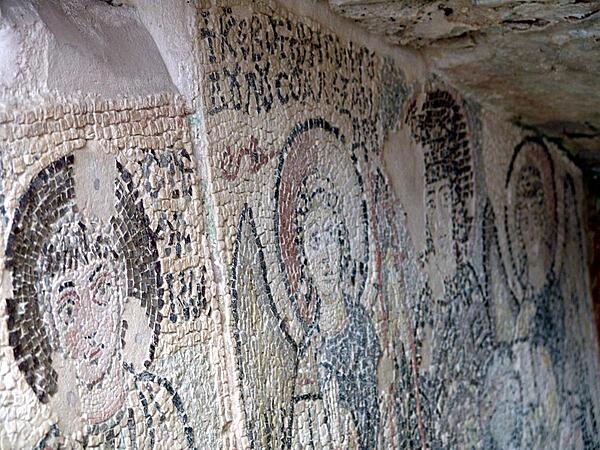
Mosaics in the Durres Amphitheater. Constructed in the 2nd century A.D., the structure could seat 20,000 people. First discovered in the late 1900's, the amphitheater is only half unearthed.
Mosaics in the Durres Amphitheater. Constructed in the 2nd century A.D., the structure could seat 20,000 people. First discovered in the late 1900's, the amphitheater is only half unearthed. • CIA World Factbook • 2020
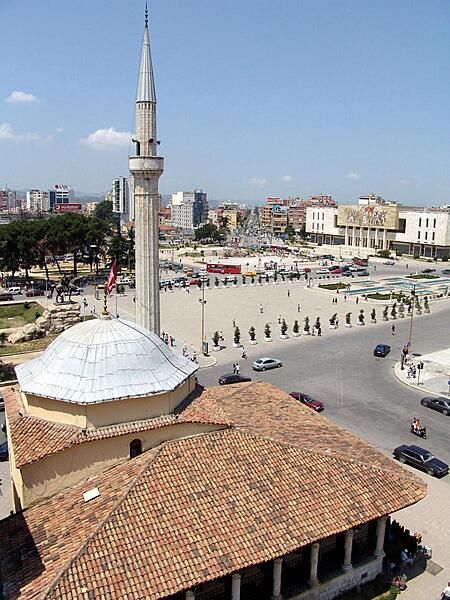
Skanderbeg Square in the center of Tirana as viewed from the city's clock tower.
Skanderbeg Square in the center of Tirana as viewed from the city's clock tower. • CIA World Factbook • 2020
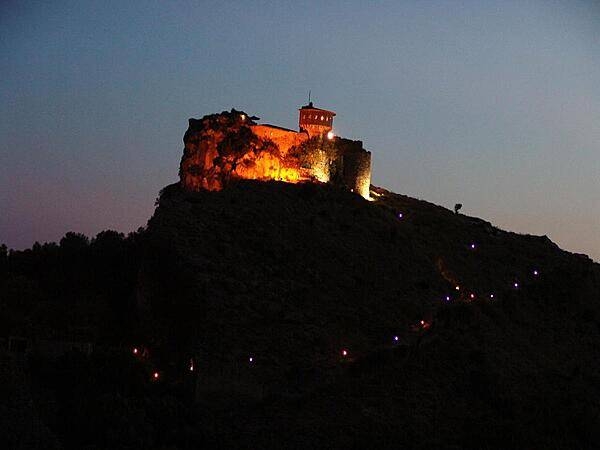
Petrela Castle (outside Tirana) was the home of Skanderbeg's sister and part of his defense network against the Ottomans. The central tower dates from 500 A.D. and the surrounding Byzantine fortifications date from the 11th to the 14th centuries.
Petrela Castle (outside Tirana) was the home of Skanderbeg's sister and part of his defense network against the Ottomans. The central tower dates from 500 A.D. and the surrounding Byzantine fortifications date from the 11th to the 14th centuries. • CIA World Factbook • 2020
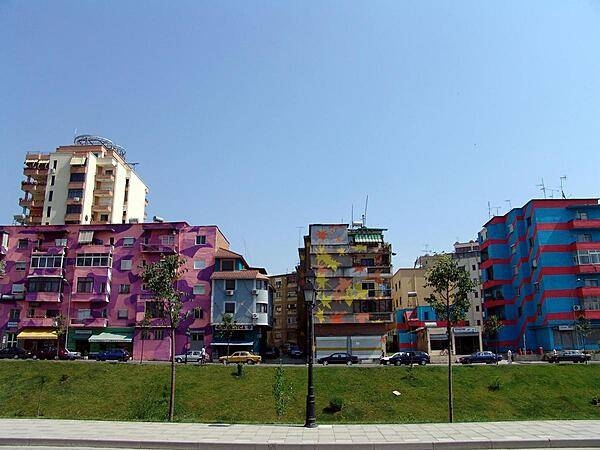
Under Communism, everything was grey and dreary. Today, Tirana's buildings are splashed with color; these are apartment buildings.
Under Communism, everything was grey and dreary. Today, Tirana's buildings are splashed with color; these are apartment buildings. • CIA World Factbook • 2020
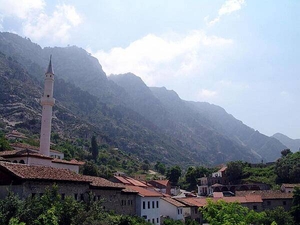
The town of Kruje is renowned as the hometown of Skanderbeg, Albania's national hero. The 15th-century military leader is remembered for his prolonged but successful struggle against the Ottoman Empire.
The town of Kruje is renowned as the hometown of Skanderbeg, Albania's national hero. The 15th-century military leader is remembered for his prolonged but successful struggle against the Ottoman Empire. • CIA World Factbook • 2020
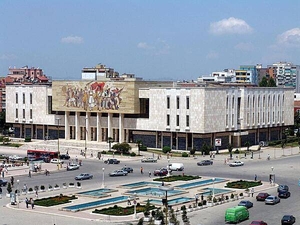
"The Albanians," a colorful mosaic on the facade of the National Historical Museum in Tirana, depicts the evolution of Albanian history from ancient Illyrians to 20th-century partisans.
"The Albanians," a colorful mosaic on the facade of the National Historical Museum in Tirana, depicts the evolution of Albanian history from ancient Illyrians to 20th-century partisans. • CIA World Factbook • 2020
12 photos available
View All Photos→Data sources: World Bank, UN Data • Updated daily •Learn about our data