›››
China
China
Population
1.4B
Rank #2Source: World Bank
Capital
Beijing
Source: REST Countries
Region
Asia
East Asia & Pacific
Source: REST Countries
GDP (Nominal)
$18.74T
Rank #2Source: World Bank
Land Area
9.7M km²
Rank #3Source: REST Countries
Life Expectancy
77.953 yrs
Source: World Bank
Historical Trends
Population Trend (5-Year)
Source: World Bank
GDP Trend (5-Year, Nominal USD)
Source: World Bank
Geography
Area: 9,706,961 km²
Landlocked: No
Independent: Yes
Climate: extremely diverse; tropical in south to subarctic in north
Terrain: mostly mountains, high plateaus, deserts in west; plains, deltas, and hills in east
Elevation: mean elevation: 1,840 m lowest point: Turpan Pendi -154 m highest point: Mount Everest (highest peak in Asia and highest point on earth above sea level) 8,849 m
Natural Hazards: frequent typhoons (about five per year along southern and eastern coasts); damaging floods; tsunamis; earthquakes; droughts; land subsidencevolcanism: China contains some historically active...
Environmental Issues: air pollution (greenhouse gases, sulfur dioxide particulates) from reliance on coal produces acid rain; China is the world's largest single emitter of carbon dioxide from the burning of fossil fuels;...
Land Use: agricultural land: 54.7% (2011 est.) forest: 22.3% (2011 est.) other: 23% (2011 est.)
Geography Note: note 1: world's fourth largest country (after Russia, Canada, and US) and largest country situated entirely in Asia; Mount Everest on the border with Nepal is the world's tallest peak above sea...
Natural Resources
coaliron oreheliumpetroleumnatural gasarsenicbismuthcobaltcadmiumferrosilicon
People & Society
Fertility Rate
1.00
Population
1.4B
Ethnic Groups
Han Chinese (91.6%)Zhuang (1.3%)other (includes Hui, Manchu, Uighur, Miao, Yi, Tujia, Tibetan, Mongol, Dong, Buyei, Yao, Bai, Korean, Hani, Li, Kazakh, Dai, and other nationalities) (7.1%)
Religions
Buddhist (18.2%)Christian (5.1%)Muslim (1.8%)folk religion (21.9%)Hindu < (0.1%)Jewish < (0.1%)other (0.7%)unaffiliated (52.2%)
Economy
GDP per Capita
$13,303.148
GDP per Capita PPP
27,104.87
(2024)
(2024)
GNI per Capita
13,660
(2024)
(2024)
Gini Index
36
(2022)
(2022)
Unemployment
4.59%
(2024)
(2024)
Inflation
0.218%
(2024)
(2024)
Public Debt
Not Available
Energy
Electricity Access
100%
(2023)
(2023)
Renewable Energy
15.2%
(2021)
(2021)
CO₂ Emissions
13,124.728 Mt
(2024)
(2024)
Energy Intensity
6.3 MJ/$
(2021)
(2021)
Renewable Electricity
28.428%
(2021)
(2021)
Environment
Forest Coverage
24.032% of land
(2023)
(2023)
Protected Areas
15.2% of land
(2007)
(2007)
Communications
Internet Users
92%
(2024)
(2024)
Mobile Penetration
128.247%
(2023)
(2023)
Broadband Subscribers
44.729%
(2023)
(2023)
Transportation
Air Transport Freight
26,170.372 M ton-km
(2023)
(2023)
Container Port Traffic
268,990,000 TEU
(2022)
(2022)
Airports
4,909,131
Rail Lines
109,767 km
Roads Total
5,436,845.21 km(©IRF)
Military
Military Forces
People's Liberation Army (PLA): Ground Forces, Navy (PLAN, includes marines and naval aviation), Air Force (PLAAF, includes airborne forces), Rocket Force (strategic missile force), and Strategic...
Personnel Strength
assessments of the size of the People’s Liberation Army (PLA) vary; approximately 2 million total active duty troops (approximately 1.0 million Ground; 250,000 Navy/Marines; 350,000 Air Force;...
Military Expenditure (USD)
$313.66B
Military Expenditure (% of GDP)
1.71%
Military Expenditure History
1.9% of GDP (2019) 1.9% of GDP (2018) 1.9% of GDP (2017) 1.9% of GDP (2016) 1.9% of GDP (2015)
Deployments
425 Mali (MINUSMA); 220 Democratic Republic of the Congo (MONUSCO); 360 Sudan (UNAMID); 410 Lebanon (UNIFIL); 1,050 South Sudan (UNMISS); est. 250 Djibouti (2020)
Equipment & Inventories
the PLA is outfitted primarily with a mix of older and modern domestically-produced systems heavily influenced by technology derived from other countries; Russia is the top supplier of foreign...
Service Age & Obligation
18-22 years of age for selective compulsory military service, with a 2-year service obligation; no minimum age for voluntary service (all officers are volunteers); 18-19 years of age for women high...
Education
Pre-Primary Enrollment
93.069%
(2021)
(2021)
Primary Enrollment
99.645%
(2024)
(2024)
Secondary Enrollment
92.26%
(2012)
(2012)
Tertiary Enrollment
76.876%
(2024)
(2024)
Education Spending
4.001% of GDP
(2023)
(2023)
Adult Literacy Rate
96.74%
(2020)
(2020)
Pupil-Teacher Ratio
16.427:1
(2018)
(2018)
Health
Physicians per 1,000
3.112
(2022)
(2022)
Safe Water Access
96.122%
(2024)
(2024)
Safe Drinking Water
Not Available
Under-5 Mortality
6.2 per 1,000
(2023)
(2023)
Maternal Mortality (World Bank)
21.212 per 100,000
(2021)
(2021)
Hospital Beds per 1,000
74.954
(2021)
(2021)
UHC Coverage Index
85
(2023)
(2023)
Measles Immunization
97%
(2024)
(2024)
Social Indicators
Extreme Poverty Rate
Not Available
Food Insecurity
2.5%
(2023)
(2023)
Youth NEET Rate
14.25%
(2021)
(2021)
Governance
Women in Government
26.537%
(2024)
(2024)
Voice & Accountability
-1.50
(Weak)
(2023)
(Weak)
(2023)
Political Stability
-0.51
(Below Average)
(2023)
(Below Average)
(2023)
Government Effectiveness
0.68
(Above Average)
(2023)
(Above Average)
(2023)
Regulatory Quality
-0.36
(Below Average)
(2023)
(Below Average)
(2023)
Rule of Law
-0.04
(Below Average)
(2023)
(Below Average)
(2023)
Control of Corruption
-0.01
(Below Average)
(2023)
(Below Average)
(2023)
Government
Government Type
communist party-led state
Legal System
civil law influenced by Soviet and continental European civil law systems; legislature retains power to interpret statutes; note - on 28 May 2020, the National People's Congress adopted the PRC Civil...
Executive Branch
chief of state: President XI Jinping (since 14 March 2013); Vice President WANG Qishan (since 17 March 2018) head of government: Premier LI Keqiang (since 16 March 2013); Executive Vice Premiers HAN...
Legislative Branch
description: unicameral National People's Congress or Quanguo Renmin Daibiao Dahui (maximum of 3,000 seats; members indirectly elected by municipal, regional, and provincial people's congresses, and...
Judicial Branch
highest courts: Supreme People's Court (consists of over 340 judges, including the chief justice and 13 grand justices organized into a civil committee and tribunals for civil, economic,...
International Organizations
National Symbols
Flag Description
red with a large yellow five-pointed star and four smaller yellow five-pointed stars (arranged in a vertical arc toward the middle of the flag) in the upper hoist-side corner; the color red...
National Symbols
dragon, giant panda; national colors: red, yellow
National Anthem
name: "Yiyongjun Jinxingqu" (The March of the Volunteers) lyrics/music: TIAN Han/NIE Er note: adopted 1949; the anthem, though banned during the Cultural Revolution, is more commonly known as...
Safety
Homicide Rate
0.502 per 100,000
(2020)
(2020)
Travel Information
Language(s): Chinese
Currency: CNY (¥)
Timezone(s): UTC+08:00
Landlocked: No
Independent: Yes
Driving Side: Right
Calling Code: +86
Car Sign: RC
Week Starts: Monday
Photos
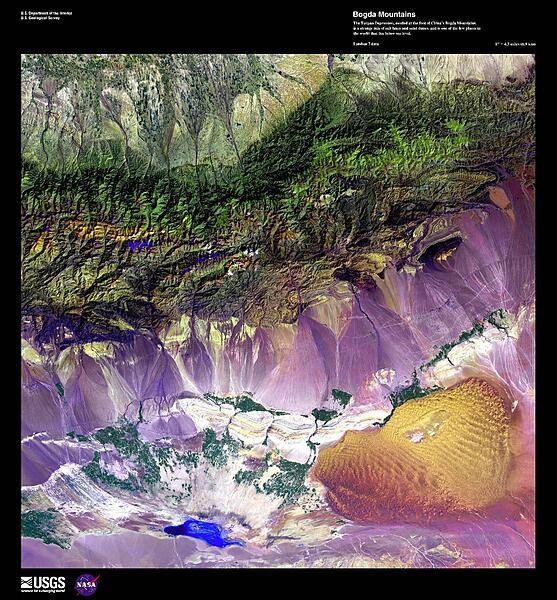
This false-color, high-resolution satellite photo shows the Turpan Depression, nestled at the foot of China's Bogda Mountains, south of the oasis city of Turpan. A strange mix of salt lakes and sand dunes, this fault-bounded trough is the lowest exposed surface in China. At the center of the basin lies Ayding Lake (bottom left), which is the third lowest exposed point on the earth's surface at -154 m (-505 ft). Image courtesy of USGS.
This false-color, high-resolution satellite photo shows the Turpan Depression, nestled at the foot of China's Bogda Mountains, south of the oasis city of Turpan. A strange mix of salt lakes and sand dunes, this fault-bounded trough is the lowest exposed surface in China. At the center of the basin lies Ayding Lake (bottom left), which is the third lowest exposed point on the earth's surface at -154 m (-505 ft). Image courtesy of USGS. • CIA World Factbook • 2020
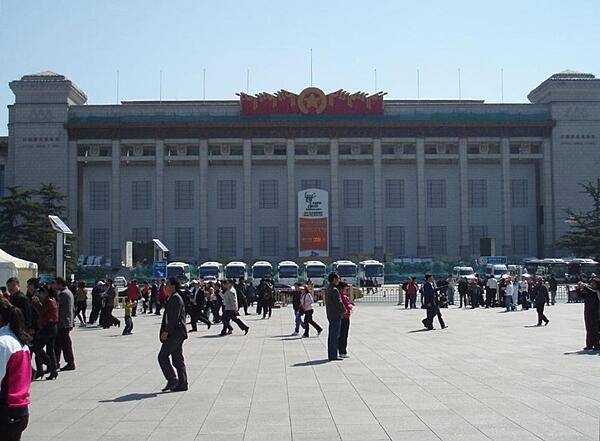
The National Museum of China on Tiananmen Square in Beijing. Completed in 1959, the museum's mission is to educate about the arts and history of China.
The National Museum of China on Tiananmen Square in Beijing. Completed in 1959, the museum's mission is to educate about the arts and history of China. • CIA World Factbook • 2020
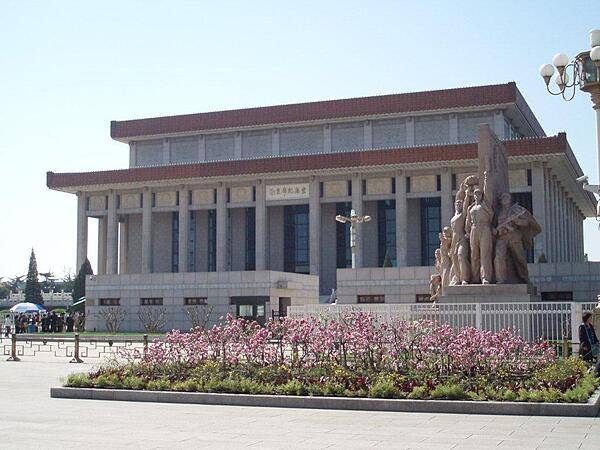
The Mao Zedong Mausoleum (or Chairman Mao Memorial Hall) was constructed in 1977 on Tiananmen Square in Beijing. Mao's body lies in a crystal casket for public viewing.
The Mao Zedong Mausoleum (or Chairman Mao Memorial Hall) was constructed in 1977 on Tiananmen Square in Beijing. Mao's body lies in a crystal casket for public viewing. • CIA World Factbook • 2020
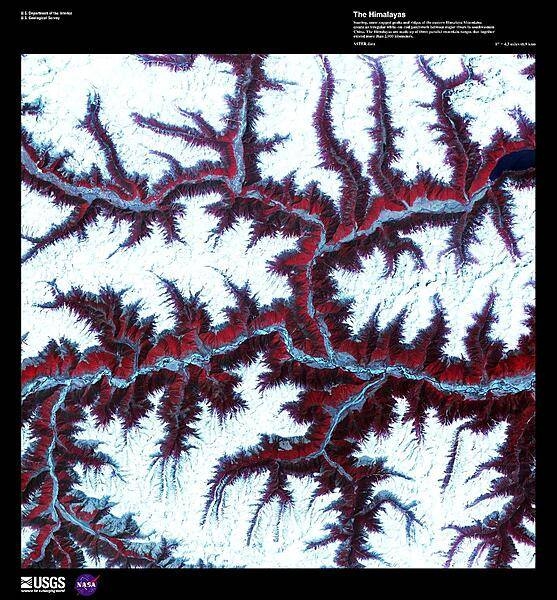
Soaring, snow-capped peaks and ridges of the eastern Himalaya Mountains create an irregular white-on-red patchwork between major rivers in southwestern China in this enhanced satellite image. The Himalayas are made up of three parallel mountain ranges that together extend more than 2,900 km (1,800 mi) and are the youngest mountain range on the planet. Some of the world's major rivers rise in these mountains and their combined drainage basin is home to almost half of the world's entire population. Image courtesy of USGS.
Soaring, snow-capped peaks and ridges of the eastern Himalaya Mountains create an irregular white-on-red patchwork between major rivers in southwestern China in this enhanced satellite image. The Himalayas are made up of three parallel mountain ranges that together extend more than 2,900 km (1,800 mi) and are the youngest mountain range on the planet. Some of the world's major rivers rise in these mountains and their combined drainage basin is home to almost half of the world's entire population. Image courtesy of USGS. • CIA World Factbook • 2020
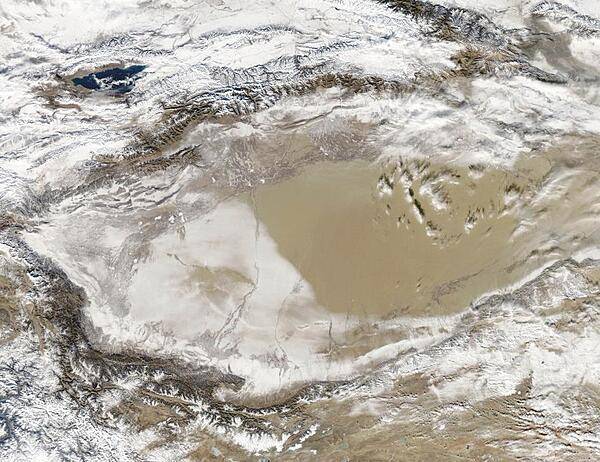
Snow-covered deserts are rare, but that is exactly what NASA's Aqua satellite observed as it passed over the Takla Makan Desert in the Xinjian Uygyr autonomous region of western China on 2 January 2013. The Takla Makan is one of the world's largest and hottest sandy deserts. Water flowing into the Tarim Basin has no outlet so, over the years, sediments have steadily accumulated. In parts of the desert, sand can pile up to 300 m (roughly 1,000 ft) high. The mountains that enclose the sea of sand - the Tien Shan in the north and the Kunlun Shan in the south - are also covered with what appears to be a significantly thicker layer of snow. Image courtesy of NASA.
Snow-covered deserts are rare, but that is exactly what NASA's Aqua satellite observed as it passed over the Takla Makan Desert in the Xinjian Uygyr autonomous region of western China on 2 January 2013. The Takla Makan is one of the world's largest and hottest sandy deserts. Water flowing into the Tarim Basin has no outlet so, over the years, sediments have steadily accumulated. In parts of the desert, sand can pile up to 300 m (roughly 1,000 ft) high. The mountains that enclose the sea of sand - the Tien Shan in the north and the Kunlun Shan in the south - are also covered with what appears to be a significantly thicker layer of snow. Image courtesy of NASA. • CIA World Factbook • 2020
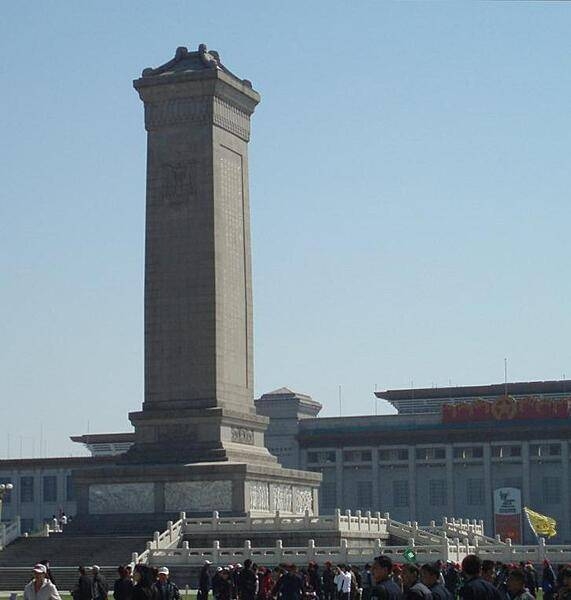
The Monument to the People's Heroes in Tiananmen Square in Beijing. Constructed in 1958, it commemorates those who fought in revolutions from 1840 to 1949.
The Monument to the People's Heroes in Tiananmen Square in Beijing. Constructed in 1958, it commemorates those who fought in revolutions from 1840 to 1949. • CIA World Factbook • 2020
102 photos available
View All Photos→Data sources: World Bank, UN Data • Updated daily •Learn about our data