›››
Egypt, Arab Rep.
Egypt, Arab Rep.
Population
116.5M
Rank #13Source: World Bank
Capital
Cairo
Source: REST Countries
Region
Africa
Middle East, North Africa, Afghanistan & Pakistan
Source: REST Countries
GDP (Nominal)
$389.06B
Rank #41Source: World Bank
Land Area
1.0M km²
Rank #30Source: REST Countries
Life Expectancy
71.633 yrs
Source: World Bank
Historical Trends
Population Trend (5-Year)
Source: World Bank
GDP Trend (5-Year, Nominal USD)
Source: World Bank
Geography
Area: 1,002,450 km²
Landlocked: No
Independent: Yes
Climate: desert; hot, dry summers with moderate winters
Terrain: vast desert plateau interrupted by Nile valley and delta
Elevation: mean elevation: 321 m lowest point: Qattara Depression -133 m highest point: Mount Catherine 2,629 m
Natural Hazards: periodic droughts; frequent earthquakes; flash floods; landslides; hot, driving windstorms called khamsin occur in spring; dust storms; sandstorms
Environmental Issues: agricultural land being lost to urbanization and windblown sands; increasing soil salination below Aswan High Dam; desertification; oil pollution threatening coral reefs, beaches, and marine...
Land Use: agricultural land: 3.6% (2011 est.) forest: 0.1% (2011 est.) other: 96.3% (2011 est.)
Geography Note: controls Sinai Peninsula, the only land bridge between Africa and remainder of Eastern Hemisphere; controls Suez Canal, a sea link between Indian Ocean and Mediterranean Sea; size, and juxtaposition...
Natural Resources
petroleumnatural gasiron orephosphatesmanganeselimestonegypsumtalcasbestoslead
People & Society
Fertility Rate
2.75
Population
116.5M
Ethnic Groups
Egyptian (99.7%)other (0.3%)
Religions
Muslim (predominantly Sunni) (90%)Christian (majority Coptic Orthodox, other Christians include Armenian Apostolic, Catholic, Maronite, Orthodox, and Anglican) (10%)
Economy
GDP per Capita
$3,338.474
GDP per Capita PPP
19,094.145
(2024)
(2024)
GNI per Capita
3,510
(2024)
(2024)
Gini Index
28.5
(2021)
(2021)
Unemployment
6.817%
(2024)
(2024)
Inflation
28.271%
(2024)
(2024)
Public Debt
Not Available
Energy
Electricity Access
100%
(2023)
(2023)
Renewable Energy
6.1%
(2021)
(2021)
CO₂ Emissions
291.639 Mt
(2024)
(2024)
Energy Intensity
3.06 MJ/$
(2021)
(2021)
Renewable Electricity
12.196%
(2021)
(2021)
Environment
Forest Coverage
0.045% of land
(2023)
(2023)
Communications
Internet Users
72.69%
(2023)
(2023)
Mobile Penetration
92.826%
(2023)
(2023)
Broadband Subscribers
10.865%
(2023)
(2023)
Transportation
Air Transport Freight
492.655 M ton-km
(2023)
(2023)
Container Port Traffic
7,765,482 TEU
(2022)
(2022)
Airports
135,253
Rail Lines
5,153 km
Roads Total
165,521 km(©IRF)
Military
Military Forces
Egyptian Armed Forces (EAF): Army (includes surface-to-surface missile forces, special forces, Republican Guard), Navy (includes coastal defense, Coast Guard), Air Force, Air Defense Command;...
Personnel Strength
estimates of the size of the Egyptian Armed Forces (EAF) vary; approximately 450,000 total active personnel (325,000 Army; 18,500 Navy; 30,000 Air Force; 75,000 Air Defense Command)
Military Expenditure (USD)
$2.40B
Military Expenditure (% of GDP)
0.67%
Military Expenditure History
1.2% of GDP (2019) 1.2% of GDP (2018) 1.4% of GDP (2017) 1.7% of GDP (2016) 1.7% of GDP (2015)
Deployments
1,000 Central African Republic (MINUSCA); 1,050 Mali (MINUSMA); 150 Sudan (UNAMID) (2020)
Equipment & Inventories
the EAF's inventory is comprised of a mix of domestically produced, Soviet-era, and more modern, particularly US, weapons systems; in recent years, the EAF has embarked on an extensive equipment...
Service Age & Obligation
18-30 years of age for male conscript military service; service obligation - 18-36 months, followed by a 9-year reserve obligation; voluntary enlistment possible from age 15
Education
Pre-Primary Enrollment
29.27%
(2019)
(2019)
Primary Enrollment
96.707%
(2024)
(2024)
Secondary Enrollment
84.829%
(2024)
(2024)
Tertiary Enrollment
37.578%
(2024)
(2024)
Education Spending
Not Available
Adult Literacy Rate
79.457%
(2022)
(2022)
Pupil-Teacher Ratio
23.679:1
(2018)
(2018)
Health
Physicians per 1,000
0.671
(2020)
(2020)
Safe Water Access
97.298%
(2024)
(2024)
Safe Drinking Water
78.94%
(2024)
(2024)
Under-5 Mortality
17.5 per 1,000
(2023)
(2023)
Maternal Mortality (World Bank)
13.236 per 100,000
(2021)
(2021)
Hospital Beds per 1,000
71.709
(2021)
(2021)
UHC Coverage Index
71
(2023)
(2023)
Measles Immunization
97%
(2024)
(2024)
Social Indicators
Extreme Poverty Rate
1.4%
(2021)
(2021)
Food Insecurity
9.4%
(2023)
(2023)
Youth NEET Rate
15.254%
(2024)
(2024)
Governance
Women in Government
27.703%
(2024)
(2024)
Voice & Accountability
-1.38
(Weak)
(2023)
(Weak)
(2023)
Political Stability
-0.87
(Below Average)
(2023)
(Below Average)
(2023)
Government Effectiveness
-0.24
(Below Average)
(2023)
(Below Average)
(2023)
Regulatory Quality
-0.67
(Below Average)
(2023)
(Below Average)
(2023)
Rule of Law
-0.18
(Below Average)
(2023)
(Below Average)
(2023)
Control of Corruption
-0.75
(Below Average)
(2023)
(Below Average)
(2023)
Government
Government Type
presidential republic
Legal System
mixed legal system based on Napoleonic civil and penal law, Islamic religious law, and vestiges of colonial-era laws; judicial review of the constitutionality of laws by the Supreme Constitutional...
Executive Branch
chief of state: President Abdelfattah ELSISI (since 8 June 2014) head of government: Prime Minister Mostafa MADBOULY (since 7 June 2018) cabinet: Cabinet ministers nominated by the executive branch...
Legislative Branch
description: bicameral Parliament consists of:Senate (Majlis Al-Shiyoukh) (300 seats; 100 members elected in single seat constituencies, 100 elected by closed party-list system, and 100 appointed by...
Judicial Branch
highest courts: Supreme Constitutional Court (SCC) (consists of the court president and 10 justices); the SCC serves as the final court of arbitration on the constitutionality of laws and conflicts...
National Symbols
Flag Description
three equal horizontal bands of red (top), white, and black; the national emblem (a gold Eagle of Saladin facing the hoist side with a shield superimposed on its chest above a scroll bearing the name...
National Symbols
golden eagle, white lotus; national colors: red, white, black
National Anthem
name: "Bilady, Bilady, Bilady" (My Homeland, My Homeland, My Homeland) lyrics/music: Younis-al QADI/Sayed DARWISH note: adopted 1979; the current anthem, less militaristic than the previous one, was...
Safety
Homicide Rate
1.312 per 100,000
(2017)
(2017)
Travel Information
Language(s): Arabic
Currency: EGP (£)
Timezone(s): UTC+02:00
Landlocked: No
Independent: Yes
Driving Side: Right
Calling Code: +20
Car Sign: ET
Week Starts: Sunday
Photos
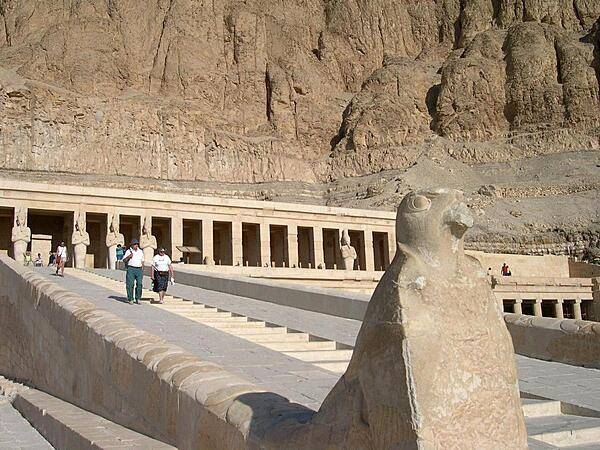
Stairway and ramp leading up to Hatshepsut's temple at Deir el-Bahri. Hatshepsut lived between 1508-1458 B.C. She was the eldest daughter of Pharaoh Thutmose I and married her half brother, Thutmose II. When he died, she became pharaoh. Her 22-year reign is known for bringing prosperity to her subjects.
Stairway and ramp leading up to Hatshepsut's temple at Deir el-Bahri. Hatshepsut lived between 1508-1458 B.C. She was the eldest daughter of Pharaoh Thutmose I and married her half brother, Thutmose II. When he died, she became pharaoh. Her 22-year reign is known for bringing prosperity to her subjects. • CIA World Factbook • 2020
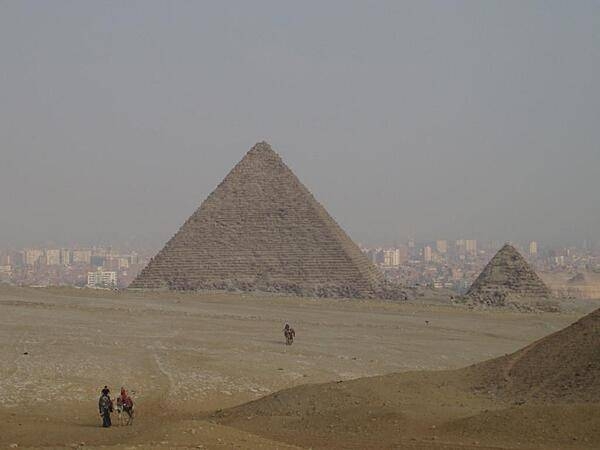
The Pyramid of Menkaure is the smallest of the three kings' pyramids on the Giza Plateau. The city of Cairo appears in the background.
The Pyramid of Menkaure is the smallest of the three kings' pyramids on the Giza Plateau. The city of Cairo appears in the background. • CIA World Factbook • 2020
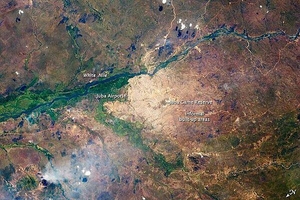
Juba, a port city on the White Nile, is the capital of South Sudan and one of the fastest growing cities in the world. Juba's population is estimated to be roughly 350,000 to 400,000. The city has doubled in size since 2005, when a peace agreement ended the civil war in Sudan. Both hopeful immigrants and returning residents have created the population surge. The city was a central point for humanitarian aid, and the operations base for the UN and NGOs during the Sudanese conflicts. During the fighting, city infrastructure and main transportation arteries suffered heavy damage. The city is still surrounded by army camps and squatter settlements (labeled "informal built-up areas" in the image). They appear as muted gray areas extending outward from the center of the city. The city also hosts the Juba Game Reserve, a protected area of savannah and woodlands that is home to key bird species. Since independence, a variety of countries and international organizations have helped rebuild Juba's roads, railroads, and airport. Unfortunately, South Sudan continues to experience local wars with a variety of armed groups, including on-going conflicts with Sudan over oil-rich territories. Image courtesy of NASA.
Juba, a port city on the White Nile, is the capital of South Sudan and one of the fastest growing cities in the world. Juba's population is estimated to be roughly 350,000 to 400,000. The city has doubled in size since 2005, when a peace agreement ended the civil war in Sudan. Both hopeful immigrants and returning residents have created the population surge. The city was a central point for humanitarian aid, and the operations base for the UN and NGOs during the Sudanese conflicts. During the fighting, city infrastructure and main transportation arteries suffered heavy damage. The city is still surrounded by army camps and squatter settlements (labeled "informal built-up areas" in the image). They appear as muted gray areas extending outward from the center of the city. The city also hosts the Juba Game Reserve, a protected area of savannah and woodlands that is home to key bird species. Since independence, a variety of countries and international organizations have helped rebuild Juba's roads, railroads, and airport. Unfortunately, South Sudan continues to experience local wars with a variety of armed groups, including on-going conflicts with Sudan over oil-rich territories. Image courtesy of NASA. • CIA World Factbook • 2020
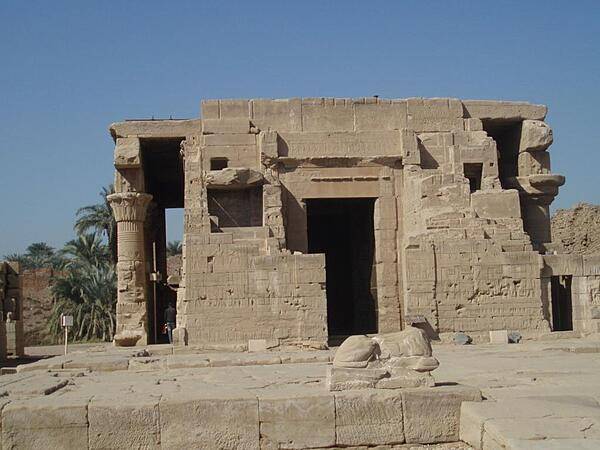
Birth House at the Temple of Hathor at Dendera. A birth house or "mammisi" was associated with the nativity of a god. The birth house at Dendera was constructed mainly by the Roman emperor Trajan, who ruled from A.D. 98 to 117.
Birth House at the Temple of Hathor at Dendera. A birth house or "mammisi" was associated with the nativity of a god. The birth house at Dendera was constructed mainly by the Roman emperor Trajan, who ruled from A.D. 98 to 117. • CIA World Factbook • 2020
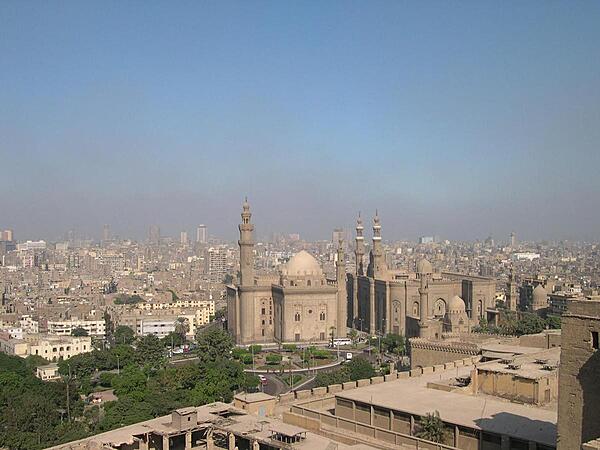
The Sultan Hassan and Ar-Rifai Mosques as seen from the Citadel with Cairo in the background. The Sultan Hassan Mosque and Madrasah (religious school) is a masterpiece of Mamluk architecture that was begun in 1356 and completed in 1363. It contains the burial chamber of the Sultan's two sons and is featured on the Egyptian hundred-pound note. The Ar-Rifai Mosque was built between 1869 and 1912. It houses the tomb of King Farouk, Egypt's last reigning monarch, and other members of the Egyptian royal family, as well as the tomb of the last shah of Iran.
The Sultan Hassan and Ar-Rifai Mosques as seen from the Citadel with Cairo in the background. The Sultan Hassan Mosque and Madrasah (religious school) is a masterpiece of Mamluk architecture that was begun in 1356 and completed in 1363. It contains the burial chamber of the Sultan's two sons and is featured on the Egyptian hundred-pound note. The Ar-Rifai Mosque was built between 1869 and 1912. It houses the tomb of King Farouk, Egypt's last reigning monarch, and other members of the Egyptian royal family, as well as the tomb of the last shah of Iran. • CIA World Factbook • 2020
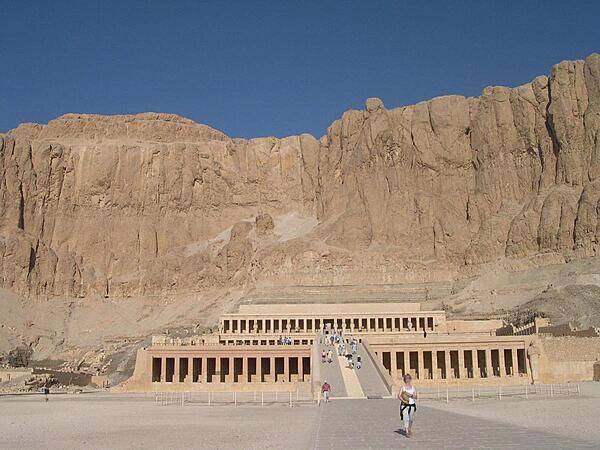
Djeser-Djeseru (the Holy of Holies) is Pharaoh Hatshepsut's mortuary temple in the temple complex of Deir el-Bahri near Luxor. Pharaohs of the 11th and 18th Dynasty's built their temples here. Hatshepsut's temple (the best preserved) was built into the cliff side on top of a series of colonnaded terraces in the classical Theban form; it includes a pylon, courts, a hypostyle hall, sun court, chapel, and sanctuary.
Djeser-Djeseru (the Holy of Holies) is Pharaoh Hatshepsut's mortuary temple in the temple complex of Deir el-Bahri near Luxor. Pharaohs of the 11th and 18th Dynasty's built their temples here. Hatshepsut's temple (the best preserved) was built into the cliff side on top of a series of colonnaded terraces in the classical Theban form; it includes a pylon, courts, a hypostyle hall, sun court, chapel, and sanctuary. • CIA World Factbook • 2020
150 photos available
View All Photos→Data sources: World Bank, UN Data • Updated daily •Learn about our data