›››
Spain
Spain
Population
48.8M
Rank #32Source: World Bank
Capital
Madrid
Source: REST Countries
Region
Europe
Europe & Central Asia
Source: REST Countries
GDP (Nominal)
$1.73T
Rank #15Source: World Bank
Land Area
506.0K km²
Rank #52Source: REST Countries
Life Expectancy
83.883 yrs
Source: World Bank
Historical Trends
Population Trend (5-Year)
Source: World Bank
GDP Trend (5-Year, Nominal USD)
Source: World Bank
Geography
Area: 505,992 km²
Landlocked: No
Independent: Yes
Climate: temperate; clear, hot summers in interior, more moderate and cloudy along coast; cloudy, cold winters in interior, partly cloudy and cool along coast
Terrain: large, flat to dissected plateau surrounded by rugged hills; Pyrenees Mountains in north
Elevation: mean elevation: 660 m lowest point: Atlantic Ocean 0 m highest point: Pico de Teide (Tenerife) on Canary Islands 3,718 m
Natural Hazards: periodic droughts, occasional floodingvolcanism: volcanic activity in the Canary Islands, located off Africa's northwest coast; Teide (3,715 m) has been deemed a Decade Volcano by the International...
Environmental Issues: pollution of the Mediterranean Sea from raw sewage and effluents from the offshore production of oil and gas; water quality and quantity nationwide; air pollution; deforestation; desertification
Land Use: agricultural land: 54.1% (2011 est.) forest: 36.8% (2011 est.) other: 9.1% (2011 est.)
Geography Note: strategic location along approaches to Strait of Gibraltar; Spain controls a number of territories in northern Morocco including the enclaves of Ceuta and Melilla, and the islands of Penon de Velez...
Natural Resources
coalligniteiron orecopperleadzincuraniumtungstenmercurypyrites
People & Society
Fertility Rate
1.12
Population
48.8M
Ethnic Groups
Spanish (86.4%)Moroccan (1.8%)Romanian (1.3%)other (10.5%)
Religions
Roman Catholic (68.9%)atheist (11.3%)agnostic (7.6%)other (2.8%)non-believer (8.2%)unspecified (1.1%)
Economy
GDP per Capita
$35,326.768
GDP per Capita PPP
57,965.295
(2024)
(2024)
GNI per Capita
33,550
(2024)
(2024)
Gini Index
33.4
(2023)
(2023)
Unemployment
11.4%
(2024)
(2024)
Inflation
2.774%
(2024)
(2024)
Public Debt
107.3%
(2023)
(2023)
Energy
Electricity Access
100%
(2023)
(2023)
Renewable Energy
19%
(2021)
(2021)
CO₂ Emissions
220.084 Mt
(2024)
(2024)
Energy Intensity
2.53 MJ/$
(2022)
(2022)
Renewable Electricity
47.015%
(2021)
(2021)
Environment
Forest Coverage
37.193% of land
(2023)
(2023)
Communications
Internet Users
95.758%
(2024)
(2024)
Mobile Penetration
127.715%
(2023)
(2023)
Broadband Subscribers
37.215%
(2023)
(2023)
Transportation
Air Transport Freight
1,130.883 M ton-km
(2023)
(2023)
Container Port Traffic
17,161,676 TEU
(2022)
(2022)
Airports
662,492.4
Rail Lines
15,963 km
Roads Total
538,577 km(©IRF)
Military
Military Forces
Spanish Armed Forces: Army (Ejercito de Tierra), Spanish Navy (Armada Espanola, AE, includes Marine Corps), Spanish Air Force (Ejercito del Aire Espanola, EdA); Civil Guard (Guardia Civil) note: the...
Personnel Strength
the Spanish Armed Forces have approximately 120,000 active duty troops (70,000 Army; 20,000 Navy; 20,000 Air Force; 10,000 other/joint); 70-75,000 Guardia Civil
Military Expenditure (USD)
$24.62B
Military Expenditure (% of GDP)
1.43%
Military Expenditure History
0.92% of GDP (2019 est.) 0.92% of GDP (2018) 0.9% of GDP (2017) 0.81% of GDP (2016) 0.92% of GDP (2015)
Deployments
150 Iraq (training mission, counter-ISIS coalition); 350 Latvia (NATO); 600 Lebanon (UNIFIL); 180 Mali (EUTM); 150 Turkey (NATO) (2020)
Equipment & Inventories
the inventory of the Spanish military is comprised of domestically-produced and imported Western weapons systems; France, Germany, and the US are the leading suppliers of military hardware since...
Service Age & Obligation
18-26 years of age for voluntary military service by a Spanish citizen or legal immigrant, 2-3 year obligation; women allowed to serve in all SAF branches, including combat units; no conscription,...
Education
Pre-Primary Enrollment
101.829%
(2020)
(2020)
Primary Enrollment
103.003%
(2023)
(2023)
Secondary Enrollment
118.362%
(2023)
(2023)
Tertiary Enrollment
93.73%
(2023)
(2023)
Education Spending
4.586% of GDP
(2022)
(2022)
Adult Literacy Rate
99.7%
(2021)
(2021)
Pupil-Teacher Ratio
13.132:1
(2017)
(2017)
Health
Physicians per 1,000
4.294
(2022)
(2022)
Safe Water Access
99.925%
(2024)
(2024)
Safe Drinking Water
99.458%
(2024)
(2024)
Under-5 Mortality
3.1 per 1,000
(2023)
(2023)
Maternal Mortality (World Bank)
22.769 per 100,000
(2021)
(2021)
Hospital Beds per 1,000
85.298
(2021)
(2021)
UHC Coverage Index
84
(2023)
(2023)
Measles Immunization
94%
(2024)
(2024)
Social Indicators
Extreme Poverty Rate
0.8%
(2023)
(2023)
Food Insecurity
2.5%
(2023)
(2023)
Youth NEET Rate
26.519%
(2024)
(2024)
Governance
Women in Government
44.286%
(2024)
(2024)
Voice & Accountability
1.20
(Strong)
(2023)
(Strong)
(2023)
Political Stability
0.29
(Above Average)
(2023)
(Above Average)
(2023)
Government Effectiveness
0.75
(Above Average)
(2023)
(Above Average)
(2023)
Regulatory Quality
0.69
(Above Average)
(2023)
(Above Average)
(2023)
Rule of Law
0.82
(Above Average)
(2023)
(Above Average)
(2023)
Control of Corruption
0.63
(Above Average)
(2023)
(Above Average)
(2023)
Government
Government Type
parliamentary constitutional monarchy
Legal System
civil law system with regional variations
Executive Branch
chief of state: King FELIPE VI (since 19 June 2014); Heir Apparent Princess LEONOR, Princess of Asturias (daughter of the monarch, born 31 October 2005) head of government: President of the...
Legislative Branch
description: bicameral General Courts or Las Cortes Generales consists of:Senate or Senado (266 seats; 208 members directly elected in multi-seat constituencies by simple majority vote and 58 members...
Judicial Branch
highest courts: Supreme Court or Tribunal Supremo (consists of the court president and organized into the Civil Room, with a president and 9 judges; the Penal Room, with a president and 14 judges;...
International Organizations
ADB (nonregional member)AfDB (nonregional member)Arctic Council (observer)Australia GroupBCIEBISCAN (observer)CBSS (observer)
National Symbols
Flag Description
three horizontal bands of red (top), yellow (double width), and red with the national coat of arms on the hoist side of the yellow band; the coat of arms is quartered to display the emblems of the...
National Symbols
Pillars of Hercules; national colors: red, yellow
National Anthem
name: "Himno Nacional Espanol" (National Anthem of Spain) lyrics/music: no lyrics/unknown note: officially in use between 1770 and 1931, restored in 1939; the Spanish anthem is the first anthem to be...
Safety
Homicide Rate
0.691 per 100,000
(2023)
(2023)
Travel Information
Language(s): Spanish, Catalan, Basque, +1 more
Currency: EUR (€)
Timezone(s): UTC to +01:00
Landlocked: No
Independent: Yes
Driving Side: Right
Calling Code: +34
Car Sign: E
Week Starts: Monday
Photos
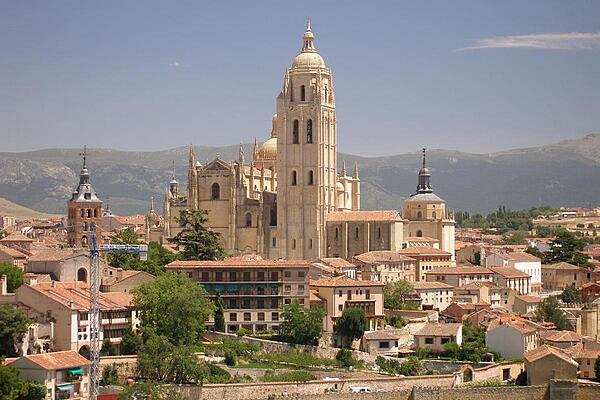
View of the 16th-century Cathedral of Segovia as seen from the Torre de Juan II (Tower of John II) in the Alcazar. Built between 1525 and 1577, this late Gothic structure - dedicated to the Virgin Mary - is referred to as the "Dame of Spanish Cathedrals."
View of the 16th-century Cathedral of Segovia as seen from the Torre de Juan II (Tower of John II) in the Alcazar. Built between 1525 and 1577, this late Gothic structure - dedicated to the Virgin Mary - is referred to as the "Dame of Spanish Cathedrals." • CIA World Factbook • 2020
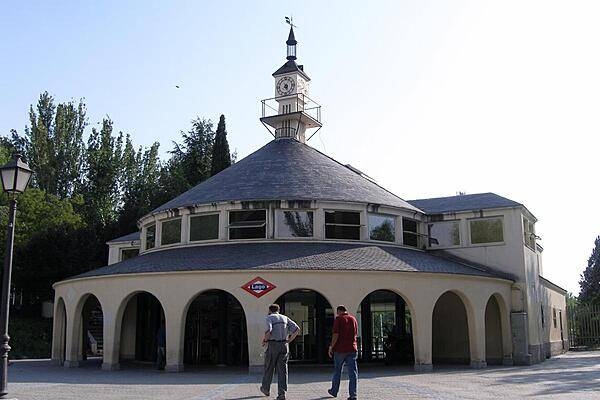
CIA World Factbook • 2020
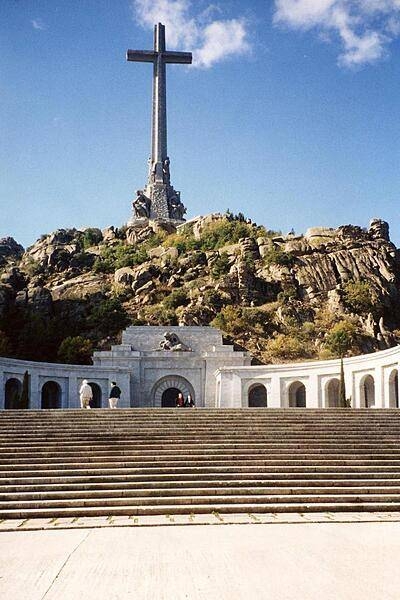
View of the Valley of the Fallen, a memorial to the dead of the Spanish Civil War (1936-1939), in the municipality of San Lorenzo de El Escorial.
View of the Valley of the Fallen, a memorial to the dead of the Spanish Civil War (1936-1939), in the municipality of San Lorenzo de El Escorial. • CIA World Factbook • 2020
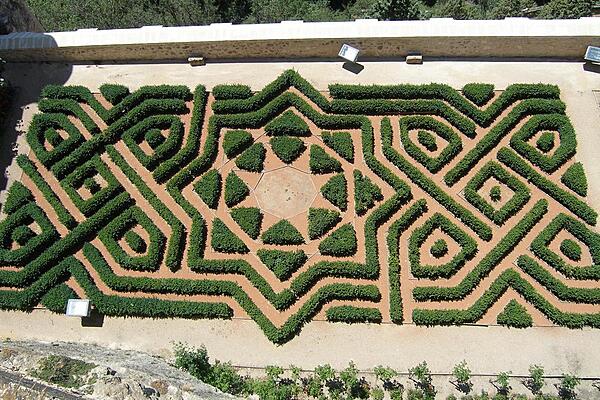
Garden at the Alcazar (fortress) in Segovia.
Garden at the Alcazar (fortress) in Segovia. • CIA World Factbook • 2020
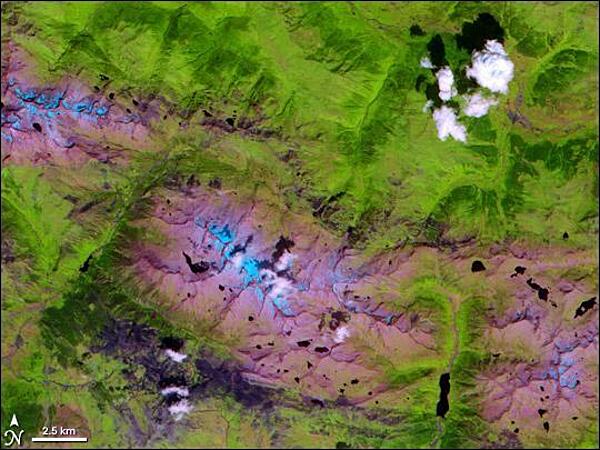
The Alps may be more famous, but the Pyrenees have been around much longer - tens of millions of years longer, in fact. These mountains formed between 100 and 150 million years ago when the landmass that Spain occupies pushed into the one that France occupies. The mountains have served as a natural barrier between the Iberian Peninsula (Spain and Portugal) and the rest of Europe ever since. Stretching east to west across 430 sq km (166 sq mi), the Pyrenees fall mostly within Spain's borders, but also pass into the independent state of Andorra. The NASA Terra satellite captured this image of part of the Central Pyrenees - the highest part of the range - on 1 August 2000. In this false-color image, clouds appear white, snow appears pale blue, vegetation appears green, and bare ground appears as either pink or dark, bluish-purple. Water on the ground appears dark blue (or nearly black). In this shot, the vegetated areas are mostly to the north, and the peaks to the south are mostly bare rock. Patches of dark purple that are visible along rivers and in valley floors are probably developed areas. Image courtesy of NASA.
The Alps may be more famous, but the Pyrenees have been around much longer - tens of millions of years longer, in fact. These mountains formed between 100 and 150 million years ago when the landmass that Spain occupies pushed into the one that France occupies. The mountains have served as a natural barrier between the Iberian Peninsula (Spain and Portugal) and the rest of Europe ever since. Stretching east to west across 430 sq km (166 sq mi), the Pyrenees fall mostly within Spain's borders, but also pass into the independent state of Andorra. The NASA Terra satellite captured this image of part of the Central Pyrenees - the highest part of the range - on 1 August 2000. In this false-color image, clouds appear white, snow appears pale blue, vegetation appears green, and bare ground appears as either pink or dark, bluish-purple. Water on the ground appears dark blue (or nearly black). In this shot, the vegetated areas are mostly to the north, and the peaks to the south are mostly bare rock. Patches of dark purple that are visible along rivers and in valley floors are probably developed areas. Image courtesy of NASA. • CIA World Factbook • 2020
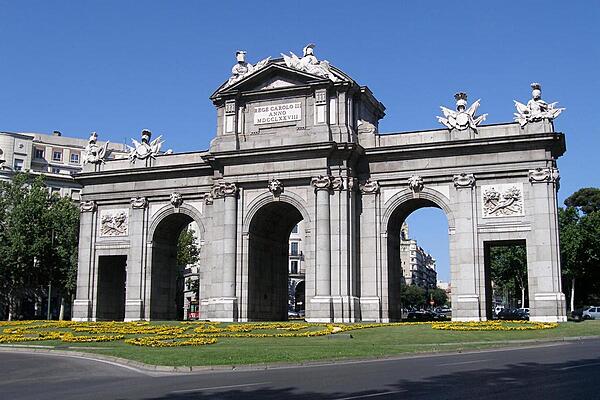
The Puerta de Alcala (Alcala Gate) monument in the Plaza de la Independencia (Independence Square) in Madrid. Inaugurated by King Carlos III in 1778, it originally functioned as an enormous gate in the city's wall.
The Puerta de Alcala (Alcala Gate) monument in the Plaza de la Independencia (Independence Square) in Madrid. Inaugurated by King Carlos III in 1778, it originally functioned as an enormous gate in the city's wall. • CIA World Factbook • 2020
105 photos available
View All Photos→Data sources: World Bank, UN Data • Updated daily •Learn about our data