›››
Ethiopia
Ethiopia
Population
132.1M
Rank #10Source: World Bank
Capital
Addis Ababa
Source: REST Countries
Region
Africa
Sub-Saharan Africa
Source: REST Countries
GDP (Nominal)
$149.74B
Rank #60Source: World Bank
Land Area
1.1M km²
Rank #27Source: REST Countries
Life Expectancy
67.315 yrs
Source: World Bank
Historical Trends
Population Trend (5-Year)
Source: World Bank
GDP Trend (5-Year, Nominal USD)
Source: World Bank
Geography
Area: 1,104,300 km²
Landlocked: Yes
Independent: Yes
Climate: tropical monsoon with wide topographic-induced variation
Terrain: high plateau with central mountain range divided by Great Rift Valley
Elevation: mean elevation: 1,330 m lowest point: Danakil Depression -125 m highest point: Ras Dejen 4,550 m
Natural Hazards: geologically active Great Rift Valley susceptible to earthquakes, volcanic eruptions; frequent droughtsvolcanism: volcanic activity in the Great Rift Valley; Erta Ale (613 m), which has caused...
Environmental Issues: deforestation; overgrazing; soil erosion; desertification; loss of biodiversity; water shortages in some areas from water-intensive farming and poor management; industrial pollution and pesticides...
Land Use: agricultural land: 36.3% (2011 est.) forest: 12.2% (2011 est.) other: 51.5% (2011 est.)
Geography Note: note 1: landlocked - entire coastline along the Red Sea was lost with the de jure independence of Eritrea on 24 May 1993; Ethiopia is, therefore, the most populous landlocked country in the world;...
Natural Resources
small reserves of goldplatinumcopperpotashnatural gashydropower
People & Society
Fertility Rate
3.99
Population
132.1M
Ethnic Groups
Oromo (34.9%)Amhara (Amara) (27.9%)Tigray (Tigrinya) (7.3%)Sidama (4.1%)Welaita (3%)Gurage (2.8%)Somali (Somalie) (2.7%)Hadiya (2.2%)Afar (Affar) (0.6%)other (12.6%)
Religions
Ethiopian Orthodox (43.8%)Muslim (31.3%)Protestant (22.8%)Catholic (0.7%)traditional (0.6%)other (0.8%)
Economy
GDP per Capita
$1,133.883
GDP per Capita PPP
3,287.535
(2024)
(2024)
GNI per Capita
1,100
(2024)
(2024)
Gini Index
31.1
(2021)
(2021)
Unemployment
3.357%
(2024)
(2024)
Inflation
21.038%
(2024)
(2024)
Public Debt
31.449%
(2019)
(2019)
Energy
Electricity Access
55.4%
(2023)
(2023)
Renewable Energy
90.6%
(2021)
(2021)
CO₂ Emissions
19.365 Mt
(2024)
(2024)
Energy Intensity
6.79 MJ/$
(2021)
(2021)
Renewable Electricity
95.434%
(2020)
(2020)
Environment
Forest Coverage
14.931% of land
(2023)
(2023)
Communications
Internet Users
16.698%
(2021)
(2021)
Mobile Penetration
56.964%
(2022)
(2022)
Broadband Subscribers
0.452%
(2022)
(2022)
Transportation
Air Transport Freight
4,015.459 M ton-km
(2023)
(2023)
Container Port Traffic
Not Available
Airports
147,319
Rail Lines
754 km
Roads Total
126,773.4 km(©IRF)
Military
Military Forces
Ethiopian National Defense Force (ENDF): Ground Forces, Ethiopian Air Force (Ye Ityopya Ayer Hayl, ETAF) note(s): in January 2020 the Ethiopian Government announced it had re-established a navy,...
Personnel Strength
estimates for the size of the Ethiopian National Defense Force (ENDF) vary; approximately 150,000 active duty troops, including about 3,000 Air Force personnel (no personnel numbers available for the...
Military Expenditure (USD)
$0.92B
Military Expenditure (% of GDP)
0.65%
Military Expenditure History
0.7% of GDP (2019) 0.7% of GDP (2018) 0.7% of GDP (2017) 0.7% of GDP (2016) 0.7% of GDP (2015)
Deployments
10-15,000 Somalia (4,500 for AMISOM); 800 Sudan (UNAMID); 3,600 Sudan (UNISFA); 2,100 South Sudan (UNMISS) (2020)
Equipment & Inventories
the ENDF's inventory is comprised mostly of Soviet-era equipment; since 2010, Russia and Ukraine are the leading suppliers of largely second-hand weapons and equipment to the ENDF, followed by China...
Service Age & Obligation
18 years of age for voluntary military service; no compulsory military service, but the military can conduct callups when necessary and compliance is compulsory
Education
Pre-Primary Enrollment
30.119%
(2021)
(2021)
Primary Enrollment
84.416%
(2024)
(2024)
Secondary Enrollment
33.911%
(2015)
(2015)
Tertiary Enrollment
5.919%
(2014)
(2014)
Education Spending
2.298% of GDP
(2024)
(2024)
Adult Literacy Rate
60.46%
(2022)
(2022)
Pupil-Teacher Ratio
55.069:1
(2011)
(2011)
Health
Physicians per 1,000
0.143
(2023)
(2023)
Safe Water Access
55.596%
(2024)
(2024)
Safe Drinking Water
13.547%
(2024)
(2024)
Under-5 Mortality
46.5 per 1,000
(2023)
(2023)
Maternal Mortality (World Bank)
18.542 per 100,000
(2021)
(2021)
Hospital Beds per 1,000
65.962
(2021)
(2021)
UHC Coverage Index
33
(2023)
(2023)
Measles Immunization
73%
(2024)
(2024)
Social Indicators
Extreme Poverty Rate
38.6%
(2021)
(2021)
Food Insecurity
19.7%
(2023)
(2023)
Youth NEET Rate
6.392%
(2021)
(2021)
Governance
Women in Government
41.314%
(2024)
(2024)
Voice & Accountability
-1.06
(Weak)
(2023)
(Weak)
(2023)
Political Stability
-1.97
(Weak)
(2023)
(Weak)
(2023)
Government Effectiveness
-0.77
(Below Average)
(2023)
(Below Average)
(2023)
Regulatory Quality
-1.02
(Weak)
(2023)
(Weak)
(2023)
Rule of Law
-0.67
(Below Average)
(2023)
(Below Average)
(2023)
Control of Corruption
-0.47
(Below Average)
(2023)
(Below Average)
(2023)
Government
Government Type
federal parliamentary republic
Legal System
civil law system
Executive Branch
chief of state: President SAHLE-WORK Zewde (since 25 October 2018) head of government: Prime Minister ABIY Ahmed (since 2 April 2018); Deputy Prime Minister DEMEKE Mekonnen Hassen (since 29 November...
Legislative Branch
description: bicameral Parliament consists of:House of Federation or Yefedereshein Mikir Bete (153 seats; members indirectly elected by state assemblies to serve 5-year terms)House of People's...
Judicial Branch
highest courts: Federal Supreme Court (consists of 11 judges); note - the House of Federation has jurisdiction for all constitutional issues judge selection and term of office: president and vice...
National Symbols
Flag Description
three equal horizontal bands of green (top), yellow, and red, with a yellow pentagram and single yellow rays emanating from the angles between the points on a light blue disk centered on the three...
National Symbols
Abyssinian lion (traditional), yellow pentagram with five rays of light on a blue field (promoted by current government); national colors: green, yellow, red
National Anthem
name: "Whedefit Gesgeshi Woud Enat Ethiopia" (March Forward, Dear Mother Ethiopia) lyrics/music: DEREJE Melaku Mengesha/SOLOMON Lulu note: adopted 1992
Safety
Homicide Rate
8.511 per 100,000
(2012)
(2012)
Travel Information
Language(s): Amharic
Currency: ETB (Br)
Timezone(s): UTC+03:00
Landlocked: Yes
Independent: Yes
Driving Side: Right
Calling Code: +251
Car Sign: ETH
Week Starts: Monday
Photos
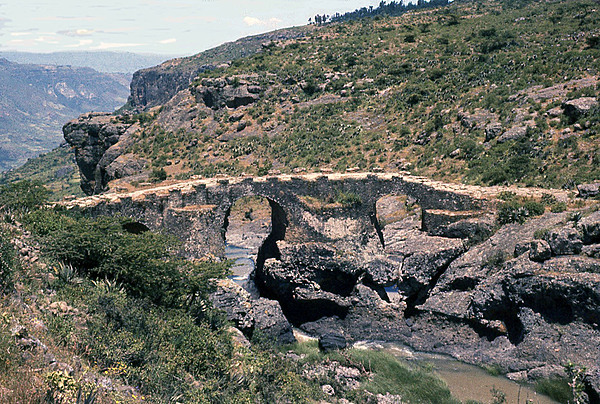
The "Portuguese Bridge" near Debre Libanos in the Oromia Region is a three-arched footbridge that locals claim dates to the 17th, or even the 16th, century (a period when Portugal assisted the Ethiopian monarchy). In fact, it was built in the early 19th century by Ethiopians, although in the old Portuguese style. This is an upstream view.
The "Portuguese Bridge" near Debre Libanos in the Oromia Region is a three-arched footbridge that locals claim dates to the 17th, or even the 16th, century (a period when Portugal assisted the Ethiopian monarchy). In fact, it was built in the early 19th century by Ethiopians, although in the old Portuguese style. This is an upstream view. • CIA World Factbook • 2020
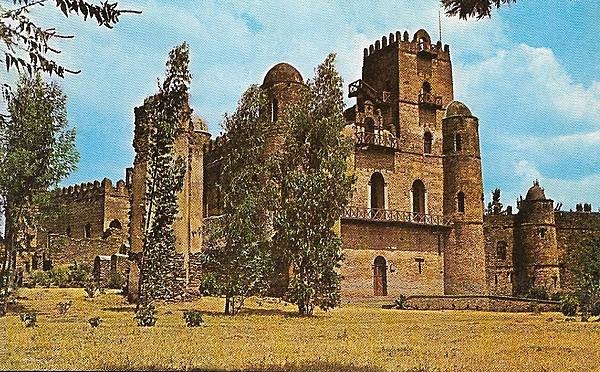
The Royal Enclosure or Fasil Ghebbi (Fasil’s Enclosure) is the remains of a fortress city in Gondar. Founded in the 17th century by Emperor Fasilides (Fasil), it was the home of Ethiopia's emperors. Its unique architecture shows diverse influences including Arab, Hindu, Nubian, and Baroque. The site was inscribed as a UNESCO World Heritage Site in 1979.
The Royal Enclosure or Fasil Ghebbi (Fasil’s Enclosure) is the remains of a fortress city in Gondar. Founded in the 17th century by Emperor Fasilides (Fasil), it was the home of Ethiopia's emperors. Its unique architecture shows diverse influences including Arab, Hindu, Nubian, and Baroque. The site was inscribed as a UNESCO World Heritage Site in 1979. • CIA World Factbook • 2020
CIA World Factbook • 2020
CIA World Factbook • 2020
At the top left, the capital city of Sudan, Khartoum, is located at the convergence of the Blue Nile and the White Nile. Although the Blue Nile is much shorter than the White Nile, it contributes about 80% of the flow of the river. The Dahlak Archipelago is seen off the Red Sea coast of Eritrea. Because of their isolation, the numerous coral reefs of the Dahlak Archipelago are some of the most pristine in the world. North of the Rift Valley, in central Ethiopia, are the Simien Mountains and Lake Tana. Lake Tana is the source of the Blue Nile. Photo courtesy of NASA.
At the top left, the capital city of Sudan, Khartoum, is located at the convergence of the Blue Nile and the White Nile. Although the Blue Nile is much shorter than the White Nile, it contributes about 80% of the flow of the river. The Dahlak Archipelago is seen off the Red Sea coast of Eritrea. Because of their isolation, the numerous coral reefs of the Dahlak Archipelago are some of the most pristine in the world. North of the Rift Valley, in central Ethiopia, are the Simien Mountains and Lake Tana. Lake Tana is the source of the Blue Nile. Photo courtesy of NASA. • CIA World Factbook • 2020
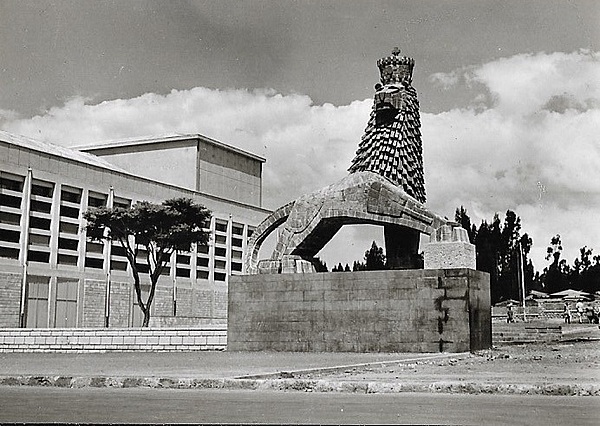
The Lion of Judah Monument is one of the most distinctive landmarks in Addis Ababa. The statue, by sculptor Maurice Calka, was commissioned by Emperor Haile Selassie and erected in front of the National Theater in 1954.
The Lion of Judah Monument is one of the most distinctive landmarks in Addis Ababa. The statue, by sculptor Maurice Calka, was commissioned by Emperor Haile Selassie and erected in front of the National Theater in 1954. • CIA World Factbook • 2020
18 photos available
View All Photos→Data sources: World Bank, UN Data • Updated daily •Learn about our data