›››
France
France
Population
68.6M
Rank #23Source: World Bank
Capital
Paris
Source: REST Countries
Region
Europe
Europe & Central Asia
Source: REST Countries
GDP (Nominal)
$3.16T
Rank #7Source: World Bank
Land Area
543.9K km²
Rank #49Source: REST Countries
Life Expectancy
82.929 yrs
Source: World Bank
Historical Trends
Population Trend (5-Year)
Source: World Bank
GDP Trend (5-Year, Nominal USD)
Source: World Bank
Geography
Area: 543,908 km²
Landlocked: No
Independent: Yes
Climate: metropolitan France: generally cool winters and mild summers, but mild winters and hot summers along the Mediterranean; occasional strong, cold, dry, north-to-northwesterly wind known as the mistral;...
Terrain: metropolitan France: mostly flat plains or gently rolling hills in north and west; remainder is mountainous, especially Pyrenees in south, Alps in east; French Guiana: low-lying coastal plains rising...
Elevation: mean elevation: 375 m lowest point: Rhone River delta -2 m highest point: Mont Blanc 4,810 note: to assess the possible effects of climate change on the ice and snow cap of Mont Blanc, its surface...
Natural Hazards: metropolitan France: flooding; avalanches; midwinter windstorms; drought; forest fires in south near the Mediterranean; overseas departments: hurricanes (cyclones); flooding; volcanism: Montagne...
Environmental Issues: some forest damage from acid rain; air pollution from industrial and vehicle emissions; water pollution from urban wastes, agricultural runoff
Land Use: agricultural land: 52.7% (2011 est.) forest: 29.2% (2011 est.) other: 18.1% (2011 est.)
Geography Note: largest West European nation; most major French rivers - the Meuse, Seine, Loire, Charente, Dordogne, and Garonne - flow northward or westward into the Atlantic Ocean, only the Rhone flows southward...
Natural Resources
metropolitan France: coaliron orebauxitezincuraniumantimonyarsenicpotashfeldsparfluorspar
People & Society
Fertility Rate
1.66
Population
68.6M
Economy
GDP per Capita
$46,103.084
GDP per Capita PPP
62,556.918
(2024)
(2024)
GNI per Capita
45,160
(2024)
(2024)
Gini Index
31.8
(2023)
(2023)
Unemployment
7.4%
(2024)
(2024)
Inflation
1.999%
(2024)
(2024)
Public Debt
Not Available
Energy
Electricity Access
100%
(2023)
(2023)
Renewable Energy
16.2%
(2021)
(2021)
CO₂ Emissions
274.451 Mt
(2024)
(2024)
Energy Intensity
2.83 MJ/$
(2022)
(2022)
Renewable Electricity
22.804%
(2021)
(2021)
Environment
Forest Coverage
32.476% of land
(2023)
(2023)
Communications
Internet Users
88.654%
(2024)
(2024)
Mobile Penetration
116.688%
(2023)
(2023)
Broadband Subscribers
48.669%
(2023)
(2023)
Transportation
Air Transport Freight
4,301.69 M ton-km
(2023)
(2023)
Container Port Traffic
6,467,242 TEU
(2022)
(2022)
Airports
497,793
Rail Lines
27,716 km
Roads Total
1,118,600 km(©IRF)
Military
Military Forces
Army (Armee de Terre; includes Foreign Legion), Navy (Marine Nationale), Air Force (Armee de l'Air (AdlA); includes Air Defense), National Guard (Reserves), National Gendarmerie (paramilitary police...
Personnel Strength
the French military has approximately 205,000 active duty troops (114,500 Army; 35,000 Navy; 40,500 Air Force; 15,000 other, such as joint staffs, medical service, etc.); approximately 100,000...
Military Expenditure (USD)
$64.68B
Military Expenditure (% of GDP)
2.05%
Military Expenditure History
1.84% of GDP (2019 est.) 1.82% of GDP (2018) 1.78% of GDP (2017) 1.79% of GDP (2016) 1.78% of GDP (2015)
Deployments
5,100 Burkina Faso/Chad/Mali/Niger (Operation Barkhane); 900 Cote D'Ivoire; 1,450 Djibouti; 300 Baltics (NATO); 2,000 French Guyana; 900 French Polynesia; 1,000 French West Indies; 350 Gabon; est....
Equipment & Inventories
the French military's inventory consists almost entirely of domestically-produced weapons systems, including some jointly-produced with other European countries; there is a limited mix of armaments...
Service Age & Obligation
18-25 years of age for male and female voluntary military service; no conscription; 1-year service obligation; women serve in noncombat posts
Education
Pre-Primary Enrollment
106.658%
(2020)
(2020)
Primary Enrollment
103.265%
(2023)
(2023)
Secondary Enrollment
103.962%
(2023)
(2023)
Tertiary Enrollment
70.454%
(2023)
(2023)
Education Spending
5.324% of GDP
(2022)
(2022)
Pupil-Teacher Ratio
18.177:1
(2013)
(2013)
Health
Physicians per 1,000
3.281
(2022)
(2022)
Safe Water Access
100%
(2024)
(2024)
Safe Drinking Water
99.713%
(2024)
(2024)
Under-5 Mortality
4.3 per 1,000
(2023)
(2023)
Maternal Mortality (World Bank)
24.86 per 100,000
(2021)
(2021)
Hospital Beds per 1,000
79.076
(2021)
(2021)
UHC Coverage Index
82
(2023)
(2023)
Measles Immunization
96%
(2024)
(2024)
Social Indicators
Extreme Poverty Rate
0.1%
(2023)
(2023)
Food Insecurity
2.5%
(2023)
(2023)
Youth NEET Rate
19.342%
(2024)
(2024)
Governance
Women in Government
36.049%
(2024)
(2024)
Voice & Accountability
1.16
(Strong)
(2023)
(Strong)
(2023)
Political Stability
0.34
(Above Average)
(2023)
(Above Average)
(2023)
Government Effectiveness
1.15
(Strong)
(2023)
(Strong)
(2023)
Regulatory Quality
1.15
(Strong)
(2023)
(Strong)
(2023)
Rule of Law
1.18
(Strong)
(2023)
(Strong)
(2023)
Control of Corruption
1.19
(Strong)
(2023)
(Strong)
(2023)
Government
Government Type
semi-presidential republic
Legal System
civil law; review of administrative but not legislative acts
Executive Branch
chief of state: President Emmanuel MACRON (since 14 May 2017) head of government: Prime Minister Jean CASTEX (since 3 July 2020) cabinet: Council of Ministers appointed by the president at the...
Legislative Branch
description: bicameral Parliament or Parlement consists of:Senate or Senat (348 seats - 328 for metropolitan France and overseas departments and regions of Guadeloupe, Martinique, French Guiana,...
Judicial Branch
highest courts: Court of Cassation or Cour de Cassation (consists of the court president, 6 divisional presiding judges, 120 trial judges, and 70 deputy judges organized into 6 divisions - 3 civil, 1...
International Organizations
ADB (nonregional member)AfDB (nonregional member)Arctic Council (observer)Australia GroupBDEACBISBSEC (observer)CBSS (observer)
National Symbols
Flag Description
three equal vertical bands of blue (hoist side), white, and red; known as the "Le drapeau tricolore" (French Tricolor), the origin of the flag dates to 1790 and the French Revolution when the...
National Symbols
Gallic rooster, fleur-de-lis, Marianne (female personification); national colors: blue, white, red
National Anthem
name: "La Marseillaise" (The Song of Marseille) lyrics/music: Claude-Joseph ROUGET de Lisle note: adopted 1795, restored 1870; originally known as "Chant de Guerre pour l'Armee du Rhin" (War Song for...
Safety
Homicide Rate
1.335 per 100,000
(2023)
(2023)
Travel Information
Language(s): French
Currency: EUR (€)
Timezone(s): UTC +01:00 to -10:00
Landlocked: No
Independent: Yes
Driving Side: Right
Calling Code: +33
Car Sign: F
Week Starts: Monday
Photos
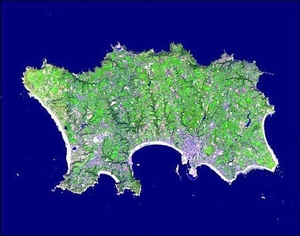
The Isle of Jersey (officially called the Bailiwick of Jersey) is the largest of the Channel Islands in the Bay of Mont St. Michel off the northwest coast of France. This Terra satellite image vividly displays the island's agricultural patchwork terrain. Image courtesy of NASA.
The Isle of Jersey (officially called the Bailiwick of Jersey) is the largest of the Channel Islands in the Bay of Mont St. Michel off the northwest coast of France. This Terra satellite image vividly displays the island's agricultural patchwork terrain. Image courtesy of NASA. • CIA World Factbook • 2020
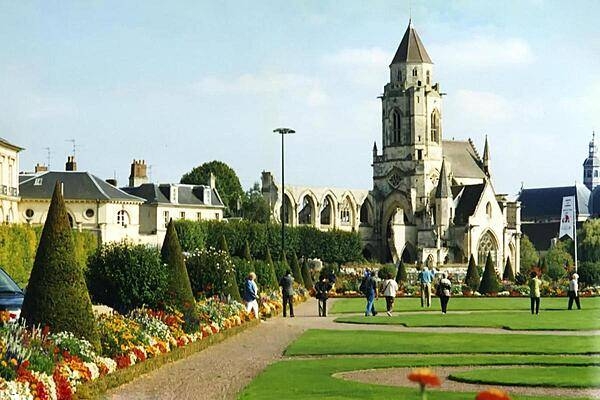
Gardens before the Church of St. Etienne in Caen. Formerly referred to as the Men's Abbey, the structure was completed in 1063 and is now dedicated to St. Stephen.
Gardens before the Church of St. Etienne in Caen. Formerly referred to as the Men's Abbey, the structure was completed in 1063 and is now dedicated to St. Stephen. • CIA World Factbook • 2020
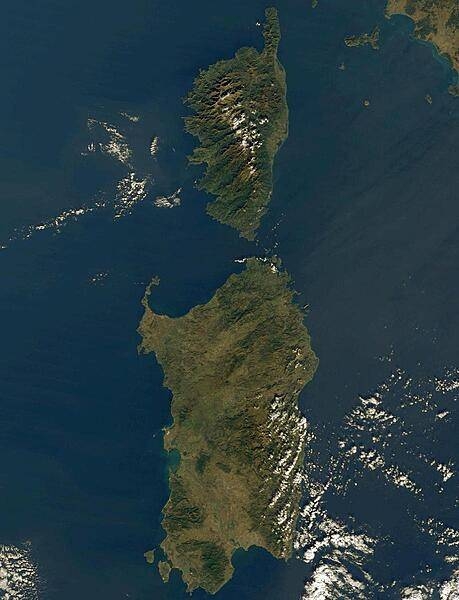
Rich in antiquities and picturesque landscapes, the island provinces of Corsica, France, (top) and Sardinia, Italy, (bottom) have captured the imaginations of historians and poets alike for centuries. Corsica, crowned with snow-capped mountains, jeweled with shimmering lakes, and cloaked in misty emerald forests, is situated in the Mediterranean Sea southeast of mainland France. The island has almost 1,700 hills and mountains, and is carved by an extensive network of rivers. Across the Strait of Bonifacio to the south is Sardinia, the Mediterranean's second largest island. Stretching across the central, eastern part of Sardinia is the rugged terrain of Gennargentu - mountainous, thickly vegetated, and mostly uninhabited. The port city of Cagliari sits on the large bay on Sardinia's southern coast. Photo courtesy of NASA.
Rich in antiquities and picturesque landscapes, the island provinces of Corsica, France, (top) and Sardinia, Italy, (bottom) have captured the imaginations of historians and poets alike for centuries. Corsica, crowned with snow-capped mountains, jeweled with shimmering lakes, and cloaked in misty emerald forests, is situated in the Mediterranean Sea southeast of mainland France. The island has almost 1,700 hills and mountains, and is carved by an extensive network of rivers. Across the Strait of Bonifacio to the south is Sardinia, the Mediterranean's second largest island. Stretching across the central, eastern part of Sardinia is the rugged terrain of Gennargentu - mountainous, thickly vegetated, and mostly uninhabited. The port city of Cagliari sits on the large bay on Sardinia's southern coast. Photo courtesy of NASA. • CIA World Factbook • 2020
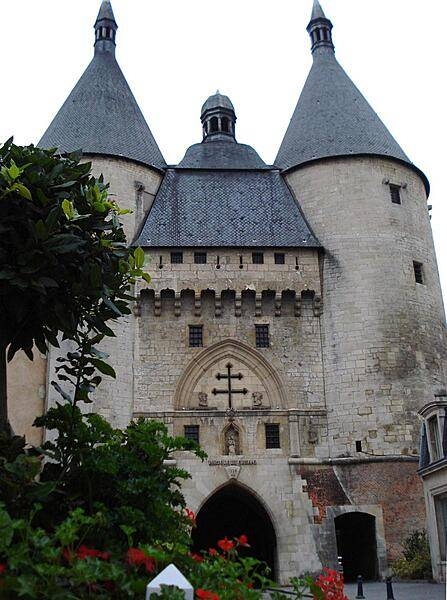
The Graffe Gate is one of the oldest remaining parts of Nancy's fortifications. It was erected in the 14th century, and its towers were used as prisons for many years. Its bell also formerly tolled the curfew. The facade displays a distinctive Lorraine Cross, since the city was the former capital of the Duchy of Lorraine.
The Graffe Gate is one of the oldest remaining parts of Nancy's fortifications. It was erected in the 14th century, and its towers were used as prisons for many years. Its bell also formerly tolled the curfew. The facade displays a distinctive Lorraine Cross, since the city was the former capital of the Duchy of Lorraine. • CIA World Factbook • 2020
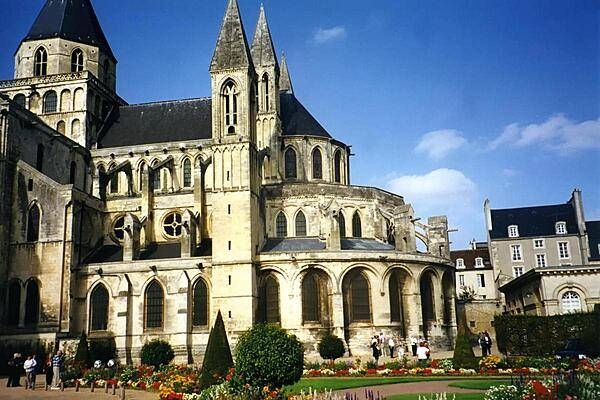
The Abbaye aux Hommes (Men's Abbey) is a Romanesque church dedicated to St. Etienne (St. Stephen) in Caen. Built by order of William the Conqueror, the former Benedictine abbey was completed in 1063.
The Abbaye aux Hommes (Men's Abbey) is a Romanesque church dedicated to St. Etienne (St. Stephen) in Caen. Built by order of William the Conqueror, the former Benedictine abbey was completed in 1063. • CIA World Factbook • 2020
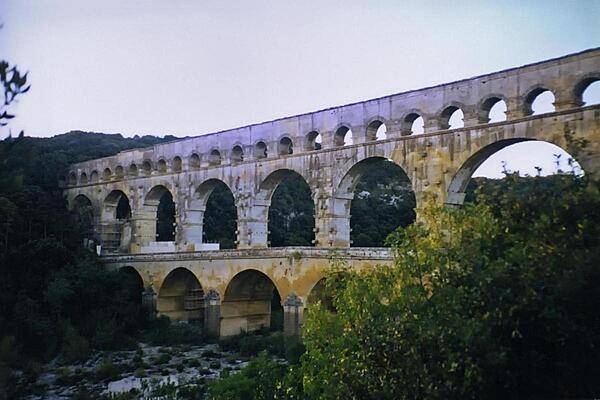
The Roman aqueduct at Pont du Gard, built during the mid-first century A.D., was part of a 50 km (30 mi) long aqueduct system that brought water to the city of Nemausus (today's Nimes). Built entirely without the use of mortar, its construction is thought to have taken about three years using 800 to 1,000 workers.
The Roman aqueduct at Pont du Gard, built during the mid-first century A.D., was part of a 50 km (30 mi) long aqueduct system that brought water to the city of Nemausus (today's Nimes). Built entirely without the use of mortar, its construction is thought to have taken about three years using 800 to 1,000 workers. • CIA World Factbook • 2020
132 photos available
View All Photos→Data sources: World Bank, UN Data • Updated daily •Learn about our data