›››
Croatia
Croatia
Population
3.9M
Rank #129Source: World Bank
Capital
Zagreb
Source: REST Countries
Region
Europe
Europe & Central Asia
Source: REST Countries
GDP (Nominal)
$92.98B
Rank #75Source: World Bank
Land Area
56.6K km²
Rank #125Source: REST Countries
Life Expectancy
78.473 yrs
Source: World Bank
Historical Trends
Population Trend (5-Year)
Source: World Bank
GDP Trend (5-Year, Nominal USD)
Source: World Bank
Geography
Area: 56,594 km²
Landlocked: No
Independent: Yes
Climate: Mediterranean and continental; continental climate predominant with hot summers and cold winters; mild winters, dry summers along coast
Terrain: geographically diverse; flat plains along Hungarian border, low mountains and highlands near Adriatic coastline and islands
Elevation: mean elevation: 331 m lowest point: Adriatic Sea 0 m highest point: Dinara 1,831 m
Natural Hazards: destructive earthquakes
Environmental Issues: air pollution improving but still a concern in urban settings and in emissions arriving from neighboring countries; surface water pollution in the Danube River Basin
Land Use: agricultural land: 23.7% (2011 est.) forest: 34.4% (2011 est.) other: 41.9% (2011 est.)
Geography Note: controls most land routes from Western Europe to Aegean Sea and Turkish Straits; most Adriatic Sea islands lie off the coast of Croatia - some 1,200 islands, islets, ridges, and rocks
Natural Resources
oilsome coalbauxitelow-grade iron orecalciumgypsumnatural asphaltsilicamicaclays
People & Society
Fertility Rate
1.46
Population
3.9M
Ethnic Groups
Croat (90.4%)Serb (4.4%)other (4.4%)unspecified (0.8%)
Religions
Roman Catholic (86.3%)Orthodox (4.4%)Muslim (1.5%)other (1.5%)unspecified (2.5%)not religious or atheist (3.8%)
Economy
GDP per Capita
$24,050.44
GDP per Capita PPP
49,645.746
(2024)
(2024)
GNI per Capita
22,250
(2024)
(2024)
Gini Index
30.1
(2023)
(2023)
Unemployment
5%
(2024)
(2024)
Inflation
2.972%
(2024)
(2024)
Public Debt
Not Available
Energy
Electricity Access
100%
(2023)
(2023)
Renewable Energy
34.1%
(2021)
(2021)
CO₂ Emissions
18.68 Mt
(2024)
(2024)
Energy Intensity
2.75 MJ/$
(2022)
(2022)
Renewable Electricity
69.881%
(2021)
(2021)
Environment
Forest Coverage
34.786% of land
(2023)
(2023)
Communications
Internet Users
83.632%
(2024)
(2024)
Mobile Penetration
117.113%
(2023)
(2023)
Broadband Subscribers
28.471%
(2023)
(2023)
Transportation
Air Transport Freight
0.146 M ton-km
(2023)
(2023)
Container Port Traffic
544,015 TEU
(2022)
(2022)
Airports
25,311
Rail Lines
2,617 km
Roads Total
26,494.94 km(©IRF)
Military
Military Forces
Armed Forces of the Republic of Croatia (Oruzane Snage Republike Hrvatske, OSRH) consists of five major commands directly subordinate to a General Staff: Ground Forces (Hrvatska Kopnena Vojska,...
Personnel Strength
the Armed Forces of the Republic of Croatia have approximately 15,000 active duty personnel (10,000 Army; 1,500 Navy; 1,500 Air force; 2,000 other)
Military Expenditure (USD)
$1.63B
Military Expenditure (% of GDP)
1.79%
Military Expenditure History
1.68% of GDP (2019 est.) 1.59% of GDP (2018) 1.67% of GDP (2017) 1.62% of GDP (2016) 1.78% of GDP (2015)
Equipment & Inventories
the inventory of the Croatian Armed Forces consists mostly of Soviet-era equipment, although in recent years, it has attempted to acquire more modern weapon systems from Western suppliers; since...
Service Age & Obligation
18-27 years of age for voluntary military service; conscription abolished in 2008
Education
Pre-Primary Enrollment
70.914%
(2020)
(2020)
Primary Enrollment
101.158%
(2023)
(2023)
Secondary Enrollment
105.025%
(2023)
(2023)
Tertiary Enrollment
81.178%
(2023)
(2023)
Education Spending
4.092% of GDP
(2021)
(2021)
Pupil-Teacher Ratio
13.506:1
(2016)
(2016)
Health
Physicians per 1,000
3.909
(2022)
(2022)
Safe Water Access
99.903%
(2024)
(2024)
Safe Drinking Water
87.268%
(2024)
(2024)
Under-5 Mortality
4.6 per 1,000
(2023)
(2023)
Maternal Mortality (World Bank)
20.295 per 100,000
(2021)
(2021)
Hospital Beds per 1,000
73.777
(2021)
(2021)
UHC Coverage Index
76
(2023)
(2023)
Measles Immunization
92%
(2024)
(2024)
Social Indicators
Extreme Poverty Rate
0.3%
(2023)
(2023)
Food Insecurity
2.5%
(2023)
(2023)
Youth NEET Rate
16.796%
(2024)
(2024)
Governance
Women in Government
33.113%
(2024)
(2024)
Voice & Accountability
0.57
(Above Average)
(2023)
(Above Average)
(2023)
Political Stability
0.60
(Above Average)
(2023)
(Above Average)
(2023)
Government Effectiveness
0.71
(Above Average)
(2023)
(Above Average)
(2023)
Regulatory Quality
0.64
(Above Average)
(2023)
(Above Average)
(2023)
Rule of Law
0.36
(Above Average)
(2023)
(Above Average)
(2023)
Control of Corruption
0.18
(Above Average)
(2023)
(Above Average)
(2023)
Government
Government Type
parliamentary republic
Legal System
civil law system influenced by legal heritage of Austria-Hungary; note - Croatian law was fully harmonized with the European Community acquis as of the June 2010 completion of EU accession...
Executive Branch
chief of state: President Zoran MILANOVIC (since 18 February 2020) head of government: Prime Minister Andrej PLENKOVIC (since 19 October 2016); Deputy Prime Ministers Damir KRSTICEVIC (since 19...
Legislative Branch
description: unicameral Assembly or Hrvatski Sabor (151 seats; 140 members in 10 multi-seat constituencies and 3 members in a single constituency for Croatian diaspora directly elected by...
Judicial Branch
highest courts: Supreme Court (consists of the court president and vice president, 25 civil department justices, and 16 criminal department justices) judge selection and term of office: president of...
National Symbols
Flag Description
three equal horizontal bands of red (top), white, and blue - the Pan-Slav colors - superimposed by the Croatian coat of arms; the coat of arms consists of one main shield (a checkerboard of 13 red...
National Symbols
red-white checkerboard; national colors: red, white, blue
National Anthem
name: "Lijepa nasa domovino" (Our Beautiful Homeland) lyrics/music: Antun MIHANOVIC/Josip RUNJANIN note: adopted in 1972 while still part of Yugoslavia; "Lijepa nasa domovino," whose lyrics were...
Safety
Homicide Rate
0.667 per 100,000
(2023)
(2023)
Travel Information
Language(s): Croatian
Currency: EUR (€)
Timezone(s): UTC+01:00
Landlocked: No
Independent: Yes
Driving Side: Right
Calling Code: +385
Car Sign: HR
Week Starts: Monday
Photos
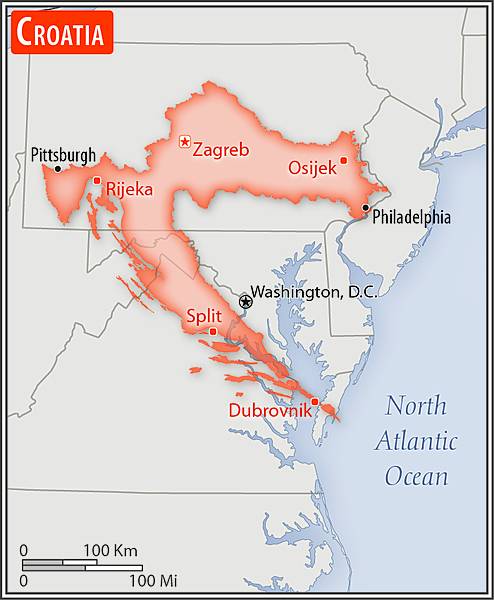
Area comparison map
Area comparison map • CIA World Factbook • 2020
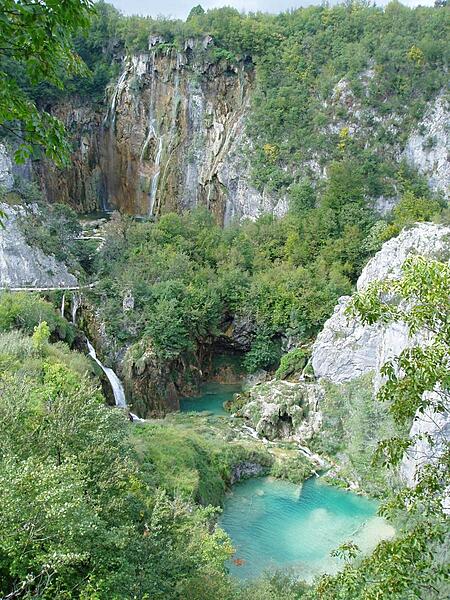
A view in Plitvice Lakes National Park looking down into the gorge where the largest waterfalls in the park - draining from one lake to the next - are located. The park has been added to the UNESCO World Heritage Register.
A view in Plitvice Lakes National Park looking down into the gorge where the largest waterfalls in the park - draining from one lake to the next - are located. The park has been added to the UNESCO World Heritage Register. • CIA World Factbook • 2020
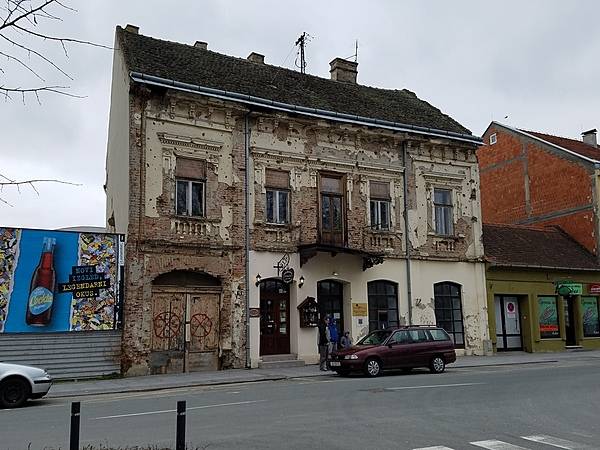
Vukovar, on the confluence of the Vuka and Danube Rivers, is Croatia's largest river port. The city was almost completely destroyed during an 87-day siege by Yugoslav forces and Serbian militias from August to November 1991 after Croatia declared its independence from Yugoslavia. The city has been largely rebuilt but certain buildings remain unrepaired as reminders of the fighting that resulted in 2,000 defenders killed, several hundred soldiers and civilians massacred after the city fell, and at least 20,000 inhabitants expelled. The fighting for Vukovar has been described as the worst in Europe since World War II; the city's population today is only about 60% of its pre-war total.
Vukovar, on the confluence of the Vuka and Danube Rivers, is Croatia's largest river port. The city was almost completely destroyed during an 87-day siege by Yugoslav forces and Serbian militias from August to November 1991 after Croatia declared its independence from Yugoslavia. The city has been largely rebuilt but certain buildings remain unrepaired as reminders of the fighting that resulted in 2,000 defenders killed, several hundred soldiers and civilians massacred after the city fell, and at least 20,000 inhabitants expelled. The fighting for Vukovar has been described as the worst in Europe since World War II; the city's population today is only about 60% of its pre-war total. • CIA World Factbook • 2020
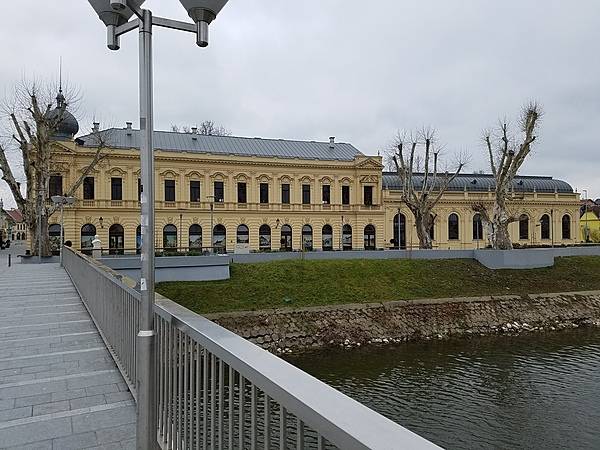
Radnicki Dom (Workers' Hall), formerly the Grand Hotel, is one of Vukovar's most famous architectural landmarks. From its opening in 1897 until its wartime destruction in 1991, it was the social and cultural center for the town's diverse population. The impetus to rebuild Workers' Hall came from the European Parliament, as part of an initiative to encourage post-conflict recovery and reconciliation through the restoration of architectural monuments destroyed in the 1991-95 war. The faithful reconstruction of the exterior, roof, and basement took two years (May 2011-April 2013) and cost €1.64 million. Fund-raising continues to rebuild the interior, estimated to cost €2.75 million.
Radnicki Dom (Workers' Hall), formerly the Grand Hotel, is one of Vukovar's most famous architectural landmarks. From its opening in 1897 until its wartime destruction in 1991, it was the social and cultural center for the town's diverse population. The impetus to rebuild Workers' Hall came from the European Parliament, as part of an initiative to encourage post-conflict recovery and reconciliation through the restoration of architectural monuments destroyed in the 1991-95 war. The faithful reconstruction of the exterior, roof, and basement took two years (May 2011-April 2013) and cost €1.64 million. Fund-raising continues to rebuild the interior, estimated to cost €2.75 million. • CIA World Factbook • 2020
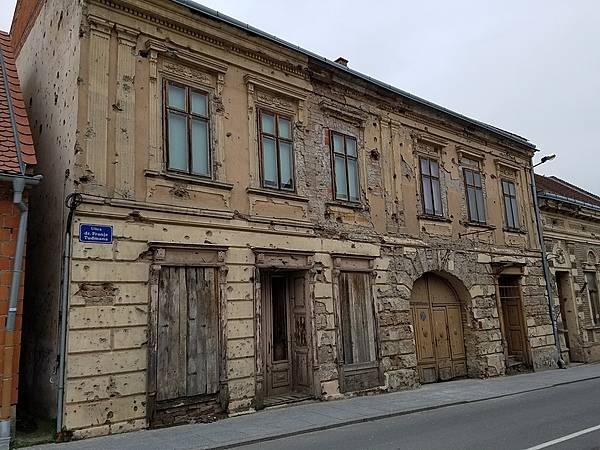
Vukovar, on the confluence of the Vuka and Danube Rivers, is Croatia's largest river port. The city was almost completely destroyed during an 87-day siege by Yugoslav forces and Serbian militias from August to November 1991 after Croatia declared its independence from Yugoslavia. The city has been largely rebuilt but certain buildings remain unrepaired as reminders of the fighting that resulted in 2,000 defenders killed, several hundred soldiers and civilians massacred after the city fell, and at least 20,000 inhabitants expelled. The fighting for Vukovar has been described as the worst in Europe since World War II; the city's population today is only about 60% of its pre-war total.
Vukovar, on the confluence of the Vuka and Danube Rivers, is Croatia's largest river port. The city was almost completely destroyed during an 87-day siege by Yugoslav forces and Serbian militias from August to November 1991 after Croatia declared its independence from Yugoslavia. The city has been largely rebuilt but certain buildings remain unrepaired as reminders of the fighting that resulted in 2,000 defenders killed, several hundred soldiers and civilians massacred after the city fell, and at least 20,000 inhabitants expelled. The fighting for Vukovar has been described as the worst in Europe since World War II; the city's population today is only about 60% of its pre-war total. • CIA World Factbook • 2020
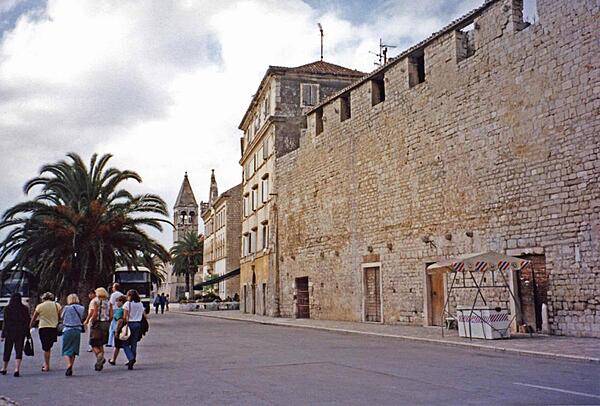
Outside the walls of historic Trogir. The town's 2,300 years of continuous urban tradition (Greek, Roman, Venetian, Habsburg) have left a fascinating and unique concentration of palaces, churches, towers, and fortifications. In 1997, Trogir was inscribed onto the UNESCO list of World Heritage Sites.
Outside the walls of historic Trogir. The town's 2,300 years of continuous urban tradition (Greek, Roman, Venetian, Habsburg) have left a fascinating and unique concentration of palaces, churches, towers, and fortifications. In 1997, Trogir was inscribed onto the UNESCO list of World Heritage Sites. • CIA World Factbook • 2020
20 photos available
View All Photos→Data sources: World Bank, UN Data • Updated daily •Learn about our data