›››
Hungary
Hungary
Population
9.6M
Rank #96Source: World Bank
Capital
Budapest
Source: REST Countries
Region
Europe
Europe & Central Asia
Source: REST Countries
GDP (Nominal)
$222.72B
Rank #55Source: World Bank
Land Area
93.0K km²
Rank #109Source: REST Countries
Life Expectancy
76.771 yrs
Source: World Bank
Historical Trends
Population Trend (5-Year)
Source: World Bank
GDP Trend (5-Year, Nominal USD)
Source: World Bank
Geography
Area: 93,028 km²
Landlocked: Yes
Independent: Yes
Climate: temperate; cold, cloudy, humid winters; warm summers
Terrain: mostly flat to rolling plains; hills and low mountains on the Slovakian border
Elevation: mean elevation: 143 m lowest point: Tisza River 78 m highest point: Kekes 1,014 m
Environmental Issues: air and water pollution are some of Hungary's most serious environmental problems; water quality in the Hungarian part of the Danube has improved but is still plagued by pollutants from industry and...
Land Use: agricultural land: 58.9% (2011 est.) forest: 22.5% (2011 est.) other: 18.6% (2011 est.)
Geography Note: landlocked; strategic location astride main land routes between Western Europe and Balkan Peninsula as well as between Ukraine and Mediterranean basin; the north-south flowing Duna (Danube) and Tisza...
Natural Resources
bauxitecoalnatural gasfertile soilsarable land
People & Society
Fertility Rate
1.51
Population
9.6M
Ethnic Groups
Hungarian (85.6%)Romani (3.2%)German (1.9%)other (2.6%)unspecified 14.1%
note: percentages add up to more than (100%)
Religions
Roman Catholic (37.2%)Calvinist (11.6%)Lutheran (2.2%)Greek Catholic (1.8%)other (1.9%)none (18.2%)no response (27.2%)
Economy
GDP per Capita
$23,292.326
GDP per Capita PPP
48,552.471
(2024)
(2024)
GNI per Capita
20,770
(2024)
(2024)
Gini Index
30.6
(2017)
(2017)
Unemployment
4.5%
(2024)
(2024)
Inflation
3.704%
(2024)
(2024)
Public Debt
75.527%
(2022)
(2022)
Energy
Electricity Access
100%
(2023)
(2023)
Renewable Energy
15.3%
(2021)
(2021)
CO₂ Emissions
42.627 Mt
(2024)
(2024)
Energy Intensity
3.12 MJ/$
(2022)
(2022)
Renewable Electricity
19.145%
(2021)
(2021)
Environment
Forest Coverage
22.448% of land
(2023)
(2023)
Communications
Internet Users
93.779%
(2024)
(2024)
Mobile Penetration
105.054%
(2023)
(2023)
Broadband Subscribers
36.79%
(2023)
(2023)
Transportation
Air Transport Freight
145.081 M ton-km
(2023)
(2023)
Container Port Traffic
Not Available
Airports
298,017
Rail Lines
8,037 km
Roads Total
220,576.5 km(©IRF)
Military
Military Forces
Hungarian Defense Forces: Ground Forces and Hungarian Air Force note: the Hungarian Defense Forces are organized into a joint force structure with ground, air, and logistic components
Personnel Strength
the Hungarian Defense Forces have approximately 29,000 active duty troops (18,000 Army; 5,000 Air Force; 6,000 other)
Military Expenditure (USD)
$4.73B
Military Expenditure (% of GDP)
2.16%
Military Expenditure History
1.21% of GDP (2019 est.) 1.15% of GDP (2018) 1.05% of GDP (2017) 1.02% of GDP (2016) 0.92% of GDP (2015)
Deployments
160 Bosnia-Herzegovina (EUFOR stabilization force); 150 Iraq (counter-ISIS coalition); 400 Kosovo (NATO) (2020)
Equipment & Inventories
the inventory of the Hungarian Defense Forces consists largely of Soviet-era weapons, with a smaller mix of more modern European and US equipment; since 2010, Hungary has received limited quantities...
Service Age & Obligation
18-25 years of age for voluntary military service; no conscription; 6-month service obligation
Education
Pre-Primary Enrollment
90.841%
(2020)
(2020)
Primary Enrollment
103.571%
(2023)
(2023)
Secondary Enrollment
105.419%
(2023)
(2023)
Tertiary Enrollment
56.592%
(2023)
(2023)
Education Spending
3.813% of GDP
(2022)
(2022)
Pupil-Teacher Ratio
10.767:1
(2016)
(2016)
Health
Physicians per 1,000
3.456
(2022)
(2022)
Safe Water Access
100%
(2024)
(2024)
Safe Drinking Water
100%
(2024)
(2024)
Under-5 Mortality
3.8 per 1,000
(2023)
(2023)
Maternal Mortality (World Bank)
18.68 per 100,000
(2021)
(2021)
Hospital Beds per 1,000
74.395
(2021)
(2021)
UHC Coverage Index
80
(2023)
(2023)
Measles Immunization
99%
(2024)
(2024)
Social Indicators
Extreme Poverty Rate
0.9%
(2017)
(2017)
Food Insecurity
2.5%
(2023)
(2023)
Youth NEET Rate
15.157%
(2024)
(2024)
Governance
Women in Government
14.573%
(2024)
(2024)
Voice & Accountability
0.36
(Above Average)
(2023)
(Above Average)
(2023)
Political Stability
0.73
(Above Average)
(2023)
(Above Average)
(2023)
Government Effectiveness
0.37
(Above Average)
(2023)
(Above Average)
(2023)
Regulatory Quality
0.32
(Above Average)
(2023)
(Above Average)
(2023)
Rule of Law
0.43
(Above Average)
(2023)
(Above Average)
(2023)
Control of Corruption
0.00
(Above Average)
(2023)
(Above Average)
(2023)
Government
Government Type
parliamentary republic
Legal System
civil legal system influenced by the German model
Executive Branch
chief of state: President Janos ADER (since 10 May 2012) head of government: Prime Minister Viktor ORBAN (since 29 May 2010) cabinet: Cabinet of Ministers proposed by the prime minister and appointed...
Legislative Branch
description: unicameral National Assembly or Orszaggyules (199 seats; 106 members directly elected in single-member constituencies by simple majority vote and 93 members directly elected in a single...
Judicial Branch
highest courts: Curia or Supreme Judicial Court (consists of the president, vice president, department heads, and approximately 91 judges and is organized into civil, criminal, and...
National Symbols
Flag Description
three equal horizontal bands of red (top), white, and green; the flag dates to the national movement of the 18th and 19th centuries, and fuses the medieval colors of the Hungarian coat of arms with...
National Symbols
Holy Crown of Hungary (Crown of Saint Stephen); national colors: red, white, green
National Anthem
name: "Himnusz" (Hymn) lyrics/music: Ferenc KOLCSEY/Ferenc ERKEL note: adopted 1844
Safety
Homicide Rate
0.723 per 100,000
(2023)
(2023)
Travel Information
Language(s): Hungarian
Currency: HUF (Ft)
Timezone(s): UTC+01:00
Landlocked: Yes
Independent: Yes
Driving Side: Right
Calling Code: +36
Car Sign: H
Week Starts: Monday
Photos
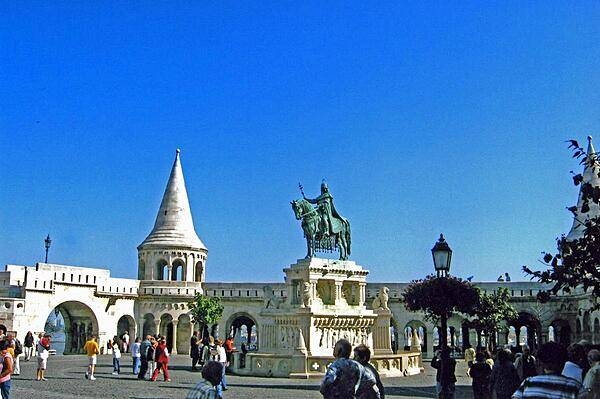
The statue of Stephen I, saint and king, in the Fisherman's Bastion terrace on the Buda side of Budapest.
The statue of Stephen I, saint and king, in the Fisherman's Bastion terrace on the Buda side of Budapest. • CIA World Factbook • 2020
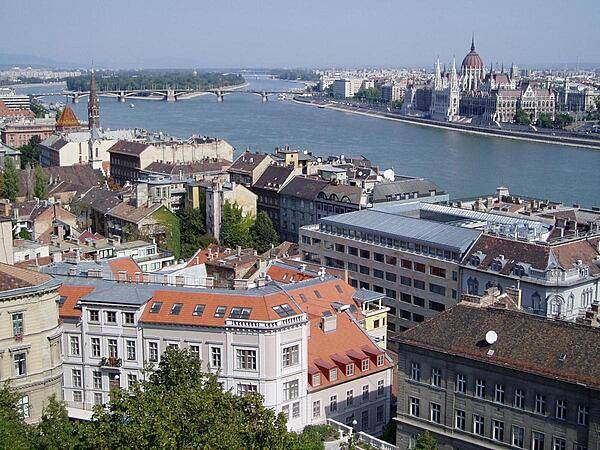
A view of the Danube River that splits Buda and Pest (which together are Budapest), as seen from Buda; the Parliament Building is visible in the distance.
A view of the Danube River that splits Buda and Pest (which together are Budapest), as seen from Buda; the Parliament Building is visible in the distance. • CIA World Factbook • 2020
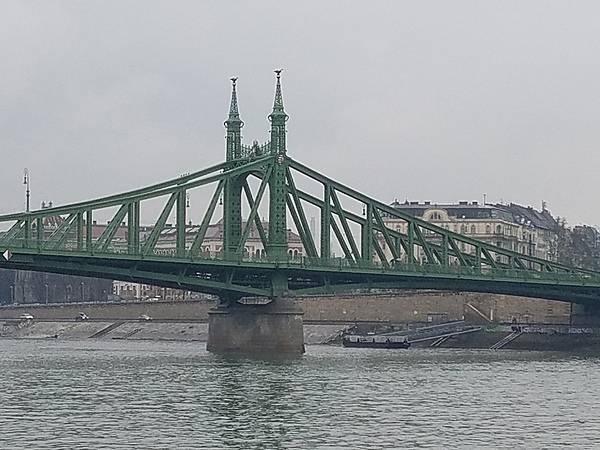
The Liberty Bridge (or Freedom Bridge) in Budapest is one of several bridges across the River Danube that connects the Buda and Pest halves. Built between 1894 and 1896 as part of Budapest's Millennium World Exhibition, the Art Nouveau bridge incorporates mythological turul bird sculptures into its spires and the country's coat of arms into its side.
The Liberty Bridge (or Freedom Bridge) in Budapest is one of several bridges across the River Danube that connects the Buda and Pest halves. Built between 1894 and 1896 as part of Budapest's Millennium World Exhibition, the Art Nouveau bridge incorporates mythological turul bird sculptures into its spires and the country's coat of arms into its side. • CIA World Factbook • 2020
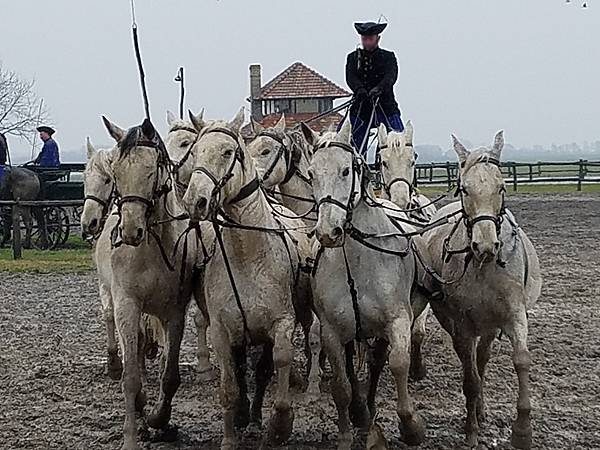
Outdoor show at the Bakodpuszta Equestrian Center near Kalocsa showing a rider controlling eight horses. The people of the Puszta region have long relied on the horse for transport, settlement, and defending their land.
Outdoor show at the Bakodpuszta Equestrian Center near Kalocsa showing a rider controlling eight horses. The people of the Puszta region have long relied on the horse for transport, settlement, and defending their land. • CIA World Factbook • 2020
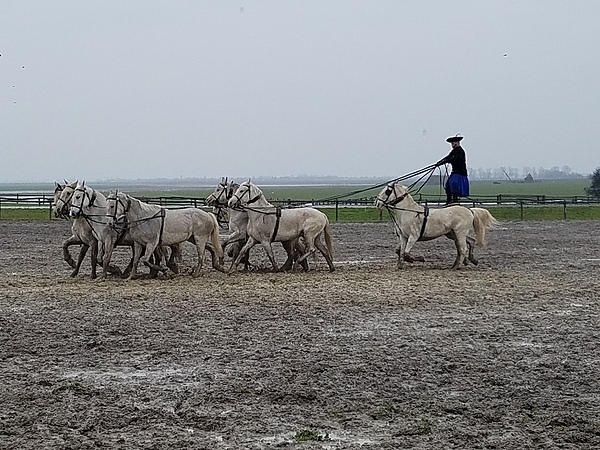
Outdoor show at the Bakodpuszta Equestrian Center near Kalocsa showing a rider controlling ten horses.
Outdoor show at the Bakodpuszta Equestrian Center near Kalocsa showing a rider controlling ten horses. • CIA World Factbook • 2020
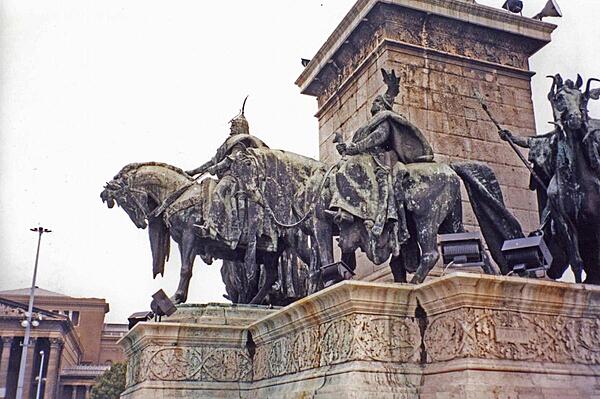
Some of the statues at Heroes' Square in Budapest.
Some of the statues at Heroes' Square in Budapest. • CIA World Factbook • 2020
25 photos available
View All Photos→Data sources: World Bank, UN Data • Updated daily •Learn about our data