›››
Korea, Rep. — Media Gallery
10 items available (flags, maps, photos)
Photos
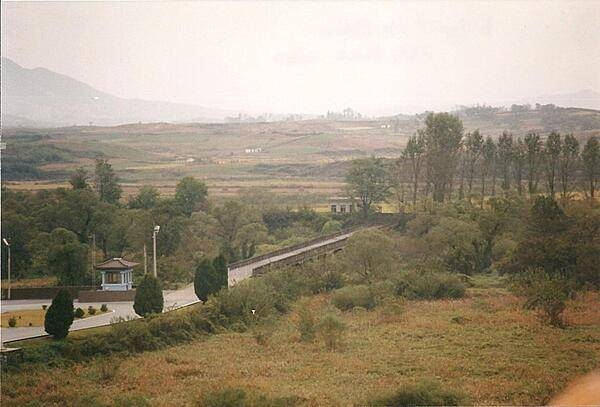
The "Bridge of No Return" in the Demilitarized Zone (DMZ) between North and South Korea was used for prisoner exchanges at the close of the Korean War.
The "Bridge of No Return" in the Demilitarized Zone (DMZ) between North and South Korea was used for prisoner exchanges at the close of the Korean War. • CIA World Factbook • 2020
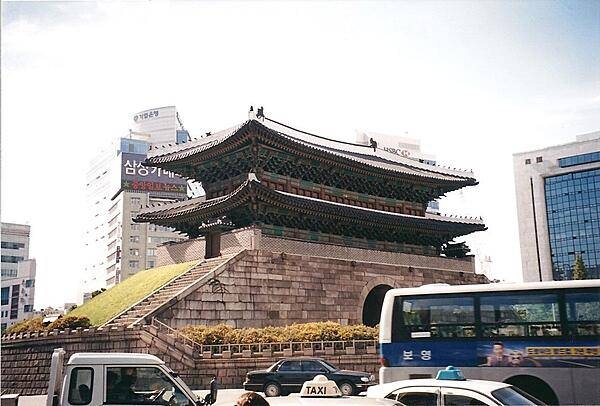
Namdaemun (Sungnyemun) in Seoul was the "Great Southern Gate" in the walls that once surrounded the city. This view was taken before the wooden upper portion was destroyed in a 2008 fire and subsequently restored.
Namdaemun (Sungnyemun) in Seoul was the "Great Southern Gate" in the walls that once surrounded the city. This view was taken before the wooden upper portion was destroyed in a 2008 fire and subsequently restored. • CIA World Factbook • 2020
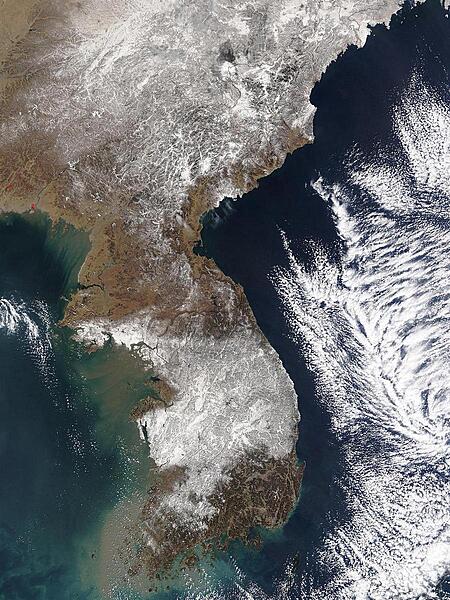
The central provinces of South Korea were crippled when heavy snow closed roads throughout the region, including many in the country's capital, Seoul. More snow fell on 6 March 2004, than ever recorded for a single March day in Korea since record keeping began in 1904. According to news reports, the city of Taejon received 49 cm (19 in) of snow on Friday, with an additional 15 cm (6 in) forecast for Saturday. The image shows the storm moving away from the peninsula on 7 March 2004, leaving much of South Korea under a blanket of snow. Image courtesy of NASA.
The central provinces of South Korea were crippled when heavy snow closed roads throughout the region, including many in the country's capital, Seoul. More snow fell on 6 March 2004, than ever recorded for a single March day in Korea since record keeping began in 1904. According to news reports, the city of Taejon received 49 cm (19 in) of snow on Friday, with an additional 15 cm (6 in) forecast for Saturday. The image shows the storm moving away from the peninsula on 7 March 2004, leaving much of South Korea under a blanket of snow. Image courtesy of NASA. • CIA World Factbook • 2020
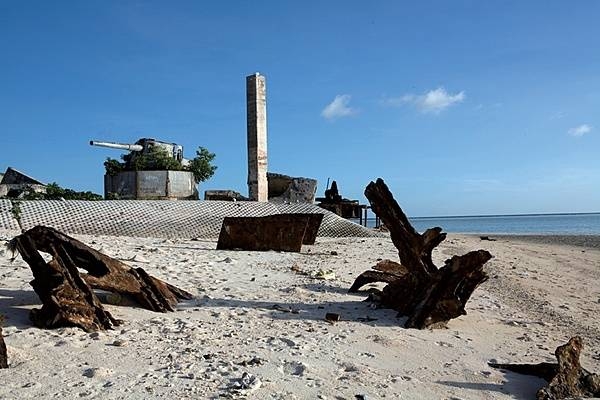
The remains of a Japanese 8-inch coastal defense gun mount sit on the point at Green Beach, Betio Island. Rising above the sand with its muzzle pointed inland, this was one of four 8-inch guns the Japanese emplaced on the island. Shrubs have overtaken the concrete and steel, and hundreds of red crabs race throughout the battlefield debris. Other than some graffiti and weathering, the area remains as it was following the Battle of Tarawa. Photo courtesy of the US Marine Corps/ Cpl. Aaron Hostutler.
The remains of a Japanese 8-inch coastal defense gun mount sit on the point at Green Beach, Betio Island. Rising above the sand with its muzzle pointed inland, this was one of four 8-inch guns the Japanese emplaced on the island. Shrubs have overtaken the concrete and steel, and hundreds of red crabs race throughout the battlefield debris. Other than some graffiti and weathering, the area remains as it was following the Battle of Tarawa. Photo courtesy of the US Marine Corps/ Cpl. Aaron Hostutler. • CIA World Factbook • 2020
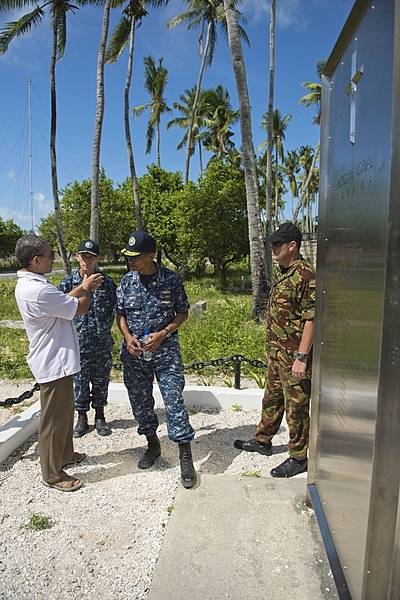
New Zealand High Commissioner of Tarawa Michael Wehi Mailetonga Walsh explains the Betio Memorial to Adm. Cecil D. Haney, commander of the US Pacific Fleet, during his visit to the Republic of Kiribati for Pacific Partnership 2013, 17 July 2013. The memorial is to 22 New Zealand, British, and Australian coastwatchers held prisoner and murdered by Imperial Japanese forces on Betio Island, Tarawa atoll, Kiribati. Photo courtesy of the US Navy/ Mass Communication Specialist 2nd Class Carlos M. Vazquez II.
New Zealand High Commissioner of Tarawa Michael Wehi Mailetonga Walsh explains the Betio Memorial to Adm. Cecil D. Haney, commander of the US Pacific Fleet, during his visit to the Republic of Kiribati for Pacific Partnership 2013, 17 July 2013. The memorial is to 22 New Zealand, British, and Australian coastwatchers held prisoner and murdered by Imperial Japanese forces on Betio Island, Tarawa atoll, Kiribati. Photo courtesy of the US Navy/ Mass Communication Specialist 2nd Class Carlos M. Vazquez II. • CIA World Factbook • 2020
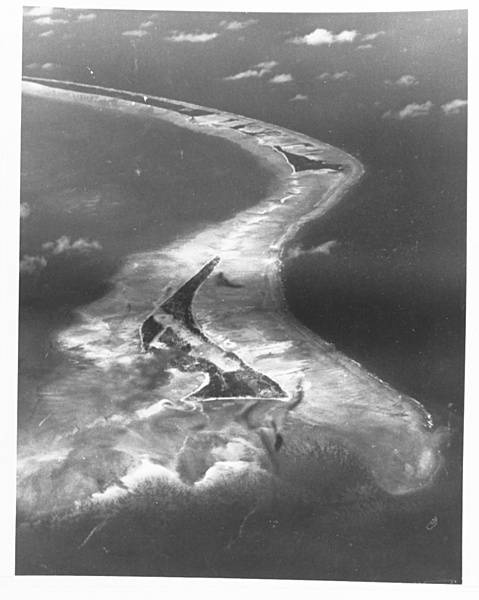
An aerial photograph of the south side of Tarawa Atoll, taken by Navy Squadron VC-24 on 9 September 1943, from an altitude of 3,660 m (12,000 ft). Betio Island is in the foreground, with Bairiki and Eita Islands beyond. The Battle of Tarawa took place on 20 November 1943 largely on Betio Island. Photo courtesy of the US Navy.
An aerial photograph of the south side of Tarawa Atoll, taken by Navy Squadron VC-24 on 9 September 1943, from an altitude of 3,660 m (12,000 ft). Betio Island is in the foreground, with Bairiki and Eita Islands beyond. The Battle of Tarawa took place on 20 November 1943 largely on Betio Island. Photo courtesy of the US Navy. • CIA World Factbook • 2020
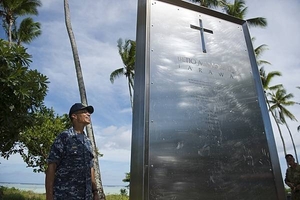
The memorial to 22 New Zealand, British, and Australian coastwatchers on Betio Island, Tarawa atoll, Kiribati. The seventeen New Zealand coastwatchers and five civilians were captured by the Japanese in the Gilbert Islands (now Kiribati) early in World War II and held prisoner on Tarawa, where they were murdered on 15 October 1942. The memorial reads, in part, "Standing unarmed at their posts, they matched brutality with gallantry, and met death with fortitude." Photo courtesy of the US Navy/ Mass Communication Specialist 2nd Class Carlos M. Vazquez II.
The memorial to 22 New Zealand, British, and Australian coastwatchers on Betio Island, Tarawa atoll, Kiribati. The seventeen New Zealand coastwatchers and five civilians were captured by the Japanese in the Gilbert Islands (now Kiribati) early in World War II and held prisoner on Tarawa, where they were murdered on 15 October 1942. The memorial reads, in part, "Standing unarmed at their posts, they matched brutality with gallantry, and met death with fortitude." Photo courtesy of the US Navy/ Mass Communication Specialist 2nd Class Carlos M. Vazquez II. • CIA World Factbook • 2020
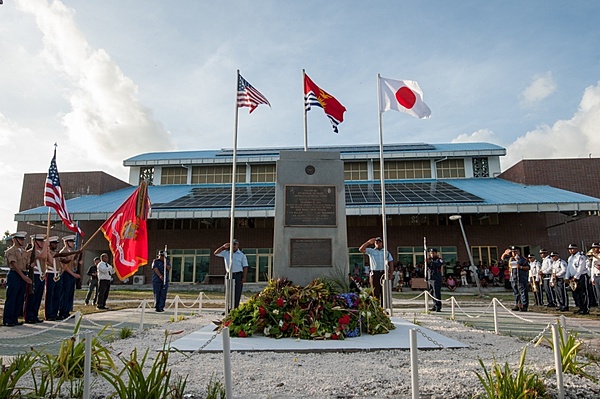
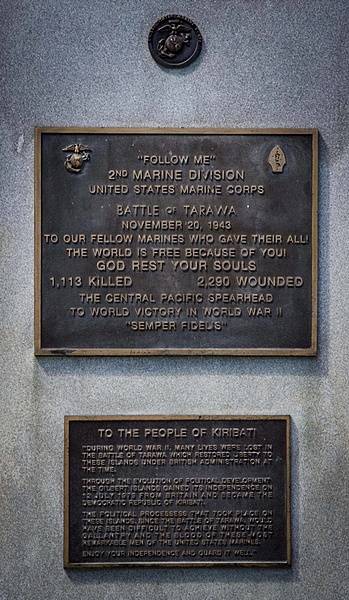
Wreaths enfold the base of the Battle of Tarawa Memorial on Betio Island in the Republic of Kiribati. A ceremony held on 20 November 2018 marked the 75th anniversary of the battle. Photo courtesy of the US Marine Corps/ Sgt. Jacqueline A. Clifford.
Wreaths enfold the base of the Battle of Tarawa Memorial on Betio Island in the Republic of Kiribati. A ceremony held on 20 November 2018 marked the 75th anniversary of the battle. Photo courtesy of the US Marine Corps/ Sgt. Jacqueline A. Clifford. • CIA World Factbook • 2020
CIA World Factbook • 2020
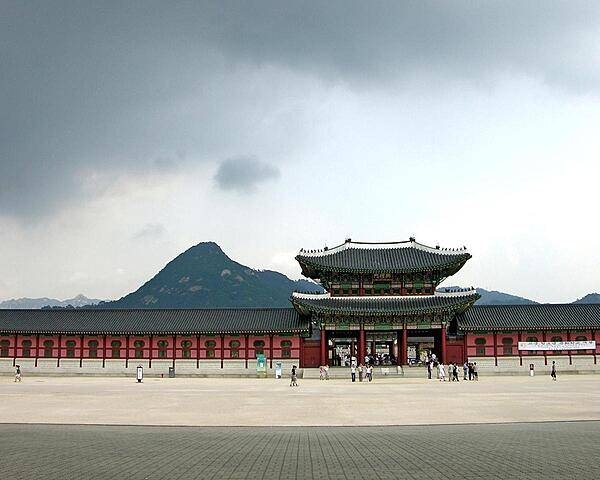
Gyeongbokgung royal palace in northern Seoul. First constructed in 1394, it was reconstructed in 1867.
Gyeongbokgung royal palace in northern Seoul. First constructed in 1394, it was reconstructed in 1867. • CIA World Factbook • 2020
Media source: CIA World Factbook (2020) — Public Domain