›››
Romania
Romania
Population
19.1M
Rank #66Source: World Bank
Capital
Bucharest
Source: REST Countries
Region
Europe
Europe & Central Asia
Source: REST Countries
GDP (Nominal)
$382.56B
Rank #42Source: World Bank
Land Area
238.4K km²
Rank #82Source: REST Countries
Life Expectancy
76.607 yrs
Source: World Bank
Historical Trends
Population Trend (5-Year)
Source: World Bank
GDP Trend (5-Year, Nominal USD)
Source: World Bank
Geography
Area: 238,391 km²
Landlocked: No
Independent: Yes
Climate: temperate; cold, cloudy winters with frequent snow and fog; sunny summers with frequent showers and thunderstorms
Terrain: central Transylvanian Basin is separated from the Moldavian Plateau on the east by the Eastern Carpathian Mountains and separated from the Walachian Plain on the south by the Transylvanian Alps
Elevation: mean elevation: 414 m lowest point: Black Sea 0 m highest point: Moldoveanu 2,544 m
Natural Hazards: earthquakes, most severe in south and southwest; geologic structure and climate promote landslides
Environmental Issues: soil erosion, degradation, and desertification; water pollution; air pollution in south from industrial effluents; contamination of Danube delta wetlands
Land Use: agricultural land: 60.7% (2011 est.) forest: 28.7% (2011 est.) other: 10.6% (2011 est.)
Geography Note: controls the most easily traversable land route between the Balkans, Moldova, and Ukraine; the Carpathian Mountains dominate the center of the country, while the Danube River forms much of the...
Natural Resources
petroleum (reserves declining)timbernatural gascoaliron oresaltarable landhydropower
People & Society
Fertility Rate
1.71
Population
19.1M
Ethnic Groups
Romanian (83.4%)Hungarian (6.1%)Romani (3.1%)Ukrainian (0.3%)German (0.2%)other (0.7%)unspecified (6.1%)
Religions
Eastern Orthodox (including all sub-denominations) (81.9%)Protestant (various denominations including Reformed and Pentecostal) (6.4%)Roman Catholic (4.3%)other (includes Muslim) (0.9%)none or atheist (0.2%)unspecified (6.3%)
Economy
GDP per Capita
$20,080.21
GDP per Capita PPP
49,558.669
(2024)
(2024)
GNI per Capita
17,600
(2024)
(2024)
Gini Index
29.8
(2023)
(2023)
Unemployment
5.4%
(2024)
(2024)
Inflation
5.721%
(2024)
(2024)
Public Debt
Not Available
Energy
Electricity Access
100%
(2023)
(2023)
Renewable Energy
23.6%
(2021)
(2021)
CO₂ Emissions
70.883 Mt
(2024)
(2024)
Energy Intensity
2.12 MJ/$
(2022)
(2022)
Renewable Electricity
44.857%
(2021)
(2021)
Environment
Forest Coverage
30.116% of land
(2023)
(2023)
Communications
Internet Users
91.291%
(2024)
(2024)
Mobile Penetration
123.252%
(2023)
(2023)
Broadband Subscribers
34.671%
(2023)
(2023)
Transportation
Air Transport Freight
2.336 M ton-km
(2023)
(2023)
Container Port Traffic
772,046 TEU
(2022)
(2022)
Airports
32,353.999
Rail Lines
10,769 km
Roads Total
118,488 km(©IRF)
Military
Military Forces
Romanian Armed Forces: Land Forces, Naval Forces, Air Force; Ministry of Internal Affairs: Romanian Gendarmerie
Personnel Strength
the Romanian Armed Forces have approximately 72,000 active duty personnel (40,000 Land Forces; 7,000 Naval Forces; 10,000 Air Force; 15,000 joint)
Military Expenditure (USD)
$8.72B
Military Expenditure (% of GDP)
2.30%
Military Expenditure History
2.04% of GDP (2019 est.) 1.82% of GDP (2018) 1.72% of GDP (2017) 1.4% of GDP (2016) 1.45% of GDP (2015)
Deployments
740 Afghanistan (NATO); 240 Mali (MINUSMA/EUTM); up to 120 Poland (NATO) (2020)
Equipment & Inventories
the inventory of the Romanian Armed Forces is comprised mostly of Soviet-era and older domestically-produced weapons systems; there is also a smaller mix of Western-origin equipment; Italy, Portugal...
Service Age & Obligation
conscription ended 2006; 18 years of age for male and female voluntary service; all military inductees (including women) contract for an initial 5-year term of service, with subsequent successive...
Education
Pre-Primary Enrollment
94.914%
(2020)
(2020)
Primary Enrollment
84.947%
(2023)
(2023)
Secondary Enrollment
81.632%
(2023)
(2023)
Tertiary Enrollment
55.168%
(2023)
(2023)
Education Spending
3.279% of GDP
(2022)
(2022)
Adult Literacy Rate
99.16%
(2021)
(2021)
Pupil-Teacher Ratio
19.335:1
(2017)
(2017)
Health
Physicians per 1,000
3.625
(2022)
(2022)
Safe Water Access
100%
(2024)
(2024)
Safe Drinking Water
82.183%
(2024)
(2024)
Under-5 Mortality
6.6 per 1,000
(2023)
(2023)
Maternal Mortality (World Bank)
20.058 per 100,000
(2021)
(2021)
Hospital Beds per 1,000
72.764
(2021)
(2021)
UHC Coverage Index
77
(2023)
(2023)
Measles Immunization
79%
(2024)
(2024)
Social Indicators
Extreme Poverty Rate
0.7%
(2023)
(2023)
Food Insecurity
2.5%
(2023)
(2023)
Youth NEET Rate
23.931%
(2024)
(2024)
Governance
Women in Government
19.207%
(2024)
(2024)
Voice & Accountability
0.50
(Above Average)
(2023)
(Above Average)
(2023)
Political Stability
0.37
(Above Average)
(2023)
(Above Average)
(2023)
Government Effectiveness
-0.09
(Below Average)
(2023)
(Below Average)
(2023)
Regulatory Quality
0.32
(Above Average)
(2023)
(Above Average)
(2023)
Rule of Law
0.44
(Above Average)
(2023)
(Above Average)
(2023)
Control of Corruption
0.04
(Above Average)
(2023)
(Above Average)
(2023)
Government
Government Type
semi-presidential republic
Legal System
civil law system
Executive Branch
chief of state: President Klaus Werner IOHANNIS (since 21 December 2014) head of government: Interim Prime Minister Nicolae-Ionel CIUCA (since 7 December 2020); Deputy Prime Minister Raluca TURCAN...
Legislative Branch
description: bicameral Parliament or Parlament consists of:Senate or Senat (136 seats; members directly elected in single- and multi-seat constituencies - including 2 seats for diaspora - by...
Judicial Branch
highest courts: High Court of Cassation and Justice (consists of 111 judges organized into civil, penal, commercial, contentious administrative and fiscal business, and joint sections); Supreme...
National Symbols
Flag Description
three equal vertical bands of cobalt blue (hoist side), chrome yellow, and vermilion red; modeled after the flag of France, the colors are those of the principalities of Walachia (red and yellow) and...
National Symbols
golden eagle; national colors: blue, yellow, red
National Anthem
name: "Desteapta-te romane!" (Wake up, Romanian!) lyrics/music: Andrei MURESIANU/Anton PANN note: adopted 1990; the anthem was written during the 1848 Revolution
Safety
Homicide Rate
1.109 per 100,000
(2023)
(2023)
Travel Information
Language(s): Romanian
Currency: RON (lei)
Timezone(s): UTC+02:00
Landlocked: No
Independent: Yes
Driving Side: Right
Calling Code: +40
Car Sign: RO
Week Starts: Monday
Photos
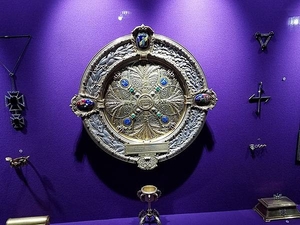
Royal paraphernalia on display at the National Museum of Romanian History in Bucharest.
Royal paraphernalia on display at the National Museum of Romanian History in Bucharest. • CIA World Factbook • 2020
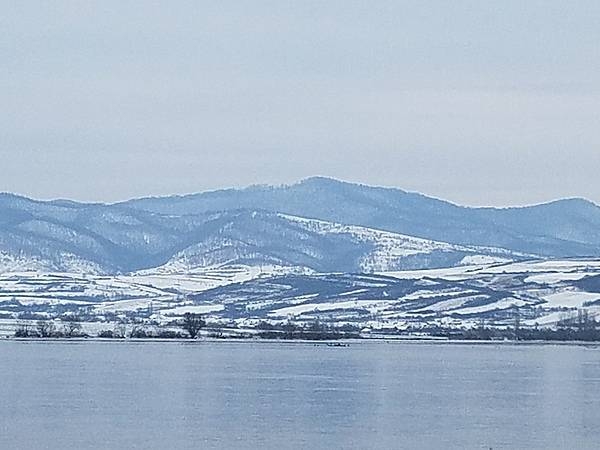
Romanian countryside from the Danube River near the Iron Gates.
Romanian countryside from the Danube River near the Iron Gates. • CIA World Factbook • 2020
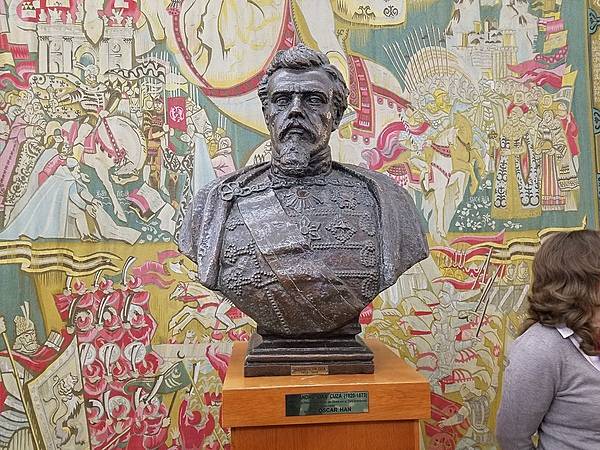
Bust of Alexandru Ioan CUZA (1820-73) in the Palace of the People. CUZA was Prince of Moldavia and Prince of Wallachia (1859-62), and later Domnitor (Ruler; 1862-66) of the Romanian Principalities.
Bust of Alexandru Ioan CUZA (1820-73) in the Palace of the People. CUZA was Prince of Moldavia and Prince of Wallachia (1859-62), and later Domnitor (Ruler; 1862-66) of the Romanian Principalities. • CIA World Factbook • 2020
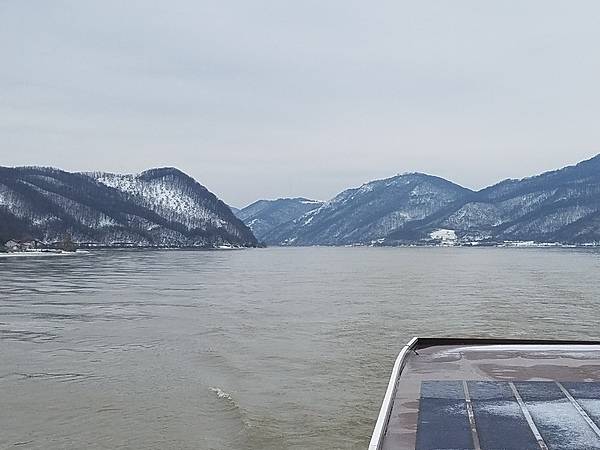
On the Danube River approaching the Iron Gates.
On the Danube River approaching the Iron Gates. • CIA World Factbook • 2020
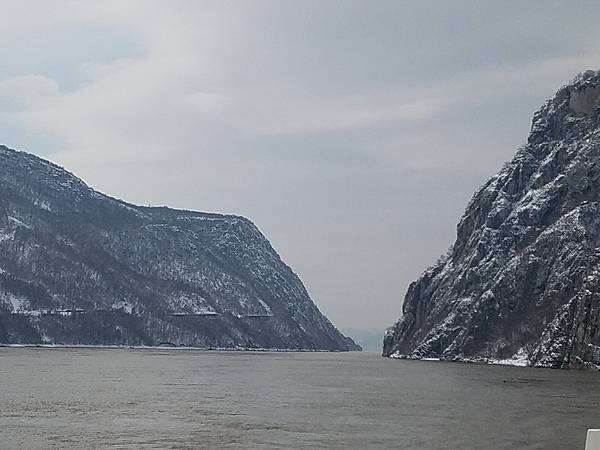
The Iron Gates is a gorge on the Danube River; it forms part of the boundary between Serbia and Romania. In the broad sense, it encompasses a route of 134 km (83 mi); in the narrow sense, it only includes the last barriers on this route - two hydroelectric dams and two power stations just beyond the city of Orsova.
The Iron Gates is a gorge on the Danube River; it forms part of the boundary between Serbia and Romania. In the broad sense, it encompasses a route of 134 km (83 mi); in the narrow sense, it only includes the last barriers on this route - two hydroelectric dams and two power stations just beyond the city of Orsova. • CIA World Factbook • 2020
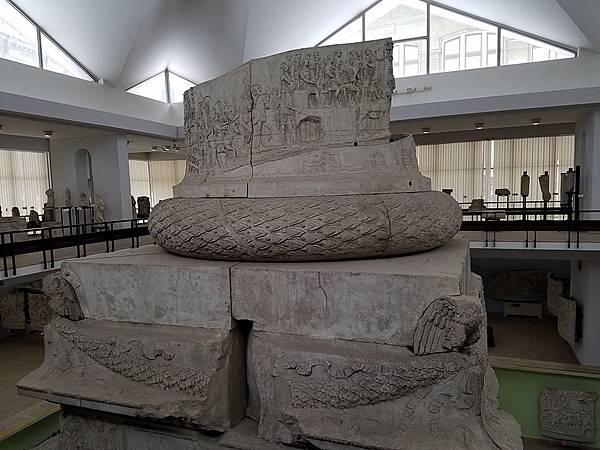
Cast of part of the base of Trajan's Column (the original stands in Rome) at the National Museum of Romanian History in Bucharest. The bas reliefs on Trajan's Column - which is about 30 m (98 ft) in height, 35 m (115 ft) including its large pedestal - depict the second century A.D. Roman conquest of Dacia, the area that today is Romania and Moldova.
Cast of part of the base of Trajan's Column (the original stands in Rome) at the National Museum of Romanian History in Bucharest. The bas reliefs on Trajan's Column - which is about 30 m (98 ft) in height, 35 m (115 ft) including its large pedestal - depict the second century A.D. Roman conquest of Dacia, the area that today is Romania and Moldova. • CIA World Factbook • 2020
18 photos available
View All Photos→Data sources: World Bank, UN Data • Updated daily •Learn about our data