›››
Viet Nam
Viet Nam
Population
101.0M
Rank #16Source: World Bank
Capital
Hanoi
Source: REST Countries
Region
Asia
East Asia & Pacific
Source: REST Countries
GDP (Nominal)
$476.39B
Rank #32Source: World Bank
Land Area
331.2K km²
Rank #68Source: REST Countries
Life Expectancy
74.588 yrs
Source: World Bank
Historical Trends
Population Trend (5-Year)
Source: World Bank
GDP Trend (5-Year, Nominal USD)
Source: World Bank
Geography
Area: 331,212 km²
Landlocked: No
Independent: Yes
Climate: tropical in south; monsoonal in north with hot, rainy season (May to September) and warm, dry season (October to March)
Terrain: low, flat delta in south and north; central highlands; hilly, mountainous in far north and northwest
Elevation: mean elevation: 398 m lowest point: South China Sea 0 m highest point: Fan Si Pan 3,144 m
Natural Hazards: occasional typhoons (May to January) with extensive flooding, especially in the Mekong River delta
Environmental Issues: logging and slash-and-burn agricultural practices contribute to deforestation and soil degradation; water pollution and overfishing threaten marine life populations; groundwater contamination limits...
Land Use: agricultural land: 34.8% (2011 est.) forest: 45% (2011 est.) other: 20.2% (2011 est.)
Geography Note: note 1: extending 1,650 km north to south, the country is only 50 km across at its narrowest point note 2: Son Doong in Phong Nha-Ke Bang National Park is the world's largest cave (greatest cross...
Natural Resources
antimonyphosphatescoalmanganeserare earth elementsbauxitechromateoffshore oil and gas depositstimberhydropower
People & Society
Fertility Rate
1.91
Population
101.0M
Ethnic Groups
Kinh (Viet) (85.7%)Tay (1.9%)Thai (1.8%)Muong (1.5%)Khmer (1.5%)Mong (1.2%)Nung (1.1%)Hoa (1%)other (4.3%)
Religions
Buddhist (7.9%)Catholic (6.6%)Hoa Hao (1.7%)Cao Dai (0.9%)Protestant (0.9%)Muslim (0.1%)none (81.8%)
Economy
GDP per Capita
$4,717.29
GDP per Capita PPP
16,385.507
(2024)
(2024)
GNI per Capita
4,490
(2024)
(2024)
Gini Index
36.1
(2022)
(2022)
Unemployment
1.602%
(2024)
(2024)
Inflation
3.621%
(2024)
(2024)
Public Debt
Not Available
Energy
Electricity Access
99.8%
(2023)
(2023)
Renewable Energy
24.2%
(2021)
(2021)
CO₂ Emissions
430.819 Mt
(2024)
(2024)
Energy Intensity
3.85 MJ/$
(2021)
(2021)
Renewable Electricity
41.17%
(2021)
(2021)
Environment
Forest Coverage
47.445% of land
(2023)
(2023)
Communications
Internet Users
84.15%
(2024)
(2024)
Mobile Penetration
130.991%
(2023)
(2023)
Broadband Subscribers
22.681%
(2023)
(2023)
Transportation
Air Transport Freight
927.889 M ton-km
(2023)
(2023)
Container Port Traffic
20,518,926 TEU
(2022)
(2022)
Airports
331,806
Rail Lines
3,159 km
Roads Total
N/A
Military
Military Forces
People's Army of Vietnam (PAVN): PAVN Ground Forces, PAVN Navy (includes naval infantry), PAVN Air Force and Air Defense, Border Defense Force, and Vietnam Coast Guard; Vietnam People's Public...
Personnel Strength
information is limited and estimates of the size of the People’s Army of Vietnam (PAVN) vary; approximately 475,000 active duty troops (405,000 ground; 40,000 naval; 30,000 air); est. 40,000 Border...
Military Expenditure (USD)
$5.50B
Military Expenditure (% of GDP)
1.81%
Military Expenditure History
2.3% of GDP (2018) 2.3% of GDP (2017) 2.5% of GDP (2016) 2.4% of GDP (2015) 2.3% of GDP (2014)
Equipment & Inventories
the PAVN is armed largely with weapons and equipment from Russia and the former Soviet Union; Russia remains the main supplier of newer PAVN military equipment, although in recent years Vietnam has...
Service Age & Obligation
18-27 years of age for compulsory and voluntary military service (females eligible for conscription, but in practice only males are drafted); conscription typically takes place twice annually and...
Education
Pre-Primary Enrollment
92.445%
(2021)
(2021)
Primary Enrollment
106.333%
(2024)
(2024)
Secondary Enrollment
93.412%
(2022)
(2022)
Tertiary Enrollment
37.592%
(2024)
(2024)
Education Spending
2.887% of GDP
(2022)
(2022)
Adult Literacy Rate
96.13%
(2022)
(2022)
Pupil-Teacher Ratio
20.277:1
(2018)
(2018)
Health
Physicians per 1,000
1.107
(2021)
(2021)
Safe Water Access
98.761%
(2024)
(2024)
Safe Drinking Water
58.581%
(2024)
(2024)
Under-5 Mortality
20 per 1,000
(2023)
(2023)
Maternal Mortality (World Bank)
16.986 per 100,000
(2021)
(2021)
Hospital Beds per 1,000
73.797
(2021)
(2021)
UHC Coverage Index
71
(2023)
(2023)
Measles Immunization
97%
(2024)
(2024)
Social Indicators
Extreme Poverty Rate
1.6%
(2022)
(2022)
Food Insecurity
5.3%
(2023)
(2023)
Youth NEET Rate
6.41%
(2024)
(2024)
Governance
Women in Government
30.629%
(2024)
(2024)
Voice & Accountability
-1.24
(Weak)
(2023)
(Weak)
(2023)
Political Stability
-0.04
(Below Average)
(2023)
(Below Average)
(2023)
Government Effectiveness
0.13
(Above Average)
(2023)
(Above Average)
(2023)
Regulatory Quality
-0.38
(Below Average)
(2023)
(Below Average)
(2023)
Rule of Law
-0.09
(Below Average)
(2023)
(Below Average)
(2023)
Control of Corruption
-0.42
(Below Average)
(2023)
(Below Average)
(2023)
Government
Government Type
communist state
Legal System
civil law system; note - the civil code of 2005 reflects a European-style civil law
Executive Branch
chief of state: President Nguyen Phu TRONG (since 23 October 2018); note - President Tran Dai QUANG (since 2 April 2016) died on 21 September 2018 head of government: Prime Minister Nguyen Xuan PHUC...
Legislative Branch
description: unicameral National Assembly or Quoc Hoi (500 seats - number following 2016 election - 494; number of current serving members - 484; members directly elected in multi-seat constituencies...
Judicial Branch
highest courts: Supreme People's Court (consists of the chief justice and 13 judges) judge selection and term of office: chief justice elected by the National Assembly upon the recommendation of the...
National Symbols
Flag Description
red field with a large yellow five-pointed star in the center; red symbolizes revolution and blood, the five-pointed star represents the five elements of the populace - peasants, workers,...
National Symbols
yellow, five-pointed star on red field; lotus blossom; national colors: red, yellow
National Anthem
name: "Tien quan ca" (The Song of the Marching Troops) lyrics/music: Nguyen Van CAO note: adopted as the national anthem of the Democratic Republic of Vietnam in 1945; it became the national anthem...
Safety
Homicide Rate
1.535 per 100,000
(2011)
(2011)
Travel Information
Language(s): Vietnamese
Currency: VND (₫)
Timezone(s): UTC+07:00
Landlocked: No
Independent: Yes
Driving Side: Right
Calling Code: +84
Car Sign: VN
Week Starts: Monday
Photos
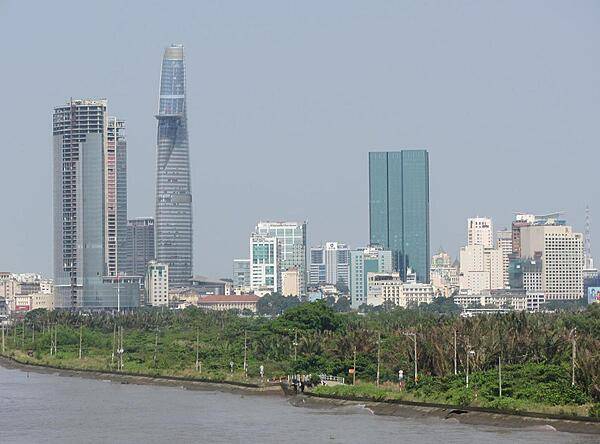
View of Ho Chi Minh City (aka Saigon) from the Saigon River. Saigon is Vietnam's major port and, with 8 million inhabitants, its largest city. It was called Saigon until 1975 when it was renamed Ho Chi Minh City following its capture by North Vietnamese communist forces. Although the city's commercial core is officially called Saigon, the entire city is widely referred to as Saigon even in the North. The city was architecturally influenced by the French during their colonial occupation of Vietnam. Numerous classical Western-style building in the city reflect this, so much so that Saigon was referred to as "The Pearl of the Far East" or "Paris in the Orient." In more recent years, a building boom has transformed the skyline of the city.
View of Ho Chi Minh City (aka Saigon) from the Saigon River. Saigon is Vietnam's major port and, with 8 million inhabitants, its largest city. It was called Saigon until 1975 when it was renamed Ho Chi Minh City following its capture by North Vietnamese communist forces. Although the city's commercial core is officially called Saigon, the entire city is widely referred to as Saigon even in the North. The city was architecturally influenced by the French during their colonial occupation of Vietnam. Numerous classical Western-style building in the city reflect this, so much so that Saigon was referred to as "The Pearl of the Far East" or "Paris in the Orient." In more recent years, a building boom has transformed the skyline of the city. • CIA World Factbook • 2020
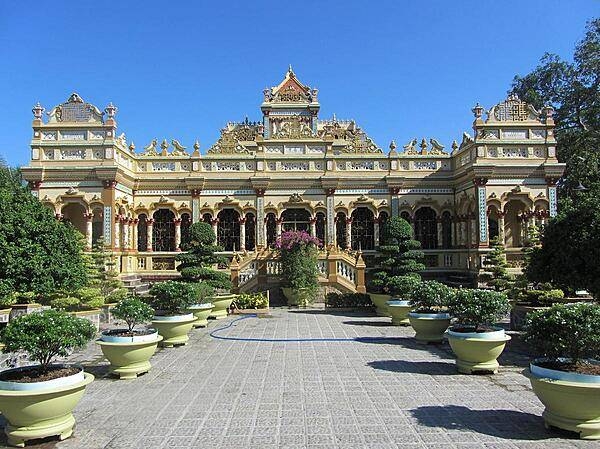
Vinh Trang Pagoda near the city of My Tho. Known of the "Gateway to the Mekong Delta," My Tho, with a population in excess of 200,000, lies on the My Tho River, a branch of the Mekong River, 70 km (45 mi) south of Saigon (Ho Chi Minh City). First completed in 1851, the Vinh Trang temple has been reconstructed a number of times.
Vinh Trang Pagoda near the city of My Tho. Known of the "Gateway to the Mekong Delta," My Tho, with a population in excess of 200,000, lies on the My Tho River, a branch of the Mekong River, 70 km (45 mi) south of Saigon (Ho Chi Minh City). First completed in 1851, the Vinh Trang temple has been reconstructed a number of times. • CIA World Factbook • 2020
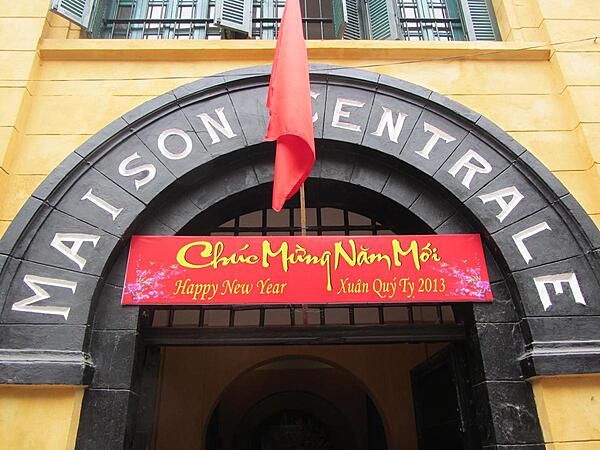
Entrance to the Maison Centrale or Central Prison in Hanoi. Built by the French beginning in 1886, it was used to imprison Vietnamese political prisoners and later by the Vietnamese to hold mostly US pilots during the Vietnamese War. It was referred to sarcastically as the "Hanoi Hilton" by US POWs and later in the US press. The prison was torn down in the mid-1990s and only the Gate House remains.
Entrance to the Maison Centrale or Central Prison in Hanoi. Built by the French beginning in 1886, it was used to imprison Vietnamese political prisoners and later by the Vietnamese to hold mostly US pilots during the Vietnamese War. It was referred to sarcastically as the "Hanoi Hilton" by US POWs and later in the US press. The prison was torn down in the mid-1990s and only the Gate House remains. • CIA World Factbook • 2020
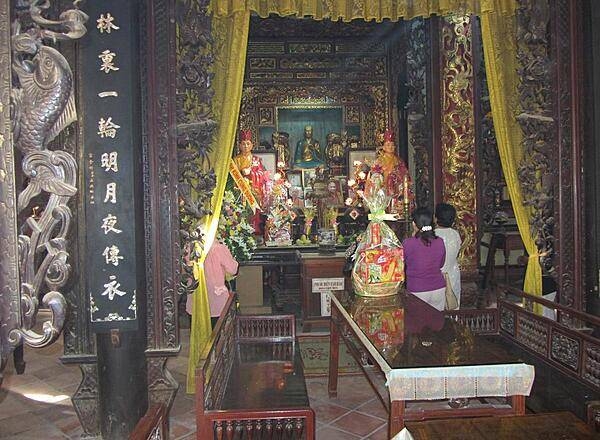
Shrine in the interior of the Vinh Trang Pagoda near the city of My Tho. Known of the "Gateway to the Mekong Delta," My Tho lies on the My Tho River, a branch of the Mekong River, 70 km (45 mi) south of Saigon (Ho Chi Minh City). First completed in 1851, the Vinh Trang temple has been reconstructed a number of times.
Shrine in the interior of the Vinh Trang Pagoda near the city of My Tho. Known of the "Gateway to the Mekong Delta," My Tho lies on the My Tho River, a branch of the Mekong River, 70 km (45 mi) south of Saigon (Ho Chi Minh City). First completed in 1851, the Vinh Trang temple has been reconstructed a number of times. • CIA World Factbook • 2020
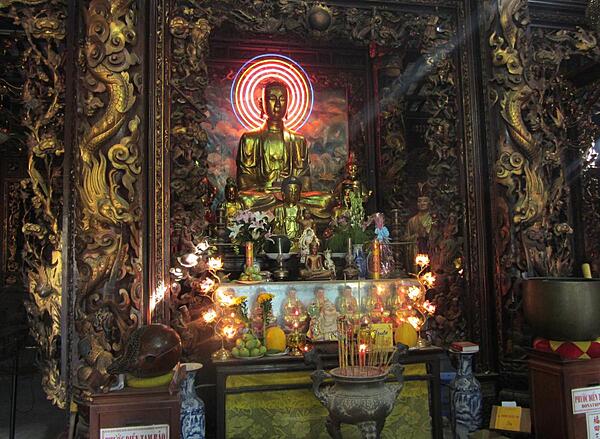
Shrine in the interior of the Vinh Trang Pagoda near the city of My Tho. Known of the "Gateway to the Mekong Delta," My Tho lies on the My Tho River, a branch of the Mekong River, 70 km (45 mi) south of Saigon (Ho Chi Minh City). First completed in 1851, the Vinh Trang temple has been reconstructed a number of times.
Shrine in the interior of the Vinh Trang Pagoda near the city of My Tho. Known of the "Gateway to the Mekong Delta," My Tho lies on the My Tho River, a branch of the Mekong River, 70 km (45 mi) south of Saigon (Ho Chi Minh City). First completed in 1851, the Vinh Trang temple has been reconstructed a number of times. • CIA World Factbook • 2020
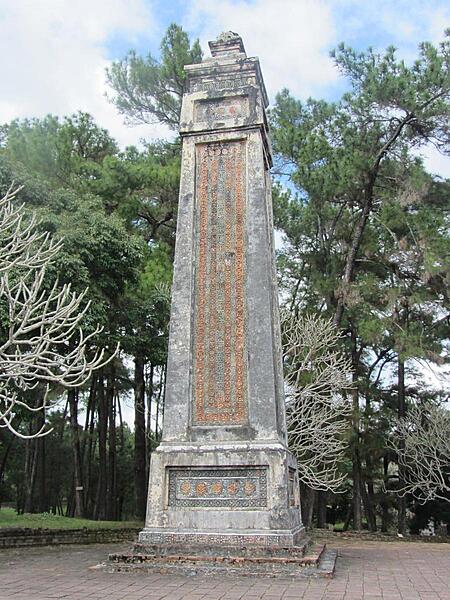
Stele in the pavilion just to the east of Emperor Tu Doc's Tomb in Hue. The stele bears Tu Doc's epitaph, which he composed himself because he never had a son. The stele is the largest of its type in Vietnam.
Stele in the pavilion just to the east of Emperor Tu Doc's Tomb in Hue. The stele bears Tu Doc's epitaph, which he composed himself because he never had a son. The stele is the largest of its type in Vietnam. • CIA World Factbook • 2020
99 photos available
View All Photos→Data sources: World Bank, UN Data • Updated daily •Learn about our data